- Home
- India
- World
- Premium
- THE FEDERAL SPECIAL
- Analysis
- States
- Perspective
- Videos
- Sports
- Education
- Entertainment
- Elections
- Features
- Health
- Business
- Series
- In memoriam: Sheikh Mujibur Rahman
- Bishnoi's Men
- NEET TANGLE
- Economy Series
- Earth Day
- Kashmir’s Frozen Turbulence
- India@75
- The legend of Ramjanmabhoomi
- Liberalisation@30
- How to tame a dragon
- Celebrating biodiversity
- Farm Matters
- 50 days of solitude
- Bringing Migrants Home
- Budget 2020
- Jharkhand Votes
- The Federal Investigates
- The Federal Impact
- Vanishing Sand
- Gandhi @ 150
- Andhra Today
- Field report
- Operation Gulmarg
- Pandemic @1 Mn in India
- The Federal Year-End
- The Zero Year
- Science
- Brand studio
- Newsletter
- Events

Why Ramayana row, demand for pre-release preview raise questions over our engagement with our epics
Delhi-based Shri Ramlila Mahasangh and Luv Kush Ramlila have written to the makers of Ranbir Kapoor, Sai Pallavi and Yash-starrer Ramayana for a pre-release review of the film scheduled to hit theatres this Nov. Questions are already being raised over Sai Pallavi's curly hair in the character of Sita. Leaving experts to worry whether modern India still possesses the confidence to let its greatest stories be argued with, questioned, reimagined and made meaningful for the present.

Long before a single ticket has been sold, before the lights dim in any cinema hall and audiences surrender themselves to wonder, the big screen adaptation of the Ramayana, slated for a November 6 release, has already been asked to defend itself. The Delhi-based Shri Ramlila Mahasangh and Luv Kush Ramlila have written to filmmaker Nitesh Tiwari and producer Namit Malhotra (of Prime...
Long before a single ticket has been sold, before the lights dim in any cinema hall and audiences surrender themselves to wonder, the big screen adaptation of the Ramayana, slated for a November 6 release, has already been asked to defend itself. The Delhi-based Shri Ramlila Mahasangh and Luv Kush Ramlila have written to filmmaker Nitesh Tiwari and producer Namit Malhotra (of Prime Focus Studios, which is collaborating with Monster Mind Creations to produce the film) demanding a pre-release preview of the under-production film. The megastarrer has Ranbir Kapoor essaying the role of Ram, while Sai Pallavi and Yash play Sita and Ravana, respectively.
Luv Kush Ramlila president Arjun Kumar’s letter says his organisation wants “to ensure that no scene or dialogue hurts Hindu sentiments” and warns “protests could follow if its concerns are ignored”.
Questioning both the trailer’s depiction of Ram — a Hindu deity, the Ramayana traces his life’s journey and his defeat of the Lanka emperor Ravana — and the casting of Ranbir Kapoor, Kumar told The Federal that “the trailer has Lord Ram bereft of any compassion or maryada [Ram is revered as Maryada Purshottam, an epitome of righteousness and virtue]. Why is the Lord making angry vows and threatening to kill? Ram always stayed calm and symbolises restraint and dignity.”
He also objected to Kapoor simultaneously endorsing an Ayodhya real-estate project while playing the lead in Ramayana. “The same actor is appearing in advertisements selling land in Ayodhya while playing our Lord Shri Ram on screen. Can Ram be associated with selling Ayodhya’s land?”
The Federal reached Ramayana director Nitesh Tiwari over phone and text messages, but received no response till the time of publication of this article. A member of the film's production team, however, speaking on condition of anonymity, wondered why the outrage was reserved only for a soft target like their film. “We haven’t seen any protest or even a simple statement from Arjun Kumar, Ramlila Mahasangh or Luv Kush Ramlila about the recent allegations of embezzlement of donations and offerings at the Ram Temple in Ayodhya. Doesn’t that amount to breaking of maryada?”
Kumar, meanwhile, recalled the controversy surrounding Adipurush (a 2023 retelling of the Ramayana), which actor Prabhas had promoted at their Ramlila before its release. “We welcomed Prabhas because Baahubali [Prabhas's 2015 film] had portrayed devotion to Lord Shiva [the Hindu diety] with grandeur and reverence. We expected Adipurush to treat Lord Ram with the same respect.”
The film, when it released, however, received not just poor reviews from critics, but backlash from the devout over alleged controversial dialogues, characterisation and more.
According to Kumar, the backlash against Adipurush stemmed from the film’s visual treatment. “Lanka, described in the Ramayana as a golden city, was shown as a dark fortress like it was inside a coal mine. The costumes looked alien to the Ramayana tradition and appeared influenced by Mughal-era styling. Those choices deeply hurt religious sentiments, and despite its enormous budget, the film collapsed.”
Brushing off allegations of “extraconstitutional censorship”, Kumar says, “We aren’t asking to certify the film. We only want any scene that could hurt crores of Hindu sentiments globally removed.”
Kumar claimed the demand for a pre-release screening for his organisation was also intended to protect the film itself. “We don’t want this Ramayana adaptation to meet the fate of earlier failures. When films based on a sacred text repeatedly provoke outrage and fail commercially, it sends a damaging message. After all, they aren’t just watched in India but across the world.”
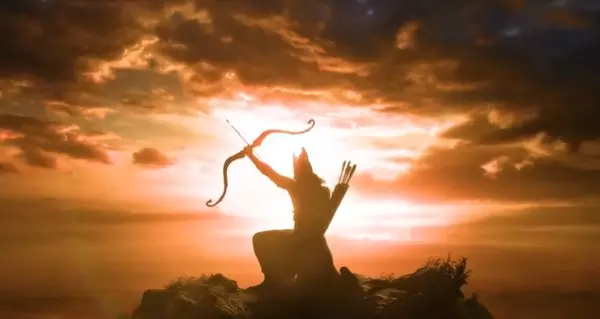
A still from the Ramayana trailer.
The many objections raised to the film since the release of its trailer and the looks of the characters have ranged from the predictable to the faintly surreal. For example, among the questions circulating online is whether Sita should have curly hair. Controversy over the character’s costume has also surfaced, with some claiming that the blouses that Sita is shown to be wearing are not appropriate for the age the film is set in. Ironically, as one social media user has pointed out, in Adipurush, Kriti Sanon’s Sita was criticised for her costume being “too revealing”, while in Ramayana the backlash against Sai Pallavi’s costume is that it is “too much” for the times.
“It may seem tempting to laugh at the absurdity of an ancient civilisation arguing about the texture of hair of a character in an epic while standing on the brink of becoming a global digital power,” observes sociocultural historian Mukund Kule, “yet the laughter catches in the throat and feels like a lump. The row is not really about curls. It is about custodianship — who gets to decide how India’s foundational stories may be imagined, narrated and reimagined.”
Also read: 30 years since launch, why Kerala’s iconic decentralisation project appears to have lost steam
The timing is revealing. Across the world, classical texts are being reopened like old houses whose windows have long been shut. Recent reinterpretations of The Odyssey (2026) have embraced contemporary storytelling and language, diverse casting and fresh emotional perspectives. Shakespeare is performed by actors across races, genders and cultures without anyone insisting that Hamlet obtain prior approval from a committee of Elizabethan loyalists. The classics survive because each generation is allowed to argue with them, love them, misunderstand them and make them new again.
“In the past in India too Yakshagana or Bharatanatyam adaptations of the Nativity story [about the birth of Jesus Christ] were appreciated as the malleability and ductility of our art forms,” says Kule, who laments, “By contrast, New India seems increasingly determined to move in the opposite direction: from interpretation to authentication, from conversation to clearance.”
This is hardly the first eruption of its kind. Sanjay Leela Bhansali’s 2018 release Padmavat became a national spectacle of outrage, with fringe groups vandalising sets, assaulting the director and threatening actor Deepika Padukone with a violent rhinectomy. Criticism ranged from the design of Padmini’s choli (the filmmakers to digitally cover her midriff to pacify protestors), to alleged distortion of history. So much so that a group of women under the banner of ‘Jauhar Kshtrani Manch’ had even threatened to self-immolate (their choice of words was ‘commit Jauhar’) ahead of the film’s release.
Earlier, Bhansali’s 2015 release Bajirao Mastani too had been accused of distorting history.
But the Ramayan controversy carries a deeper charge because it touches one of the most revered and politically weaponised narratives in the Indian imagination: a story that has travelled through temples, village squares, shadow puppetry, folk songs, television serials and family bedtime tales for centuries, has in recent years, become the core of the political narrative of the Hindu Right in India, embodied in the successful consecration of the Ram Temple in Ayodhya in 2024.
The irony, as Kule emphasises, however, is that there has never been one standard homogenised Ramayana but many versions of the mythological epic. Valmiki’s Sanskrit epic (with multiple mentions of veal, venison and boar meat consumption, as Kule recalls) is only the oldest surviving riverhead in a vast delta of retellings: Kamban’s Ramavataram, Tulsidas’s Ramcharitmanas, Krittibas’ Bengali Shriram Pacali, Thunchaththu Ramanujan Ezhuthachan’s Malayalam Adhyatma Ramayanam, Jain tellings in which Ravana is a tragic scholar, Buddhist versions that soften the martial edges of the tale and countless oral traditions that reshape the story around local landscapes and anxieties.
“In Thailand’s Ramakien, Hanuman becomes a flamboyant romantic hero; in Bali Sita is a warrior princess and all the men in the Ramayan play second fiddle to her — the narrative bends with the needs of performance; in tribal India, Sita may be remembered less as a queen than as a woman bound to the earth and forest,” he says. “The genius of the Ramayana tradition has never been rigidity; it has been its astonishing hospitality to variation.”
Plurality is not an unfortunate side effect of the epic; it is its organising principle. Every poet who retold the story left fingerprints on its surface. To insist on a single authorised version is therefore to misunderstand the very tradition one claims to defend, say experts.
What distinguishes the present moment is the rise of pre-emptive offence. A film no longer has to exist in order to provoke outrage. A casting announcement, a leaked costume sketch, an unverified rumour or a strategically edited screenshot can generate a digital wildfire within hours. The controversy becomes the event; the artwork itself becomes incidental.
Political scientist Dr Kesari Dave argues that India has allowed “the Frankenstein of extra-constitutional censorship to grow steadily since Independence, normalising attacks on freedom of expression and empowering groups with no legal authority to dictate cultural boundaries.” Reflecting on the violence surrounding Padmavat and the recent ultimatums to the Ramayana makers, she warns that “what begins as symbolic outrage quickly mutates into the legitimisation of intimidation as a form of enforced cultural participation.”
Filmmaker Anurag Kashyap has, in the past, spoken candidly about the fear this atmosphere creates, noting that “everyone gets offended so easily” that it is becoming increasingly difficult to be an artiste. The fear operates quietly: a line softened, a character made less ambiguous, a metaphor abandoned because someone asks, “Why invite trouble?”
The most effective censorship is not the cut imposed after creation. It is the idea never pursued.
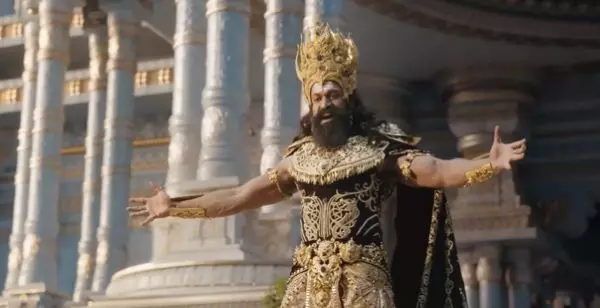
Yash in a still from the Ramayana trailer.
India has long celebrated artistic brilliance while periodically attempting to silence it.
In a 2018 interview, Kiran Nagarkar had recalled how his Bedtime Stories effectively endured a 17-year extra-constitutional ban despite support from theatre luminaries such as Dr Shreeram Lagoo. Late theatre icon Vijay Tendulkar too faced similar hostility for Sakharam Binder and Ghashiram Kotwal. Books by Salman Rushdie, Taslima Nasrin, James Laine and others have encountered bans, protests or organised intimidation; the attack on Pune’s Bhandarkar Oriental Research Institute remains a stark example of scholarship answered with vandalism rather than argument.
Cinema has been especially vulnerable because of its emotional reach, says Kule. From Aandhi and Kissa Kursi Ka during the Emergency to Bombay, Fanaa, My Name is Khan, Ae Dil Hai Mushkil and Indu Sarkar, films across ideological lines have discovered that legal certification offers only partial protection when organised groups decide to object.
What has changed is the ferocity and velocity of opposition. Earlier controversies unfolded over weeks or months; today they unfold over lunch. Television studios amplify social-media storms, political actors sense opportunity, and outrage acquires the momentum of a monsoon river carrying everything in its path.
Essayist and Booker Prize-winning novelist Arundhati Roy once remarked that in India “censorship has been outsourced to the mob”. The mechanism is now familiar: a group declares offence, threatens disruption, exhibitors grow nervous, local authorities urge “restraint” from filmmakers rather than firmness from protesters and the work is altered, delayed or quietly withdrawn.
Senior advocate Mihir Desai says he has repeatedly pointed out that the Supreme Court has held that once a film is certified, it is the duty of the state to maintain law and order and ensure its exhibition. “The law is unambiguous,” he says, though reality is not. A threat does not have to be carried out in order to be effective. Fear performs the work the law is not permitted to perform.
For a film such as Ramayana, reportedly mounted on a colossal budget with global ambitions, the economic pressure is immense. Investors do not merely ask whether a creative decision is artistically sound; they ask whether it might trigger organised outrage across multiple states or complicate theatrical exhibition. Mythology begins to resemble a field of unexploded mines rather than a source of imaginative possibility.
Adipurush director Om Raut voices exactly this concern, when he says, “If we allow ideological policing to dictate every detail, leaving no room to interpret, improvise or reimagine even the smallest element of a narrative, then we will either have to stop making films on these subjects altogether, or reduce them to sanitised, comic-book versions where characters are no longer psychologically alive, but merely polished icons.”
Great epics endure because they contain moral weather, not instruction manuals. The Mahabharata revels in ethical uncertainty; the Ramayana too is filled with painful questions about duty, exile, kingship, obedience, gender and justice. If all its meanings were already settled, generations of poets would not keep returning to it.
Yet ideological policing flattens complexity into a binary of reverence versus insult. Characters cease to be psychologically alive and become polished icons.
The fixation on Sai Pallavi’s hair or the style of her blouse is emblematic of this flattening. An extraordinary amount of public energy has been invested in a visual detail that tells us almost nothing about the film’s interpretation of Sita. Far more interesting questions remain unexplored: Will the film grant her interiority? Will it engage with the loneliness of exile, the ordeal of public suspicion, the tension between personal dignity and royal duty?
Those are the questions that could make an ancient story breathe in the present.
“If Indian creators are permitted only devotional repetition, the country risks exporting spectacle without originality,” insists Dave, “In trying to protect the epic from change, we may prevent the very process of renewal that has kept it alive for more than two millennia. A sacred text locked behind glass may remain untarnished, but it also ceases to be fully alive.”
A revealing precedent already exists. Peter Brook’s stage production of The Mahabharata (1985), written with Jean-Claude Carriere and performed by a multinational cast, provoked anxieties strikingly similar to those surrounding contemporary adaptations of Indian epics. Though some critics accused it of “cultural appropriation and orientalism,” it was also celebrated “for freeing epic theatre from the museum-like weight of colonial and nationalist expectations through elemental imagery, compressed storytelling and moral ambiguity.”
Accomplished Kuchipudi and Bharatanatyam exponent Mallika Sarabhai, who played Draupadi in the production, observes that Brook approached the epic as “the story of the race of men rather than as devotional spectacle.” She recalls that the production’s power lay in stark visual metaphors — Karna’s defeat suggested through the image of a broken cartwheel rather than elaborate pageantry.
More revealingly, the controversy soon extended beyond aesthetics. Sarabhai recalled hostility to the casting of black actors as the Pandavas [central characters of the Mahabharata, fathered by various Gods]. “The authorities refused to bring the production to India because, they said, it would ‘confuse’ audiences keyed into BR Chopra’s Mahabharat which was then airing on Doordarshan.”
The irony is impossible to miss. A civilisation whose epics have survived through centuries of retelling, contradiction and regional reinvention was suddenly being told that viewers must be protected from encountering another version.
That episode now reads less like an isolated quarrel and more like an early warning about the impulse to place India’s foundational narratives under cultural supervision.
The pattern began early with the banning of The Ramayana (1954), a satirical retelling by Thiruvananthapuram-born Indo-Irish writer Aubrey Menen, whose irreverent passages were deemed offensive. “The row over the current movie Ramayan will eventually subside as headline hunters and rabble rousers find something new,” avers Kule, “The film might release, critics might quarrel, audiences might decide whether it moved them or left them cold and another controversy will rise to claim the nation’s attention. India’s outrage cycle is relentless and forgetful in equal measure.”
Also read: Why for Gen Z kanwariyas, politics is walking a tightrope between faith and concerns about future
The real issue, then, according to Dave, “was never Sita’s curls. It is whether modern India still possesses the confidence to let its greatest stories be argued with, questioned, reimagined and made meaningful for the present. He adds: “A culture secure in its inheritance does not fear interpretation; it welcomes it as evidence that the inheritance is still alive. A culture that fears interpretation may preserve its icons, but it risks losing the living conversation that gives those icons warmth, relevance and human depth.”
In the end, the battle over Ramayana is not about protecting an ancient epic from filmmakers. “It is essentially about protecting the freedom to keep retelling the stories that made us, in voices that belong not only to the past, but also to the restless, argumentative and gloriously unfinished present,” says Dave.
And so, after the hashtags fade, the only question that will remain, hovering over our cultural landscape like smoke after a festival fire, will be: Who owns the Ramayana? Is it owned by religious organisations? By governments? By scholars? By filmmakers? Or does it belong, as it always has, to the countless communities that have inherited different versions of the story through language, performance, memory and imagination?