- Home
- India
- World
- Premium
- THE FEDERAL SPECIAL
- Analysis
- States
- Perspective
- Videos
- Sports
- Education
- Entertainment
- Elections
- Features
- Health
- Business
- Series
- In memoriam: Sheikh Mujibur Rahman
- Bishnoi's Men
- NEET TANGLE
- Economy Series
- Earth Day
- Kashmir’s Frozen Turbulence
- India@75
- The legend of Ramjanmabhoomi
- Liberalisation@30
- How to tame a dragon
- Celebrating biodiversity
- Farm Matters
- 50 days of solitude
- Bringing Migrants Home
- Budget 2020
- Jharkhand Votes
- The Federal Investigates
- The Federal Impact
- Vanishing Sand
- Gandhi @ 150
- Andhra Today
- Field report
- Operation Gulmarg
- Pandemic @1 Mn in India
- The Federal Year-End
- The Zero Year
- Science
- Brand studio
- Newsletter
- Events

Why Tamil Nadu’s new Singappen police force is making both the public, serving officers optimistic
Singappen literally means lioness. The Singappen Special Force, brought in by the new Vijay government, aims to not merely respond to crime against women and children, but prevent it. While women say the force gives them confidence, those part of the team believe they have received an opportunity 'to make a real difference'.

Every morning at 7am, teams of women police officers in blue shirts and khaki trousers fan out across bus stands, railway stations, college campuses, markets and IT corridors across Tamil Nadu. Members of the newly-launched Singappen Special Force (SSF) — Singappen literally means lioness — their task is to not merely respond to crime against women and children, but prevent it.A tall...
Every morning at 7am, teams of women police officers in blue shirts and khaki trousers fan out across bus stands, railway stations, college campuses, markets and IT corridors across Tamil Nadu. Members of the newly-launched Singappen Special Force (SSF) — Singappen literally means lioness — their task is to not merely respond to crime against women and children, but prevent it.
A tall order, but one that is already winning hearts among sections of Tamil Nadu residents.
“I feel this government [the newly-elected Tamilaga Vettri Kazhagam, or TVK, government in the state] wants to change the way crime against women and children has been handled all these years here. Whenever I see Singappen officers at railway stations, I explain about this new force to my friends. It gives me hope,” says 22-year-old S.Daisy, a college student living in Chennai.
Unveiled by Tamil Nadu Chief Minister C. Joseph Vijay earlier this month, the SSF represents the latest chapter in the state's long history of women-focused policing initiatives. Tamil Nadu launched what is often claimed to be “India's first all-women police stations” in 1992, creating a dedicated institutional framework for handling crimes involving women. Over the years, successive governments introduced their own women-safety initiatives.
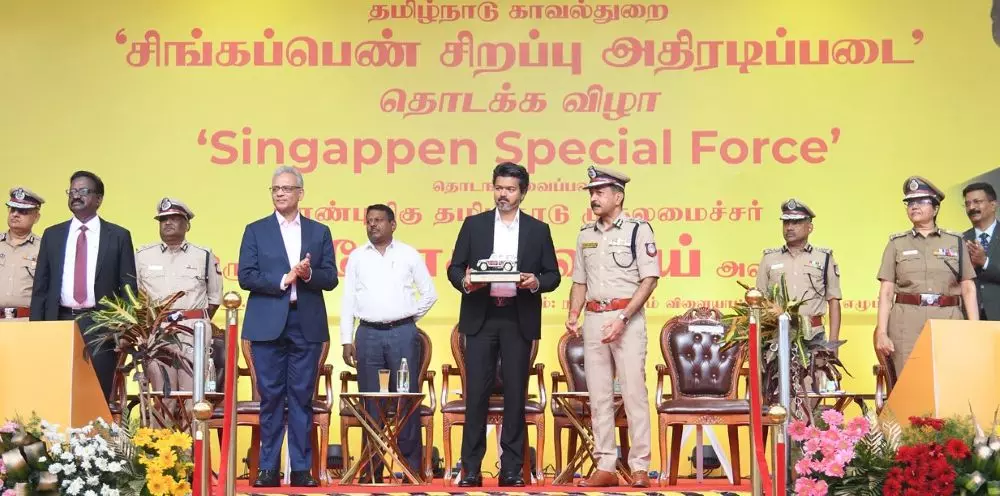
CM Vijay at the unveiling of the Singappen force earlier this month. Photo courtesy Department of Information and Public Relations, Tamil Nadu
The then All India Anna Dravida Munnetra Kazhagam (AIADMK) government in the state launched Amma Patrol in 2019 (named after late party leader and CM Jayalalithaa, popularly addressed as Amma), deploying pink-and-white patrol vehicles to curb crime against women and children. The Dravida Munnetra Kazhagam (DMK) government, which came later, expanded and rebranded the initiative as Pink Patrol, extending its reach across major cities and districts, while equipping vehicles with GPS tracking and surveillance systems.
Now, the TVK government has introduced the Singappen Force.
Also read: Why Bengal’s oft-cited cultural supremacy might be on a decline
Predictably, opposition parties have criticised the move as a rebranding exercise similar to previous governments' initiatives. Yet supporters argue that the force differs in its emphasis on preventive policing and dedicated surveillance. For many TVK supporters like Daisy — a first-time voter in the recent 2026 Tamil Nadu assembly elections, in which she admits to having supported the Vijay-led party — the force also represents the fulfilment of a key campaign promise.
The issue of women’s safety had become a major part of the 2026 election discourse. Although Tamil Nadu has traditionally projected itself as one of India's safer states for women, public anxiety over rising cases of harassment, stalking, substance abuse and crimes against women dominated the political narrative.
During his election campaign, Vijay repeatedly promised a "zero-tolerance" approach towards crimes against women and children. He had also pledged the formation of the Singappen Force, to function directly under his supervision and focus on proactive intervention rather than merely responding to crimes.
The launch of the force comes amid an increase in reported crimes against women. According to the National Crime Records Bureau's Crime in India 2024 report, Tamil Nadu recorded 11,363 crimes against women in 2024, compared to 8,943 in 2023 and 9,207 in 2022. Domestic violence-related offences constituted the biggest category. The state recorded 3,344 cases of cruelty by husband or relatives, 34 dowry deaths and 2,042 cases under The Dowry Prohibition Act. Chennai alone reported 1,093 crimes against women. Despite the increase in reported cases, Tamil Nadu maintained a charge-sheeting rate of 93 per cent. Yet, that alone has not eased public concerns.
Days after the launch of the force, Tamil Nadu was rocked by the death of a three-year-old in Tiruvallur district, allegedly following sexual assault.
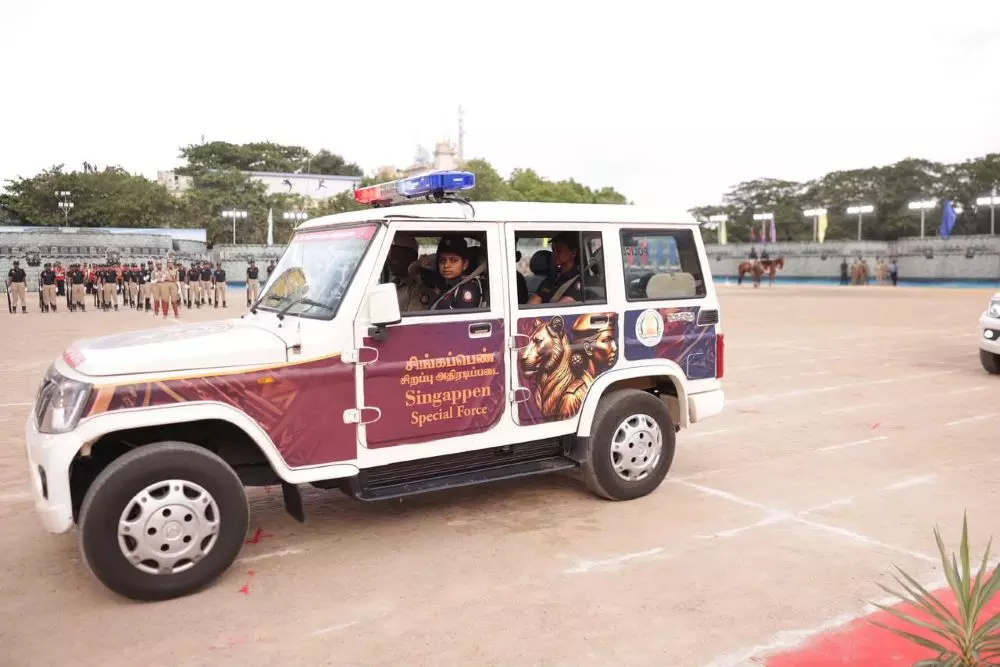
One of the patrol vehicles used by the Singappen force. Photo courtesy Department of Information and Public Relations, Tamil Nadu
For the women officers of the Singappen Force who now patrol Tamil Nadu’s streets in two shifts, from 7 am to 2 pm and from 2 pm until midnight, the assignment marks a significant departure from conventional police duties.
The day begins with identifying vulnerable locations, monitoring potential threat zones, conducting surprise inspections and interacting with women and children. Awareness campaigns in schools, colleges and residential neighbourhoods form a major part of their work.
The initiative has been designed as a dedicated women's safety and preventive intervention mechanism, reiterates K. Bhavaneeswari, a senior IPS officer who heads the Singappen Special Force. “In its initial phase, 70 operational field units have begun functioning across Tamil Nadu, powered by 140 sub-inspectors and 420 constables. The force has received a government allocation of Rs 354.67 crore, including Rs 310.98 crore for operational expenses and Rs 43.69 crore for infrastructure development,” she says. With the government having sanctioned 2,545 new posts exclusively for the force, the network is expected to eventually expand to 270 field units across Tamil Nadu, she adds.
Explaining the force’s operating procedure, Bhavaneeswari says the SSF is equipped with 319 four-wheelers and 101 two-wheelers. Each patrol vehicle carries a compact team comprising one sub-inspector, two head constables and a driver.
One of its most distinctive features is the introduction of drone-assisted surveillance, which officials describe as the first such deployment in the country for women-focused policing. Body-worn cameras capable of live-streaming footage to control rooms have also been introduced. The officers have specialised training in drone operations, weapon handling, self-defence, community policing and victim-sensitive communication.
"Our force works on crime prevention. We want to instil confidence among women and children to report crimes. We explain to them that their identities will not be revealed. Conducting regular safety audits and awareness programmes is part of our routine work. Outreach is not an annual event; it is a daily responsibility," Bhavaneeswari explains.
Also read: What attempt to cover Mohenjo-daro Dancing Girl’s bare torso exposes about our own discomforts
The officers making up the force are themselves upbeat about their new responsibilities, with some claiming that it gives them an opportunity to make a real contribution to society.
K Thara, a sub-inspector posted in the Nungambakkam area, had been posted with the law-and-order policing and the armed reserved police, before making the shift to the Singappen team. While her past duties ranged from escorting accused for court appearances and routine assignments, today she is trained to handle women and child victims, securing accused persons and dealing sensitively with children. "If we receive information about crimes involving women, our first priority is the safety and protection of the victim. We coordinate with local police stations and ensure immediate intervention," she explains.
Thara adds: "We [her unit] cover areas including Nungambakkam, Egmore, Chintadripet, Anna Salai and Triplicane [in Chennai]. We regularly conduct awareness programmes in schools and colleges. We identify vulnerable spots and bring them to the attention of authorities.”
The public response, she says, has been encouraging. "Women are happy to see us. Many women tell us they trust us, they feel confident approaching us with their complaints, and that they want to report issues directly to us. That confidence itself is important."
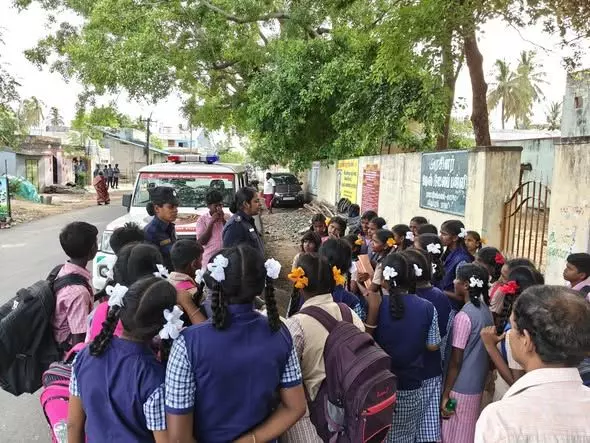
Singappen officers with school children at an event to build public awareness. Photo: By special arrangement
Another SSF member, grade-II constable G. Muthulakshmi, who joined the police service in 2020, sees the force as an opportunity to specialise.
Like Thara, before joining Singappen, Muthulakshmi worked in armed reserve and law-and-order policing. Her responsibilities included bandobast duties, handling theft cases, escorting accused persons to courts and hospitals, and responding to a variety of criminal incidents.
"Earlier, we handled everything ranging from mobile phone thefts, law-and-order issues, court duties, security arrangements and many other assignments. Now our focus is entirely on crimes against women and children," she says, adding that she spends much of her day conducting awareness sessions.
"We tell children and women about emergency contact numbers. We encourage them not to hide abuse, even if the offender is a family member. Many victims are worried about social stigma. We assure them that their identities will remain confidential."
Muthulakshmi recalls a recent case involving a young widow who sought help after facing sexual harassment on the road. "We received the call and reached the location quickly. The accused was secured and remanded. Awareness is making a difference because people now know whom to approach."
One of the biggest advantages of the new force, she says, is the ability to concentrate on a single mission. "In regular policing, officers often get diverted for VIP movements, bandobast duties or emergency law-and-order situations. Here, we are asked to focus only on women and child safety. That allows us to work more effectively."
At the time of the SSF’s launch, Tamil Nadu director general of police (DGP) Mahesh Kumar Aggarwal had also assured that the police department will put in their best efforts to ensure safety for women and children.
The SSF comes at a time when, across the country, attention is being given to women’s safety. Days after the launch of the Singappen Force, Delhi inaugurated its first all-women police station to create a dedicated space to handle cases relating to domestic abuse, dowry harassment and other gender-related complaints.
Women's rights activist B. Renuka believes the SSF deserves cautious optimism. Talking to The Federal on the SSF she said while it was a welcome move, it should not become just another force with a new name.
“Earlier initiatives focused largely on post-crime intervention, legal support, investigation and prosecution. This force appears to be focusing more on prevention, surveillance, surprise inspections and protection. That is an important shift," says Renuka, adding that success should ultimately be measured not by the number of patrol vehicles or awareness programmes but by outcomes.
Renuka adds: "The Chief Minister has shown commitment by creating a dedicated surveillance and protection mechanism. But he must also ensure transparency and monitor its functioning closely. Reporting crime should become easier. Victim blaming must end. We should celebrate convictions and justice delivered to survivors rather than obsessing over daily crime numbers."
Meanwhile, the Singappen patrol teams are already being noticed on the ground.
M. Radha, a 36-year-old textile entrepreneur and frequent traveller, says she recently encountered Singappen patrol teams near the airport and major bus stands. "I first heard about them on social media. Seeing them on the ground gave me confidence. Their presence itself sends a message that someone is watching and that help is nearby," she says.
The Coimbatore resident adds: “Though critics contend that the force's performance can only be judged after a year, many women have welcomed the initiative, saying it gives them greater confidence to come forward and report crimes.”
Coming in the heels of the Vijay-led TVK’s stunning victory in the 2026 Tamil Nadu elections, part of the public reaction to the SSF is reflective of the euphoria surrounding the new government. As the newness wears off, what will make a difference is how dedicated the team remains to the cause that seems like an opportunity to them today and how sincere the government stays to its promise of bringing real security for women and children. The energy with which the officers head out at 7am today must be sustained to ensure the force is not reduced to just a brief political and administrative optics.