- Home
- India
- World
- Premium
- THE FEDERAL SPECIAL
- Analysis
- States
- Perspective
- Videos
- Sports
- Education
- Entertainment
- Elections
- Features
- Health
- Business
- Series
- In memoriam: Sheikh Mujibur Rahman
- Bishnoi's Men
- NEET TANGLE
- Economy Series
- Earth Day
- Kashmir’s Frozen Turbulence
- India@75
- The legend of Ramjanmabhoomi
- Liberalisation@30
- How to tame a dragon
- Celebrating biodiversity
- Farm Matters
- 50 days of solitude
- Bringing Migrants Home
- Budget 2020
- Jharkhand Votes
- The Federal Investigates
- The Federal Impact
- Vanishing Sand
- Gandhi @ 150
- Andhra Today
- Field report
- Operation Gulmarg
- Pandemic @1 Mn in India
- The Federal Year-End
- The Zero Year
- Science
- Brand studio
- Newsletter
- Events

Why in Kashmir, those associated with adventure tourism business are struggling to keep afloat
Since last year’s Pahalgam attack, most trekking routes and destinations have remained closed to public, reportedly owing to 'inadequate security infrastructure and limited police presence at remote sites', putting thousands of trekking agencies, camping site owners, ponywallahs, guides and others out of business. As uncertainty over reopening continues, many say they have been forced to take up odd jobs to support families.

“The day is not far when I will have to decide whether to feed my family or my horse,” says 36-year-old Shabir Ahmed, a resident of Yusmarg, a popular picnic and trekking destination in Kashmir’s Budgam district. Worry lines are etched deep in his face and his body language is one of acute stress mixed with depression.Since 2017, Ahmed had been working as a ‘ponywallah’ — one of...
“The day is not far when I will have to decide whether to feed my family or my horse,” says 36-year-old Shabir Ahmed, a resident of Yusmarg, a popular picnic and trekking destination in Kashmir’s Budgam district. Worry lines are etched deep in his face and his body language is one of acute stress mixed with depression.
Since 2017, Ahmed had been working as a ‘ponywallah’ — one of the many support groups associated with Kashmir’s mountain tourism industry — ferrying tourists and cargo up and downhill. That changed last year, when the April 2025 Pahalgam terror strike resulted in the death of 26 civilians, 25 of them tourists.
The attack brought a premature end to the summer tourist season in Jammu and Kashmir, as a thick blanket of security covered the Valley. In May 2025, India responded with Operation Sindoor, launching missile strikes on terrorism related infrastructure facilities across the border with Pakistan. India holds Pakistan responsible for supporting terror activities in Kashmir.
More than a year later, while the authorities have reopened many prominent tourist destinations in the Union Territory, the ban on trekking continues. According to reports, security reviews have highlighted inadequate security infrastructure and limited police presence at several remote tourist and trekking sites, leaving their reopening dependent on further security assessments and deployment.
And so in the past months, Ahmed has been doing odd jobs to support his family of seven, including a sister, parents, wife and two children. But there has been a drastic shift in earnings — “from Rs 1500-2000 a day during the peak tourist season of March to September, to Rs 500 a day, or less”.
And he is hardly the only one to be suffering.
The closure of the trekking trails has impacted an estimated 20,000 to 30,000 people, according to industry insiders, including adventure tourism operators, ponywallas, guides and other workers whose livelihoods depend on these destinations.
Also read: What Indian mountaineers feel about Nepal’s likely move to make permission for Everest climb tougher
Junaid Ahmad, a 25-year-old guide from Pahalgam, says he has been working as a daily-wage labourer, earning Rs 500 a day on good days. But often there is no work at all. “I have done two 15-day guide courses conducted by the Department of Tourism—the Basic Mountaineering Course (BMC) and the Emergency Mountaineering Course (EMC)—each costing Rs 15,000 and was subsequently issued a licence by the Tourism Department. In the Pahalgam area, there are about 21 of us who completed these courses. All of them are now sitting idle at home,” says Ahmad.
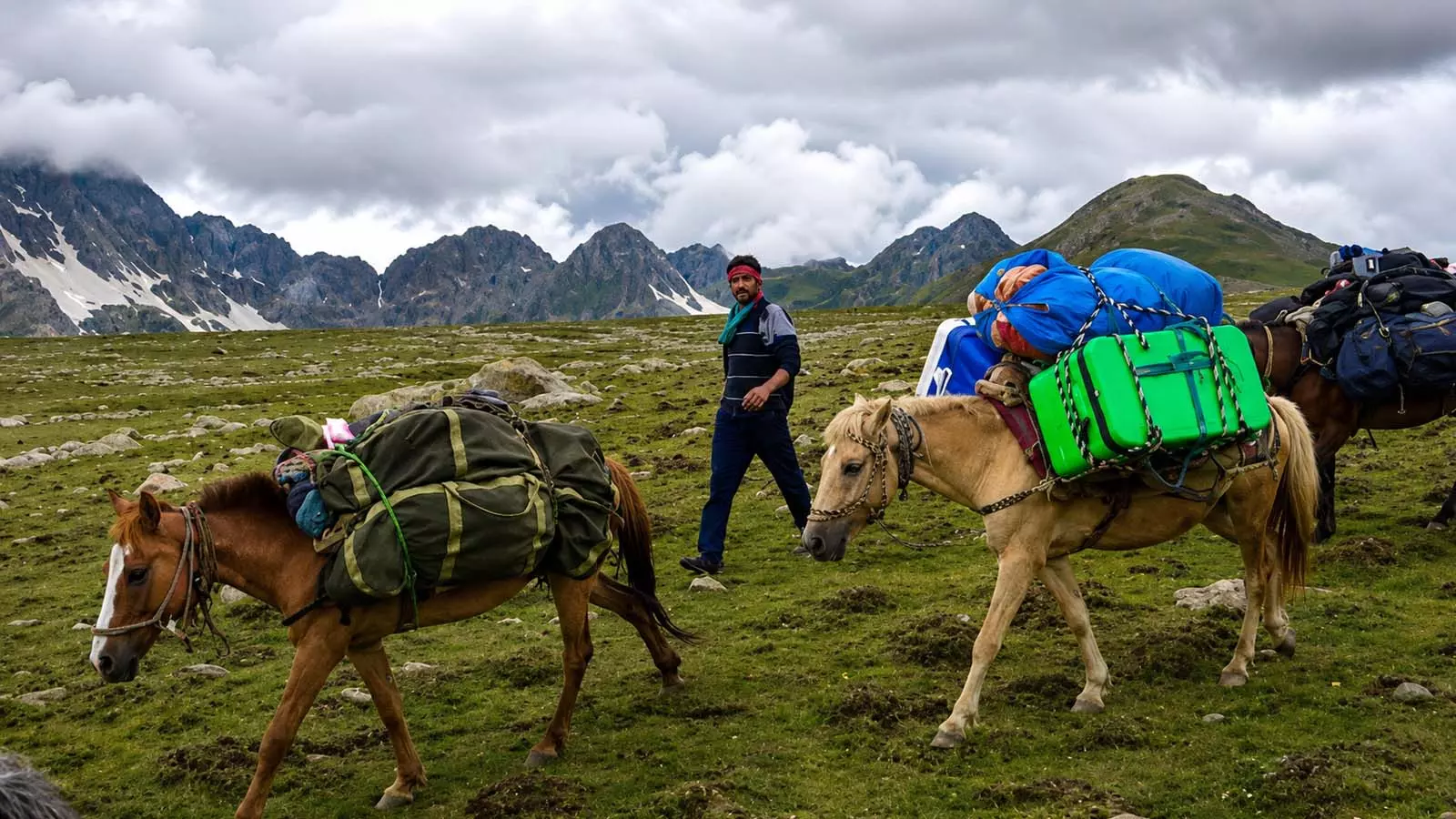
Ponywallah Shabir Ahmed walks with the horses. Photo: Basharat Amin
Mehrajuddin Andrabi, 40, a resident of Khan Sahab Budgam, was engaged in clearing the weeds in his vegetable orchard when The Federal caught up with him earlier this month.
The owner of Kashmir Hikes and Treks, a registered trekking agency, Andrabi would lead eight to ten groups a day to various trekking destinations across Jammu and Kashmir, including Tosamaidan and Yousmarg in Budgam district; Aharbal and Kounsarnag in Kulgam; Aru Valley in Pahalgam, Anantnag and the Great Lakes route from Sonamarg to Drangbal in Ganderbal. For the past few months, however, he has been dividing his time between his orchard and in looking for odd jobs across the district.
“Each group provided employment to several people. Four to five ponywallas would accompany every group, along with two guides and three helpers who would wash utensils, sometimes work as security guards and perform other support duties,” he recalls. “We have been left helpless. There seems to be no future in the profession we were passionate about.”
Giving an idea of the livelihood impact, Andrabi says “ponywallas and guides would earn Rs 1,000 to Rs 1,500 a day, but now they are unable to earn even Rs 100 a day [doing odd jobs].” He himself would earn anything between “Rs 50000-250000” from each group, depending on the duration of the trek, number of members in the group, location, etc.
Andrabi had registered his company with the tourism department in 2017 and rented a building in Budgam for the company’s office. Despite the collapse in business in the past year, he continues to maintain the office, an additional financial burden of Rs 5000 per month in rent, excluding electricity and water charges.
Explaining why he had to rent an office space, Andrabi says the tourism department required trekking agencies to have proper office facilities before registration. He continues to maintain the office now, to retain the registration and in the hope that he might soon be able to return to the work that he had loved. “We still have to pay the electricity and water bills,” he says, but adds, “there were three-four office staff who lost their jobs because I could no longer pay them.”
Ironically, while the trekking routes remain closed, he continues to receive calls from interested travellers, from across the country and abroad, looking for trekking reservations, claims Andrabi. “People are still contacting us for bookings. Before the Pahalgam attack, we had groups coming from other states as well as foreign countries,” he says.
His frustration is echoed by Owais Mushtaq, a tourism degree holder from Shopian, who started his trekking company, Hype Kashmir Adventures, in 2018, in partnership with four other local youths. Mushtaq says they had later hired a professional mountaineer from the Jawahar Institute of Mountaineering, along with guides, ponywallas and helpers. Following the Pahalgam attack, he had to let go of all of them, he rues.
“Adventure tourism has huge potential in Kashmir, but instead of facilitating these sites with basic infrastructure and security, the government has closed them. Like other parts of Kashmir, Shopian has tremendous potential for adventure tourism,” Mushtaq says.
According to Mushtaq, Keller tehsil, in Shopian district, alone has several unexplored destinations, including Cooler, Garder and Shukroo, which offer vast meadows. The Peer Gali area along the historic Mughal Road boasts of picturesque locations such as Bremsar and Chirsar lakes, perfect draws for adventure tourists.
Talking about the security concerns, Mushtaq alleges the government has repeatedly maintained that security arrangements are in place and that areas located far from Pahalgam could be opened for trekking and other adventure activities, but no action has followed.
“If we continue to link the closure of all these sites with the Pahalgam attack, how long will we have to wait for their reopening?” he wondered aloud. “We cannot say that we can prevent incidents like the Pahalgam attack, and the attack was widely condemned, including by the people of Kashmir. But that should not mean that all adventure tourism activities remain suspended indefinitely,” he pleads.
Mushtaq maintains that tourists from across India are passionate about exploring Kashmir’s lesser-known trekking destinations and are equally put out by the current closure of trekking trails. “They want to explore new and virgin destinations, but how is that possible when these sites are still closed?” he asks.
Industry leaders say they have approached Chief Minister Omar Abdullah and Lieutenant Governor Manoj Sinha seeking the reopening of the trek routes, but to no avail.
“We have time and again requested the government to review its policy of shutting down these sites, as the livelihoods of thousands of people are associated with adventure tourism. However, we are unable to understand why these sites have not been reopened, particularly when the security situation has improved considerably,” says Farooq Kutho, president of the Travel Agents Association of Kashmir.
He adds that while adventure tourism has “huge potential” for creating livelihoods in Kashmir, there has been “zero activity” in the sector since the Pahalgam attack.
“Adventure tour operators are among the worst hit. They are the ones who manage this business and are responsible for bringing tourists to the Valley. People from not only different states of India but from across the world visit Kashmir as tourists. Tourism is a strong contributor to the GDP of the erstwhile state,” Kutho continues.
The president of the travel agents association explains, “A good percentage of tourists come to Kashmir to experience and understand its culture. They are particularly interested in the lives of people living in far-flung and hilly areas, including tribal communities. Tourists are eager to learn about their way of life—what they eat, how they survive and how they live in these difficult terrains. It is actually a cultural exchange.”
While the plight of those associated with the adventure tourism sector in Kashmir has not drawn any major political outrage yet, Chief Minister Omar Abdullah has spoken on the subject once or twice, highlighting that the impact on tourism affects the entire Kashmir economy. About seven per cent of Kashmir’s GDP is attributed to earnings from the tourism sector.
The Federal reached both director (tourism), Syed Qamar Sajad and the L-G’s office over phone and text messages and email, respectively, for information on the reopening of trekking routes in Kashmir, but received no response till the time of publication of this report. The article will be updated if a response is received.
Also read: Down the decades, how experience of travelling with the Indian passport has changed for citizens
Meanwhile, those like Junaid (identified by first name only), a 40-year-old from Pahalgam in Anantnag district, and the owner of Inter Experia, a registered camping agency established in 2016, continue to wait for business.
“Here in Pahalgam, there were around 35 camping agencies, including a few from outside Kashmir. The livelihoods of many local youths were associated with these agencies. Even businesses supplying camping equipment, tents and mountaineering gear have been badly affected, as they have also been forced to shut down,” says Junaid.
He adds: “Before the Pahalgam attack, we used to take hundreds of tourists on treks every day. The season usually begins in March and continues until September. But since the attack and the closure of these sites, our business has come to a standstill and we are struggling to survive.”
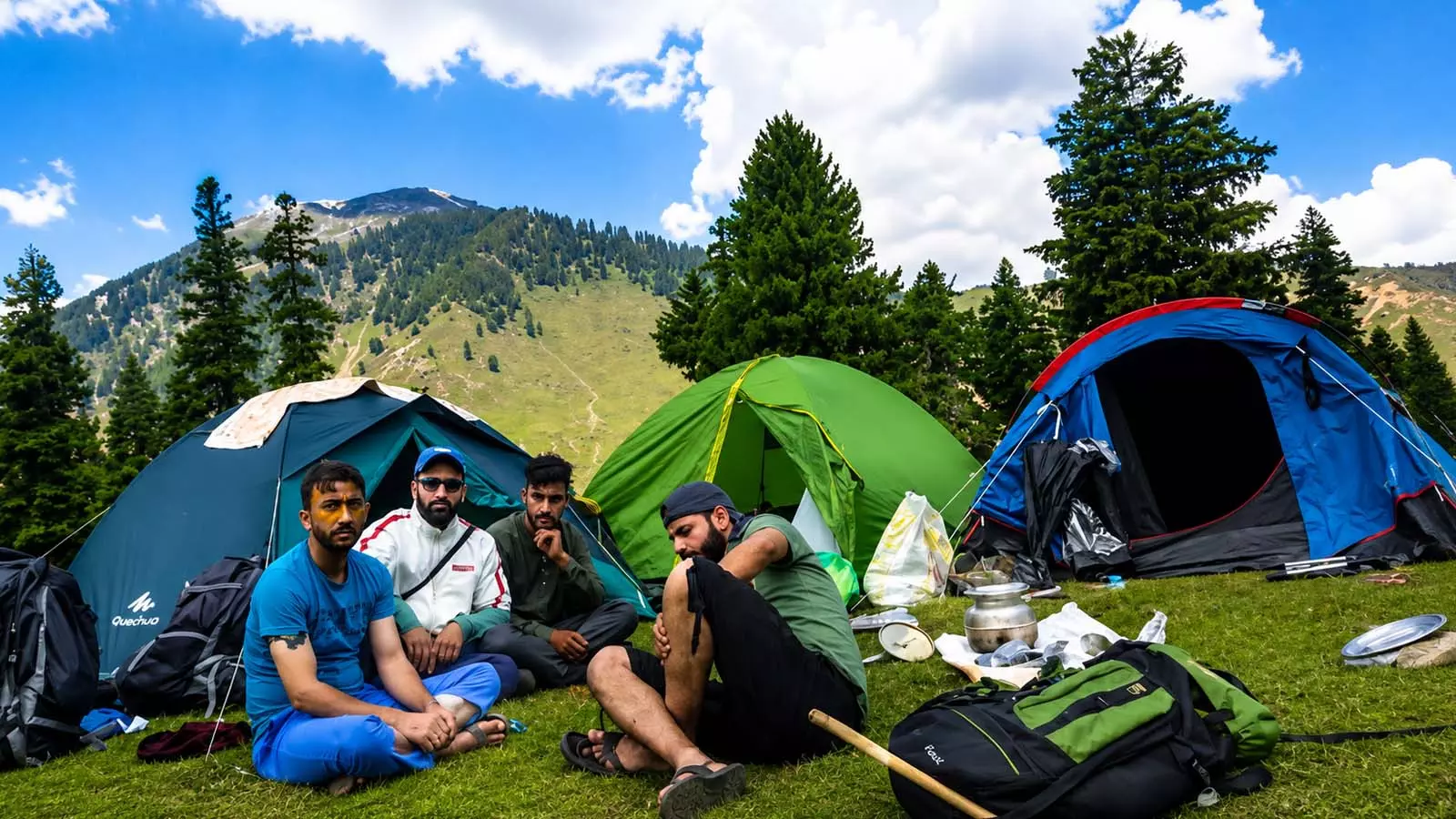
And it is not just those who have been financially hit who are lamenting the closure.
It is the same narrative of gloom that is repeated by Zubair Firdous, a financial investigator based in Baramulla, who says he has been trekking for the past 12 years and had founded a group of like-minded trekking enthusiasts, Alpine Hacks Baramulla, in 2017, with more than 100 members.
“Before the Pahalgam attack, tourists would throng routes such as Tarsar-Marsar, the Sheshnag route and Tulail Lake in Anantnag. And hundreds of people from neighbouring areas earned their livelihoods from tourism. It was not only ponywallahs, porters, helpers, guides and trekking agency owners who benefited. Small village markets also depended on the tourists. With these routes closed, entire local economies are being affected.”
Like Shabir Ahmed, Bilal Hajam, a 38-year-old ponywallah from Arizal near Tosa Maidan in Budgam district, has also been struggling to make ends meet since the trekking routes closed, relying on a small patch of maize that he has been cultivating. But the produce is hardly enough to feed his eight-member family.
Meanwhile, Ahmed looks forlornly at his horse. The animals require a monthly investment of Rs 10000, he says, including feed, grooming and other expenditure. Straining to support his human family, he wonders how long he will be able to continue to support the animals if he continues to fail to get proper work.