- Home
- India
- World
- Premium
- THE FEDERAL SPECIAL
- Analysis
- States
- Perspective
- Videos
- Sports
- Education
- Entertainment
- Elections
- Features
- Health
- Business
- Series
- In memoriam: Sheikh Mujibur Rahman
- Bishnoi's Men
- NEET TANGLE
- Economy Series
- Earth Day
- Kashmir’s Frozen Turbulence
- India@75
- The legend of Ramjanmabhoomi
- Liberalisation@30
- How to tame a dragon
- Celebrating biodiversity
- Farm Matters
- 50 days of solitude
- Bringing Migrants Home
- Budget 2020
- Jharkhand Votes
- The Federal Investigates
- The Federal Impact
- Vanishing Sand
- Gandhi @ 150
- Andhra Today
- Field report
- Operation Gulmarg
- Pandemic @1 Mn in India
- The Federal Year-End
- The Zero Year
- Science
- Brand studio
- Newsletter
- Elections 2024
- Events

Academic disruption, financial crisis — the human cost of Kashmir's Jamia Siraj-ul-Uloom’s UAPA ban
The institution in Shopian, with alleged links to banned outfit Jamaat-e-Islami, was declared an ‘unlawful entity’ last month. The closure has left the future of hundreds of students and staff members uncertain, many of whom also wonder if their association with Jamia Siraj-ul-Uloom will bring them under government scanner.

Twelve-year-old Musaib Ahmad, a student of Class 6 in Kashmir’s Shopian district, wakes up at the same hour every morning; so early that even the Sun is not fully out at that hour. He dresses in his neatly pressed school uniform, packs his bag… and waits. That’s been the routine for Ahmad ever since the Jamia Siraj-ul-Uloom (JSU) was closed on April 24, following the Jammu and...
Twelve-year-old Musaib Ahmad, a student of Class 6 in Kashmir’s Shopian district, wakes up at the same hour every morning; so early that even the Sun is not fully out at that hour. He dresses in his neatly pressed school uniform, packs his bag… and waits. That’s been the routine for Ahmad ever since the Jamia Siraj-ul-Uloom (JSU) was closed on April 24, following the Jammu and Kashmir administration’s order declaring the institute an ‘unlawful entity’ under the Unlawful Activities (Prevention) Act (UAPA), 1967.
Sitting by a window at home, Ahmad’s eyes fill with tears as he stares at the road that he would once take daily to school. “Every day I think maybe today it will open,” he tells The Federal. “I get ready… but then I just sit here.”
The wait has begun to weigh on him in ways he cannot fully explain. “I have not spoken to my teachers for days. They were always there for me; they would guide me every day,” he says, trying to put his emotions into words. Having only ever studied at JSU, for Ahmad, the institute is more than school. It is part of how he identifies himself, a comfort zone and a daily habit, the sudden disruption of which has left him shaken. Which perhaps explains his extreme attachment to JSU and the people who, till days back, had been his world outside his home and family.
While words such as ‘independence’, ‘rebellion’, ‘dissent’, ‘protest’, ‘lawful’ or its antonym, ‘security’ and ‘militancy’... probably enter the dictionary of Kashmiri kids sooner than for others, Ahmad still displays a political awareness and defiance far beyond his years as he questions, “What kind of government is this that does not care about our education?... We are children, we only want to study. Why are we being punished like this? If they close our school like this, what will happen to us? Where will we go?”
His mother, Rafiqa Bano, watches helplessly as he petulantly refuses to change out of his uniform, clinging to the comfort of the familiar attire. “He was doing so well there, both academically and morally. His teachers knew him, guided him… he was growing every day. Here, it’s not easy to find a good school. We are still at a loss as to where to put him now,” she says.
Ahmad and his family’s anguish is shared by hundreds across Kashmir, as students and their parents grapple with the question, “what next”. Families The Federal spoke to all said the closure has come as a rude shock to them.
Also read: Why a 31-year-old's death has revived talks of ‘extrajudicial killings’, ‘fake encounters’ in Kashmi
Located in the Imam Sahib area of Shopian, the JSU is a seminary — an educational institution for teaching the scriptures and theology — that was established between 1998 and 2000, according to information on the institute’s website, and offers education to students from class 5 to the undergraduate level. The boys-only institute is affiliated to the Jammu and Kashmir Board of School Education (JKBOSE) and the University of Kashmir, and claims to “follow recognised academic structures, while also providing Quranic and religious studies alongside the common subjects”. At the time of being closed, JSU sources say the institute had a student strength of 900, whose futures remain uncertain following the government decision.
The April 24 order, issued by the divisional commissioner, Kashmir and accessed by The Federal, claims that the institution, “though ostensibly functioning as a religious educational establishment, is marred by serious legal, administrative, and financial irregularities”. Allegations include “questionable land acquisition, lack of mandatory registration with competent authorities, and deliberate attempts to evade statutory oversight”, as well as “financial opacity, suspicious handling of institutional funds, and changes in financial control structures raising apprehensions regarding diversion and misuse of funds”. But perhaps the most serious allegation that’s been levelled against JSU in the order is that of “sustained and covert linkages” to banned outfit Jamaat-e-Islami, with “continued de facto control by individuals affiliated with the said organisation… placed in key administrative and academic positions”. The Jamaat-e-Islami had been banned for "activities against the security, integrity and sovereignty of the nation", as per a Union government release dated 2024. It was first proscribed by in 2019. The April 24 order of the divisional commissioner, Kashmir, also claims that “reports further indicate" that JSU "has fostered an environment conducive to radicalisation, with a number of its former students having been found involved in militant activities...”.
The Federal has reached the office of the divisional commissioner, Kashmir and the office of the senior superintendent of police, Shopian, for comment. The article will be updated if a response is received.
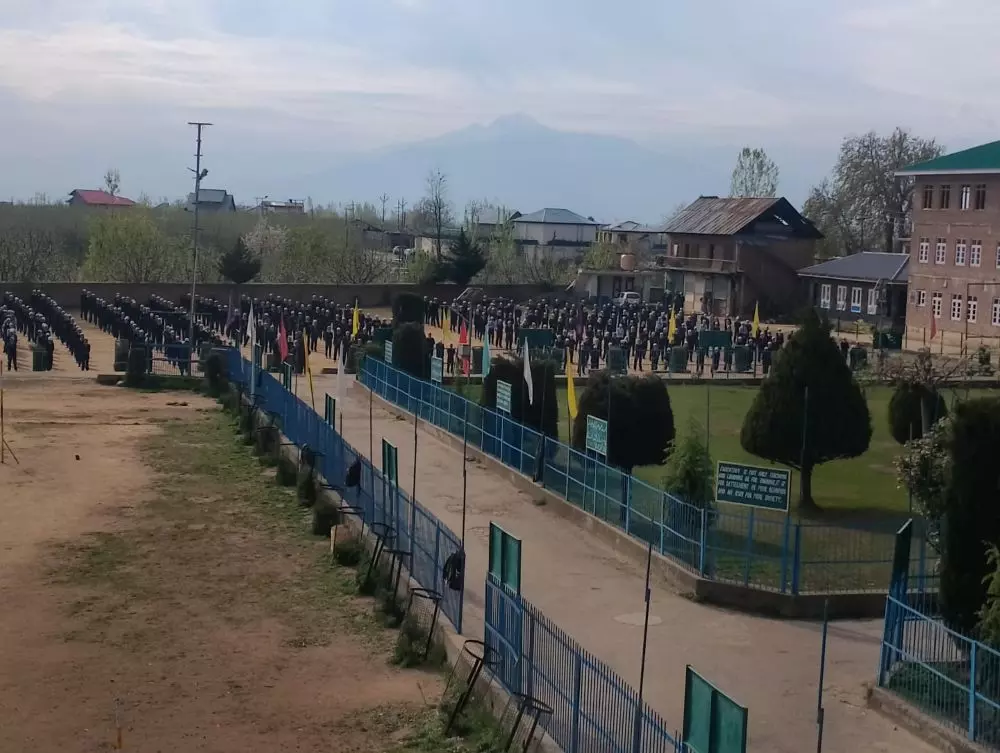
The Shopian seminary declared an 'unlawful entity' under UAPA. Photo: By special arrangement
The allegations were refuted by JSU chairman Mohammed Shafi Lone, who in a conversation with The Federal, claimed that the institution has been “misrepresented” and insisted that its primary role has always been educational. Insisting that the institution had “no affiliation with Jamaat-e-Islami”, he added, “Many of those being referred to as ‘former students’ [might have] studied here only up to Class 10 or 12, when they were minors. After that, they moved to other colleges and institutions for further studies. It is not correct to attribute their later actions solely to this institution.” Lone rejected the portrayal of the institution as a ‘darul uloom’, or seminary, in the narrow sense, claiming, “We are a full-fledged educational institution where formal academic subjects are taught alongside religious studies. Our institute is recognised by the Jammu and Kashmir Board of School Education and our college wing is affiliated with the University of Kashmir. We are also associated with the Kashmir School Federation. These are all recognised bodies and our academic structure follows prescribed norms.”
The JSU chairman added: “We are not involved in any unlawful activity. We have always followed government rules and regulations. Our institute celebrates both Republic Day and Independence Day every year.”
Lone’s claims were echoed by Mohammad Yousuf Mantoo, a former chairman of the institution. “We built this institution with the idea of education and discipline. Thousands of students have passed through these classrooms and gone on to pursue different careers.” Talking about the impact of the closure, Mantoo said, “The immediate concern should be the students whose education has been disrupted and the teachers who have lost their livelihoods.”
Also read: How maiden Ranji win has given momentum to the J&K youths’ dreams of a professional cricket career
For many, Mantoo’s concern has been the reality of the past few days, one that they are still grappling to come to terms with.
“I had my exams coming up,” says a Class 10 student of the institute speaking on condition of anonymity. “Now everything has been put on hold. No one has told us what happens next — whether we will be accommodated somewhere or if we will have to repeat the year.”
The ‘what next’ question is one that has also been haunting another student of the institute, a 15-year-old, who says the uncertainty has left him “stressed out”. “I haven’t been able to sleep properly since that day. I don’t see any clear future anymore,” he says.
For students at higher levels, the disruption feels even more severe. An undergraduate student says the closure has put his academic continuity at risk. “We were preparing for our exams. Now everything is uncertain. If we are asked to move, will our work be recognised? Will another college take us?” he wonders.
Parents, meanwhile, are struggling with the dual burden of consoling and reassuring their children while trying to figure out the next course of action. “We are worried about our children’s future,” admits Imtiyaz Ahmad, whose son was a Class 5 student at JSU. “If the school remains closed, where will we take them? Admissions are not easy in the middle of the session, and not every school will accept them.” Ahmad, who works as a technician installing CCTV cameras, adds that the lack of clarity has left families anxious. “There should be some direction from the authorities,” he murmurs.
For staff members, the disruption brings financial uncertainty and the pressure to find alternative employment. Faculty members and others The Federal spoke to, claimed the last salary they had received was at the beginning of April (for March 2026). Since the institution was closed in the last week of April, payrolls couldn’t be processed and the last month’s salary remains pending, they say. The repeated calls from students, whose questions about the future they are unable to answer, add to their sense of misery and helplessness.
“We earned this job on merit,” says 43-year-old Reyaz Ahmad, a teacher at JSU for over two decades. “This was our identity. And now, suddenly, we are left with nothing.”
According to staff members, an estimated 100 employees — teaching and non-teaching — have had their lives upended by the closure.
Already, some say they have been moved by desperation to take up work far removed from their experience and expertise. A 48-year-old teacher of social studies at the institute says he has been doing odd jobs, including as an assistant to a mason, to earn some money. “My salary at JSU was Rs 15,000 a month. I last received it at the beginning of April. My family depends upon me. What do I do,” he asks. The teacher adds: “The academic year has already started and recruitments at most schools are over. It’s not easy finding another job in the middle of the year.”
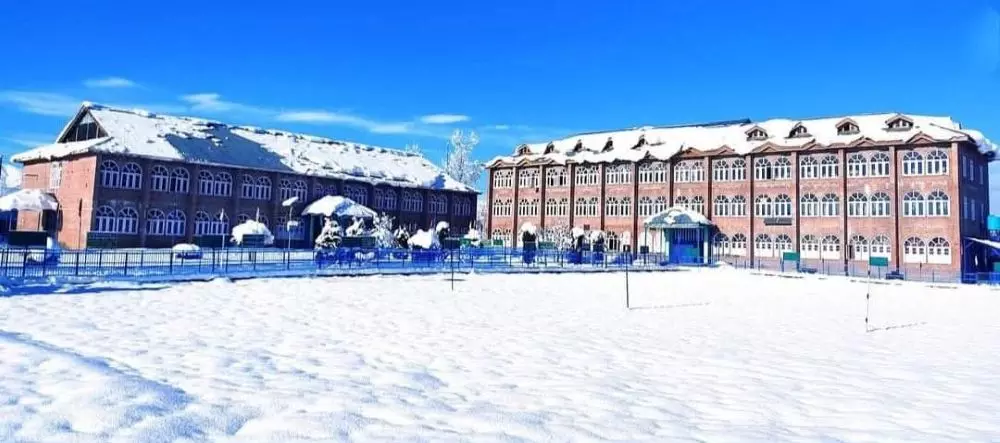
The administration has accused the institution of having links with the banned terror outfit Jamaat-e-Islami. Photo: By special arrangement
Unsurprisingly, those at the bottom of the financial pyramid are feeling the worst of it.
Asadullah Sheikh of West Bengal says he has worked as a cleaner at JSU for the past 20 years. “For two decades, this institution put food on the plate for my family. Now, we have nothing.” Sheikh adds: “People talk about orders and cases, but people like us only think about how to feed our families the next day. I am in such dire straits that I called the administration a few days back requesting them to give me something, anything, even Rs 4,000, because there is no food at home.”
The JSU case has created a stir in Kashmir, with former students and independent academics rallying behind the institute.
“We studied like students at any other school—mathematics, science, languages. There was discipline, but nothing that could be called extreme,” claims a former student, who graduated from the institute in 2012 and now works as a civil engineer, requesting anonymity.
Another former student, Faheem Ahmad, who is now a physics researcher at a university abroad, agrees, “We had regular classes, exams, and teachers guiding us. We spent years there. It was part of our journey.”
Now, the closure has come as a shock to the academic community in Kashmir.
“For years, Jamia Siraj-ul-Uloom has been regarded as a recognised educational institution in south Kashmir”, says an academic and social observer, speaking on condition of anonymity. He adds: “Students from different backgrounds studied there and continued into higher education and professional fields. When an institution with such a large student base is shut overnight, the immediate victims are the children and teachers. Institutions should be judged in their entirety, including the thousands of students who passed through them and contributed positively to society. Reducing an educational space only to allegations without considering its wider social and academic role creates fear and uncertainty within society.”
Also read: Why Kashmiri traders scattered across India claim fear of verbal abuse, assault
The decision has also drawn a fair bit of political backlash, with former Jammu and Kashmir Chief Minister and Peoples Democratic Party president Mehbooba Mufti taking to the social media platform X to speak up against it. Terming the closure a “flagrant injustice” against poor and underprivileged sections of society, Mufti said the institution had been a beacon of affordable quality education and had produced several reputed doctors and professionals serving the nation. She also alleged that banning such institutions without “solid evidence of anti-national activity” reflects “deep-seated prejudice and ill intention”.
The Federal reached Tanvir Sadiq, MLA and chief spokesperson of Kashmir’s ruling Jammu and Kashmir National Conference, for comment, but received no response. The article will be updated if a response is received.
Meanwhile, far away from the cacophony of adult voices, Ahmad holds on to the hope that his school will reopen soon. Childish petulance, loyalty and attachment take the form of an almost grown-up determination, as he declares, “I will not go to any other school. This is my only place.”