Lata Shashikumar, a resident of Gollahalli village in Bengaluru district, remembers the incident in minute details. It was August 15 last year. Around 5.15 in the evening. She was washing utensils in the courtyard of her house when suddenly there was an explosion. A dynamite blast in a nearby stone quarry caused a cement chunk on the roof to loosen and crash down into the courtyard, narrowly missing Lata. Windowpanes shattered and cracks appeared on the walls of the neighbouring house.
The issue of ‘unregulated’ stone quarrying and crushing units is not new in Karnataka. An undated analysis of the Karnataka State Western Ghats Conservation Taskforce Committee available online highlights the problem of “illegal mining and quarrying activities in the Western Ghats of Karnataka”, terming it “one of India's most significant environmental disasters”. The committee cited news reports to claim that “In Hassan district alone, 400 acres of deemed forest land were illegally quarried in 2024, despite forest department notifications” and that there was “Quarrying beyond legal boundaries in 146 locations covering 8.90 lakh square meters”.
In December 2020, the Karnataka high court had reportedly directed the state government to consider setting up a redress mechanism to facilitate people to register complaints regarding illegal quarrying and stone crushing. The order came while the court was hearing a petition filed against alleged illegal quarrying in the vicinity of the Tippagondanahalli reservoir and the Manchanabele reservoir.
More recently, in May 2025, a visit by Karnataka upalokayukta, Justice B Veerappa, a former Karnataka high court judge, to some villages in Kolar district reportedly revealed violations by stone quarries and stone-crushing units operating in the area.
In recent years, however, the issue of alleged unregulated stone quarrying and operation of crushing units has become more critical in villages on the outskirts of Bengaluru.
Shobha and Ramesh (identified by first names only) own a farm between Gollahalli and Sulivara villages near Bengaluru. But despite spending substantially on crops ranging from brinjal and pigeon peas to tomatoes, the two claim the returns are poor. “Stone quarrying is taking place just 300 metres away, and excessive dust has reduced crop yields. The farmhouse and water tank built on the same land have developed cracks due to rock blasting. Coconut and arecanut trees on the property, too, have failed to bear fruit,” alleged Ramesh.
On December 27, 2025, a leopard was killed by a stone blast near Gollahalli village. In the days following the incident, when The Federal visited the quarry-affected areas earlier this month, the deafening roar of crushers continued unabated.
“The noise of the daily rock blasting and inhalation of stone dust have caused persistent headaches. Despite medication, the pain just doesn’t recede. The crushers have robbed us of all peace. Not just humans, even livestock are facing severe problems owing to dust inhalation. We live in fear of becoming victims of blasting,” lamented a homemaker from Sulivara village, who did not wish to be named.
Across villages such as Sulivara, Madapatana, Donnenahalli, Kurubarapalya and Gollahalli, on the outskirts of Bengaluru city, stone quarrying and crushing units have raised issues of noise and dust pollution and the chaos of relentless traffic movement. Residents complain of respiratory disorders. There are reports of water contamination and impact on wildlife. The use of dynamite in stone quarrying has caused houses in Sulivara, Gollahalli and Kurubarapalya to develop cracks. Rock blasting takes place daily between 5:15 pm and 5:30 pm. Families living in these houses are gripped by fear of what lies ahead.
Stone quarrying in Karnataka is regulated under the Karnataka Minor Mineral Concession Rules (KMMCR), 1994 and the Karnataka Regulation of Stone Crushers Act, 2011. These laws require quarry operators to obtain necessary licences, pay royalty, comply with environmental norms (pollution control and noise regulations), and secure transport permits through the Integrated Lease Management System (ILMS). To prevent illegal mining and address violations, the Department of Mines and Geology is authorised to impose penalties.
Granted operating permission for a period of five years at a time, each quarry must have a minimum area of one acre and be located within a designated safety zone. Crushers are mandated to install 20-foot vacuum systems to control dust, as per the rules.
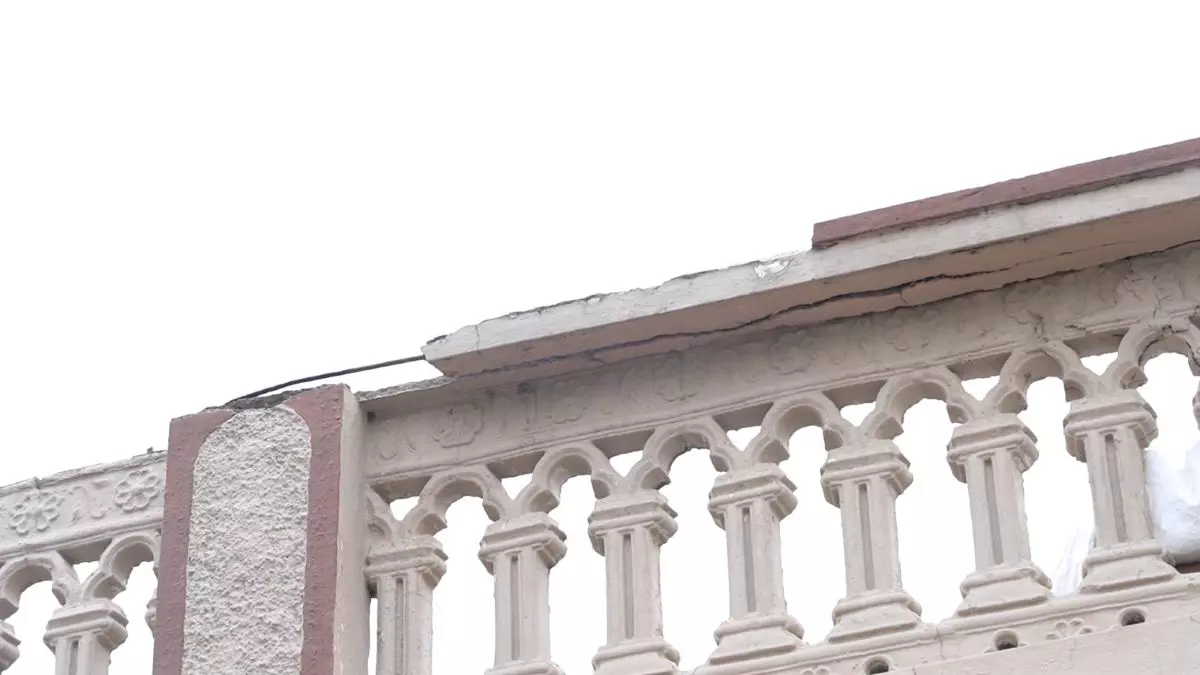
The use of dynamite in stone quarrying has caused houses in Sulivara, Gollahalli and Kurubarapalya to develop cracks. Families living in these houses are gripped by fear of what lies ahead. Photo: RD Raghu
However, locals allege rampant flouting of rules.
“Households in Gollahalli receive Rs 40,000 and those in Sulivara Rs 30,000 annually as compensation from crusher owners. We don’t want this money. Our houses are cracking, our health is deteriorating and crops are being destroyed. Stopping quarrying itself would be our real compensation,” said Shobha, a homemaker from Gollahalli.
A villager in Maregowda, speaking on condition of anonymity, recalled a recent incident, when “there was a sudden loud noise like lightning”. “Utensils shook inside our houses. The ground trembled. But officially, no blasting was reported at that time. Crusher workers denied having used dynamite.”
Living with the stone dust from the quarries and crushing units has allegedly caused many to fall prey to respiratory issues.
“My 73-year-old mother developed lung problems from dust exposure. We had to spend nearly Rs 1.5 lakh on treatment,” claimed Shashikumar, Lata’s husband. “Owners of crusher units keep violating norms, but the Pollution Control Board officials turn a blind eye. They visit rarely. When they do, owners appear to have been informed in advance and use vacuum machines to temporarily control the dust.”
A doctor at a private clinic near Chandrappa Circle, Bengaluru, speaking on condition of anonymity, said that most patients who come in from areas in the vicinity of quarries and crushing units, complain of persistent coughing and breathing difficulties.
“The movement of trucks, carrying sand and stones from the quarries, adds to the pollution,” agreed a staff member at the Community Health Centre near Chandrappa Circle. “People from nearby villages come with respiratory issues. Elderly people are developing breathing and lung diseases. Those requiring advanced care are being referred to hospitals in Kengeri and Bengaluru.”
A news report from March 2025, highlighted the issue of water contamination at the Manchanabele reservoir, located in the vicinity of the quarrying site near Gollahalli. The report also quoted activist Nirmala Gowda, who is associated with Paani.Earth, an organisation working for sustainable river management. The activist had reportedly cited studies showing the presence of “heavy metals” in the water, “which can cause kidney ailments.”
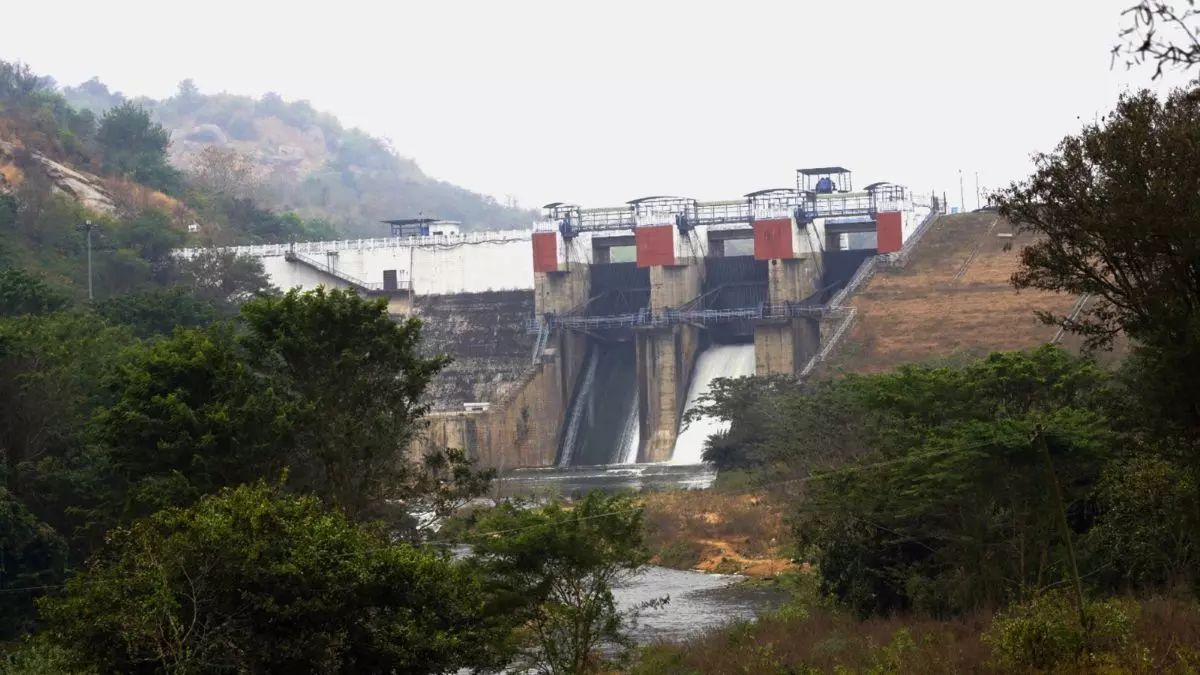
There have been reports of water contamination in the Manchanabele reservoir, located in the vicinity of the quarrying site near Gollahalli. Residents blame it on pollutants from the quarries and crushing units. Photo: RD Raghu
Residents living in the vicinity of the reservoir, which supplies drinking water to Ramanagara and Magadi towns, blamed the contamination, at least in part, on the pollutants from the quarries and crushing units.
“Stone-washing water is flowing into the Manchanabele reservoir, contaminating it. Groundwater pollution is also feared,” alleged V Ganesh, assistant conservator of forests, Bengaluru South Division.
Then there is the threat to wildlife. The death of the leopard was just one example of a wider risk, says experts.
“Allowing quarrying right up to forest boundaries poses a major threat to wildlife. Quarrying should be permitted only beyond a minimum 1000-metre buffer zone from forests, Ganesh added.
According to wildlife experts, unrestrained quarrying in the Dubbaguni forest, which connects to the Savandurga forest in Ramanagara district, has disrupted traditional elephant corridors in the area. The animals would move from Bannerghatta National Park through Savandurga and Manchanabele to Tumakuru in search of food and water. However, for the past seven to eight years, blasting has forced elephants to change routes, moving instead towards Ramanagara and Channapatna, they say.
Explained YT Lohith, senior programme officer of the World Wildlife Fund (WWF) “Elephants are extremely sensitive animals and can sense underground vibrations through their feet. They have followed the same migration routes for generations. But now, excessive quarrying around Savandurga and Tavarekere may have forced them to change paths.”
While leopard numbers have reportedly gone up in the local forests, stone blasting is forcing them out of forests and into villages, claim experts.
“The government has permitted quarrying in grazing lands adjoining the forests. The sound and activity have forced animals like leopards and bears into the open. There have been deaths of animals caused by stone blasting. The forest department is treating this issue very seriously,” Ganesh told The Federal.
A "400-year-old banyan tree", locally referred to as the "Big Banyan Tree", a popular tourist draw near Kengeri in Bengaluru, stands covered in dust from the quarries, its very height appearing stunted. The birds which once made the tree their home, too, seem to have been driven away by the noise of the stone crushers. The rhythm of tranquillity and the happy chirping of birds has been replaced by the ugly, mechanical sound of machines.
Even the Indian Space Research Organisation (ISRO) has not spared. The space agency’s Indian Deep Space Network (IDSN)’s campus in Byalalu, near Sulivara, operational since 2008, is barely a kilometre away from the nearest quarrying site. Residents and officials report experiencing daily ground vibrations due to blasting.
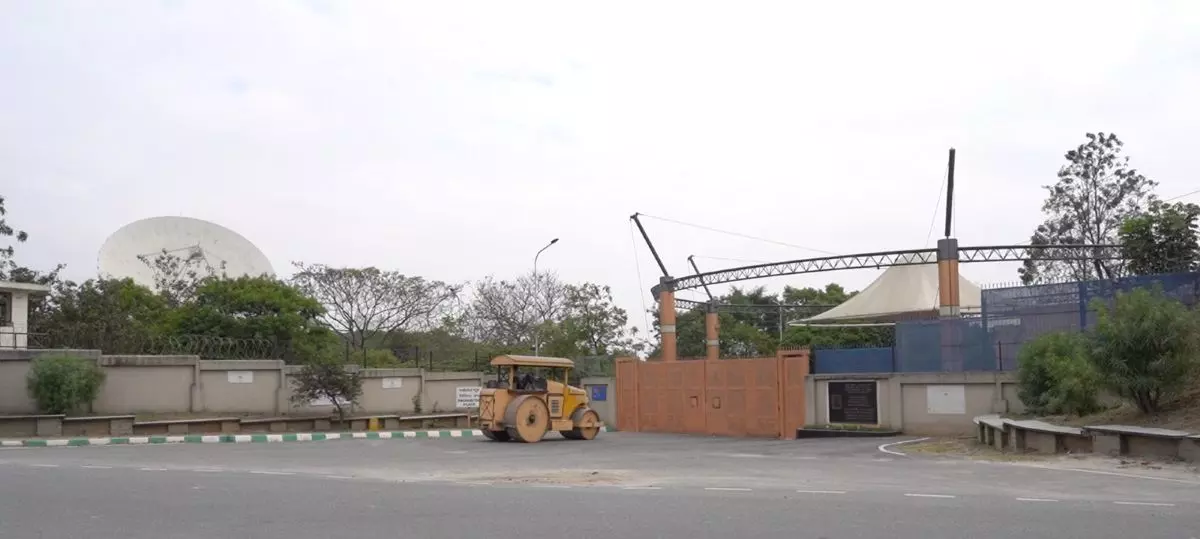
ISROs Indian Deep Space Network (IDSN)’s campus in Byalalu, near Sulivara, operational since 2008, is barely a kilometre away from the nearest quarrying site. Photo: RD Raghu
“The antennas at the Byalalu centre have highly sensitive amplifiers. Ground vibrations caused by blasting can transfer to the antennas, potentially disrupting the reception of delicate signals sent by satellites. Data analysis could also be affected,” a retired ISRO official told The Federal.
He added: “When antennas track deep-space satellites, even a slight ground movement can distort measurements. For instance, if a satellite is 100,000 km away and the ground beneath the antenna vibrates, the satellite’s distance may be inaccurately recorded. This can affect navigation data.”
According to official estimates, there are over 30 stone quarries and more than 150 crushing units operating in Tavarekere, Bengaluru South Taluk, alone. All units are functioning with valid permissions, claim officials. To curb illegal activities, the Department of Mines and Geology maintain strict surveillance, while the Pollution Control Board has been instructed to conduct regular inspections related to dust control, they add.
Meanwhile, regarding concerns about possible damage to ISRO facilities and the Manchanabele reservoir, additional deputy commissioner of Bengaluru Urban district, Jagadish Naik, told The Federal Karnataka that no official information indicating such damage has been received so far and the matter will be brought to the notice of the deputy commissioner if a complaint is received. The Federal also reached deputy commissioner Jagadeesh G over the phone for comment, but received no response.
Meanwhile, an owner of a stone crushing unit, speaking on the condition of anonymity, downplayed the risk to villagers. “To prevent dust from rising during blasting, we use water sprinklers and vacuum machines. Roads used by trucks are regularly watered to suppress dust. We are also providing compensation to households in villages near the quarries that experience minor inconvenience,” he claimed.
But residents insist the monetary compensation is “meaningless” when weighed against the damage done to their health and safety.
“Many of the owners of the stone crushing units are in politics or have political links. To silence opposition, they pay ₹35,000–40,000 annually to each household in surrounding villages. Those who refuse the money and protest are allegedly threatened with death,” claimed Shashidhar Aradhya, an activist spearheading the protest against the increasing quarrying and crushing activities in the area.
Both Aradhya and the locals have now pinned their hopes on the National Green Tribunal, which Aradhya says they will approach for relief from the problem.
As Lata’s neighbour, Bhavya (identified by first name only), the walls of whose house had cracked up in the August 2025 blast, puts it, “This is about our lives. Quarrying must be stopped.”