


- Home
- India
- World
- Premium
- THE FEDERAL SPECIAL
- Analysis
- States
- Perspective
- Videos
- Sports
- Education
- Entertainment
- Elections
- Features
- Health
- Business
- Series
- In memoriam: Sheikh Mujibur Rahman
- Bishnoi's Men
- NEET TANGLE
- Economy Series
- Earth Day
- Kashmir’s Frozen Turbulence
- India@75
- The legend of Ramjanmabhoomi
- Liberalisation@30
- How to tame a dragon
- Celebrating biodiversity
- Farm Matters
- 50 days of solitude
- Bringing Migrants Home
- Budget 2020
- Jharkhand Votes
- The Federal Investigates
- The Federal Impact
- Vanishing Sand
- Gandhi @ 150
- Andhra Today
- Field report
- Operation Gulmarg
- Pandemic @1 Mn in India
- The Federal Year-End
- The Zero Year
- Science
- Brand studio
- Newsletter
- Elections 2024
- Events

How women’s unpaid labour, the foundation of our families and society, goes unacknowledged
A UNDP report last year stated women in India spend 301 minutes a day on unpaid work, while men spend 98 minutes. India’s Time Use Survey too shows that women do 2.6 times more unpaid care work than men. Given the magnitude of her daily contribution, should 'Women's Day' be the only time to celebrate her?

In her 2023 release, ‘Labour’, British singer-songwriter Paris Paloma sings, “All day, every day, therapist, mother, maid/Nymph, then a virgin, nurse, then a servant/Just an appendage, live to attend him/So that he never lifts a finger… It’s not an act of love if you make her/You make me do too much labour”. The lyrics could be representative of women across the world,...
In her 2023 release, ‘Labour’, British singer-songwriter Paris Paloma sings, “All day, every day, therapist, mother, maid/Nymph, then a virgin, nurse, then a servant/Just an appendage, live to attend him/So that he never lifts a finger… It’s not an act of love if you make her/You make me do too much labour”.
The lyrics could be representative of women across the world, who spend their day, every day, ensuring that others around them are fed, dressed, taken care of; their efforts not only uncompensated in monetary terms, but often unacknowledged by the ones she serves. Dressed up as “noble”, “selfless” and an “act of love”, it comes with the added pressure on women of feeling guilty, selfish and inadequate, if they resent or question the burden.
“On a recent holiday with my parents, while the three of us were enjoying a buffet breakfast, my mother took it upon herself to make the coffee for my dad. She knows better than him how much milk and sugar he likes in his morning cup,” recalls a 38-year-old Delhi-based media professional who did not wish to be named. “I watched as my father picked up his perfectly-made cup of coffee and proceeded to drink it, his eyes glued to the newspaper. My mom had paused her own breakfast to serve my father, but it did not occur to him to even say a simple ‘thank you’. When I pointed it out to my father, he looked genuinely surprised and said, ‘But she has been doing it for decades’. While he was at a loss as to why he needed to thank her for a cup of coffee after years of having her do everything for him, my point was that acknowledgement has to start at some point.”
She adds: “Funnily, my dad thought it would be belittling my mom’s efforts through the years, born of her conditional love and support for her family, by thanking her for it. ‘As if she is a stranger, an outsider,’ he argued. My mom only smiled.”
Also read: Voices from behind the silence: What it means ‘to survive’ sexual violence
A study by the United Nations Development Programme (UNDP) published last year and titled ‘Who cares? Making Care Everyone’s Work’, found that women in India spend 301 minutes a day on unpaid work, while men spend just 98 minutes. According to India’s Time Use Survey findings, published in 2025, women aged between 15 to 59 spend over seven hours each day on unpaid domestic and caregiving tasks, while men spend less than three hours. The ratio is similar in urban India; women do 2.6 times more unpaid care work than men, even in a dual-income household.
The UN Women defines this unpaid care work as “daily labour that keeps households, families, and communities running – work that is mostly done by women and girls without pay. It includes raising children, caring for older or sick relatives, and supporting a person with disabilities, as well as cleaning, cooking, washing and collecting water or fuel. It also includes organizing schedules and anticipating household or community needs – often called the ‘mental load’, unpaid care work is the invisible force that holds households and communities together.”
It can extend beyond the home, including “voluntary community care, such as running community kitchens, neighbourhood childcare groups, and informal support networks”.
While it is “deeply meaningful” and “physically and emotionally demanding, and skilled”, the UN Women adds, “it goes unseen and taken for granted. With its true economic and social value hidden and uncounted”.

Dressed up as “noble”, “selfless” and an “act of love”, it comes with the added pressure on women of feeling guilty, selfish and inadequate, if they resent or question the burden. Photo: iStock
Fifty-six-year-old, Chennai-based Rukmini N was 25 when she got married and moved abroad to join her husband. “I had to leave my accountancy job,” she says, adding, “Many of my friends are now managers at big banks; I offer tuitions at home to make a little money for myself.” While Rukmini insists that she does not regret her choice of quitting her job to take care of her family, she adds, “I do think homemakers are not appreciated enough; work in the home is work too. Men think that only women who go out and work have a lot of work to do. But women at home also do a lot of work, constantly. They think we work and then rest for most of the day. Work at home is so constant that we can't even get time to sleep. Just because they don't see us working at home as they are in the office, it doesn't mean we don't work.”
The social conditioning is such that often the ‘care work’ spills outside the domestic setup, with women handling chores like planning events or offering food to male colleagues at workplaces.
Sindhu (identified by first name only), a 38-year-old single mother and senior management consultant who is currently on a sabbatical, points out that unpaid labour is “everything from taking care of the husband's parents to, in an office, shouldering the responsibility of asking what people would like to drink, for example. This conditioning starts from home, till it becomes an ‘invisible language’ and is expected of women in all spaces without even being vocalised.”
Agrees Richa M, a 33-year-old videographer based in Bengaluru, “When there is a cake cutting in the office, for example, I only see women go around, serving everyone. I do not see the men doing it.”
A 2017 Hindi short-film Juice, directed by Neeraj Ghaywan of Masan and Homebound fame, shows an Indian household where the husband (or patriarch) is sitting comfortably on a large couch by himself as his male friends sit around him and pass misogynistic comments about female colleagues. Through this chaos, there is the silent, dependable Mrs. Singh - the wife - who is shown clearing up the coffee table and putting out new dishes, kneeling on the floor. She is barely perceptible to the others. Then, in a twist towards the end, Mrs Singh steps out of the kitchen, grabs a glass of juice and sits herself down in the same room as the men, right in front of the AC. The room is stunned into silence by the “unusual”.
“I think it is a mental conditioning that if you enter the home [as a woman], you have to work,” says 26-year-old Chennai-based chartered accountant, Anjana (identified). “I see men of my father’s generation, men in my family who enter the home and don’t even bother putting their things away, just sitting down to take a breather. They are just handed things without having to ask.”
But what the older generation had accepted as the norm, millennials and Gen Z are not just questioning, but often resenting.
“Care work done by women or girls, which remains unacknowledged, is terrifying and not just for women,” says Radhika Chopra, former professor of sociology at the University of Delhi. But adds, “Memory studies show, however, such care work does not in fact remain unacknowledged or invisible. It is remembered by subsequent generations. It is remembered [acknowledged] practices that are passed on through the stories family members tell each other about themselves.”
Unfortunately, however, the memory can serve as a pattern to be set and followed.
“This [care work] is an expectation placed on me whenever a male relative comes over, like it’s supposed to be as natural as breathing,” says Anjana.
Also read: Why law banning commercial surrogacy has landed women who rented their wombs in greater misery
It’s draining, not only being at the beck and call of every adult and minor member of the family, but also often anticipating their needs and fulfilling them even before they are voiced. For her, there are no weekends, no holidays, no retirement age. Years of putting herself secondary take a toll, the marks of labour leaving physical and emotional marks on her. But it's rarely, if ever, spoken of.
“People think things like meal-prepping, booking doctor appointments, and keeping a mental track of what chores need to be done are easy. But it takes a lot of effort. You have to note the details, plan your entire calendar accordingly, and coordinate; it is a difficult task to tackle, but women are expected to do it effortlessly. And most often they are not even recognised, let alone appreciated for it,” says 29-year-old Chennai-based media professional Meenakshi M.
UN Women acknowledges the impact on the women, the “long hours, physical effort, emotional strain, stress, lost earnings, and persistent time poverty that narrows many women’s choices and opportunities”.
That the burden falls unfairly and unevenly on the shoulders of women is something that is not neglected by family members; they remain ignorant of how much it adds up to, till someday they have to do the chores themselves.
“Once I moved out of home, I realised that there’s so much more than just cleaning, folding clothes and other things that you think are the ‘labour’ part [of domestic care work that becomes the lot of women],” says 30-year-old Hyderabad-based accounts specialist, Roshan Kumar. “You need to manage the whole household. People don’t seem to take that into consideration. You have to run the household, maintain a budget, and all these financial decisions are made by women consistently. Even making a meal plan is not easy. I feel like this is invisible labour, because we just take it for granted, like if I put my clothes somewhere, I know they will eventually get washed, but this is taken on by the women, with no thanks or appreciation for them, usually.”
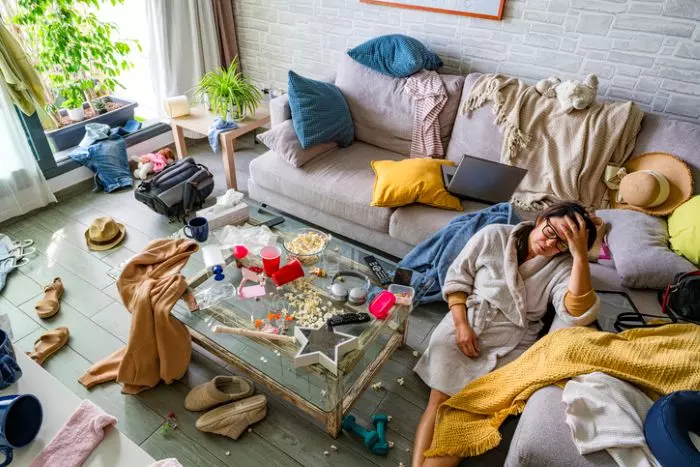
It’s draining, not only being at the beck and call of every adult and minor member of the family, but also anticipating their needs and fulfilling them even before they are voiced. For her, there are no weekends, no holidays, no retirement age. Photo; iStock
While Kumar had a delayed awakening, Chennai-based consultant clinical psychologist, Dr Vandhana (identified by first name only), explains that many times men don’t see things the way women perceive them. “I have come across this globally — even clients in the US — where women take up more responsibility. This is owing to the pattern and culture. They are given more work as they are more responsible and by default, it falls on them,” she explains.
When men participate in the domestic/care labour, it is termed as “help”. “But it is shared responsibility. That is the correct term and it should start at home,” Vandhana adds.
Observers also draw attention to how men who participate in domestic labour talk about it, expecting appreciation for it, while women carry the burden silently.
“I wouldn’t deny that when it comes to voicing out concerns, women aren’t being heard. Having said that, if a woman feels like it’s labour [too much work], she should speak up; otherwise, it may build up slowly over time and lead to burnout,” says Vandhana. “Even if we feel unheard, it’s our duty to speak out and negotiate for what we deserve.”
The feeling of being ‘unseen’ and ‘unheard’ can also end up in resentment.
Interestingly, according to the UNDP study cited earlier, government estimates place the value of women’s unpaid domestic and care work at 15 to 17 per cent of GDP. Meanwhile, India’s female labour force participation rate stands at 31.7 per cent, despite rising levels of education and skill attainment among women.
“Often, family comes at the cost of the individual’s personal desires and career ambitions. I am a single parent, so I am the only one to go to my daughter's parent-teacher meetings, but even in other cases, I’ve never seen the fathers of my daughter’s classmates come,” says Sindhu. “The parents of one of my daughter’s classmates are ophthalmologists. The mother practices part-time currently, but during the Covid pandemic, she had given up her practice for the children. She is back only part-time right now as she has the complete responsibility of the kids.”
Also read: Despite laws, why inheriting parental property remains a challenge for women
The economics and income loss owing to the pressures of unpaid labour, however, come up only when a family collapses.
“Unpaid domestic labour is the foundation on which families are built, yet it becomes one of the least considered contributions when a marriage is dissolved. This labour is structurally invisible,” says advocate Aarzu Khattar, a Delhi High Court lawyer.
She adds: “As a matrimonial litigation lawyer, I have seen how, in the home-maker’s view, they are treated as non-earning spouses. Courts have held that domestic work is a contribution to the family and matrimonial courts are moving from it being charity-based to contribution-based, taking into account the equality and dignity of women. Courts understand women often sacrifice their careers and interrupt their career leading to permanent earning disadvantages.”
In cases where it is not a mutual separation or when the spouse is unwilling to give a fair alimony, if a litigant shows the court how she lost a job opportunity owing to childcare responsibilities, she can get compensated for it accordingly, says Khattar.
Meanwhile, those who remain trapped in the ‘happy family’ or office or friendship/relationship setup, continue to daily lose a little bit more of themselves in answering the demands of her husband, children, in-laws, parents and the extended family, friends and colleagues.
For her, the indispensable workers without whom families and the very framework of our society can potentially collapse, is it enough to be feted a single day of the year, designated as International Women’s Day (March 8)?
In the video for Labour, Paloma serves food and watches a man eat his fill at a candlelit table she has set up. The video then shows her spiralling, even as she continues to smile and he laughs. And then, she is gone, her candle snuffed out.
Years of being ‘unseen’, ‘unheard’ and ‘invisible’ giving way to a deafening, impossible to unsee absence.
