- Home
- India
- World
- Premium
- THE FEDERAL SPECIAL
- Analysis
- States
- Perspective
- Videos
- Sports
- Education
- Entertainment
- Elections
- Features
- Health
- Business
- Series
- In memoriam: Sheikh Mujibur Rahman
- Bishnoi's Men
- NEET TANGLE
- Economy Series
- Earth Day
- Kashmir’s Frozen Turbulence
- India@75
- The legend of Ramjanmabhoomi
- Liberalisation@30
- How to tame a dragon
- Celebrating biodiversity
- Farm Matters
- 50 days of solitude
- Bringing Migrants Home
- Budget 2020
- Jharkhand Votes
- The Federal Investigates
- The Federal Impact
- Vanishing Sand
- Gandhi @ 150
- Andhra Today
- Field report
- Operation Gulmarg
- Pandemic @1 Mn in India
- The Federal Year-End
- The Zero Year
- Science
- Brand studio
- Newsletter
- Events

Why in Haryana’s Balali, the Phogat family home is missing its mud pit action
The Phogat sisters, trained by patriarch Mahavir Phogat, became synonymous with women's wrestling in India. Today they are spread across professions, cities and political parties. The sporting and legal battle over Vinesh Phogat's participation in the Asian Games 2026 selection trials put the family in news again. But there have also been speculations of differences within the family.

In Haryana’s Balali village a mud pit which had once birthed wrestlers of national and international repute is undergoing a quiet transformation. Overseeing the change is a man who had singlehandedly challenged traditions in this north Indian village where women in wrestling were unheard of.Himself an amateur wrestler, the man, Mahavir Singh Phogat, made a mud pit at home in the ‘90s and...
In Haryana’s Balali village a mud pit which had once birthed wrestlers of national and international repute is undergoing a quiet transformation. Overseeing the change is a man who had singlehandedly challenged traditions in this north Indian village where women in wrestling were unheard of.
Himself an amateur wrestler, the man, Mahavir Singh Phogat, made a mud pit at home in the ‘90s and went to train his daughters and nieces — Geeta, Babita, Ritu, Sangeeta, Vinesh and Priyanka — to be wrestlers. Now in his late sixties, he spends much of his time supervising the construction of a new house that is being built over the erstwhile mud pit.
The crowds that once gathered here to catch a glimpse of India's most famous wrestling family are gone, there are whispers of cracks within the family, but the Phogat name continues to be in the news.
Most recently when Vinesh Phogat, Olympian wrestler and Congress MLA from Julana, became embroiled in a sporting and legal battle over her participation in the Asian Games 2026 selection trials. Vinesh eventually lost in the trials, but the spotlight was back on the Phogats. For no news on any of the sisters is hers alone.
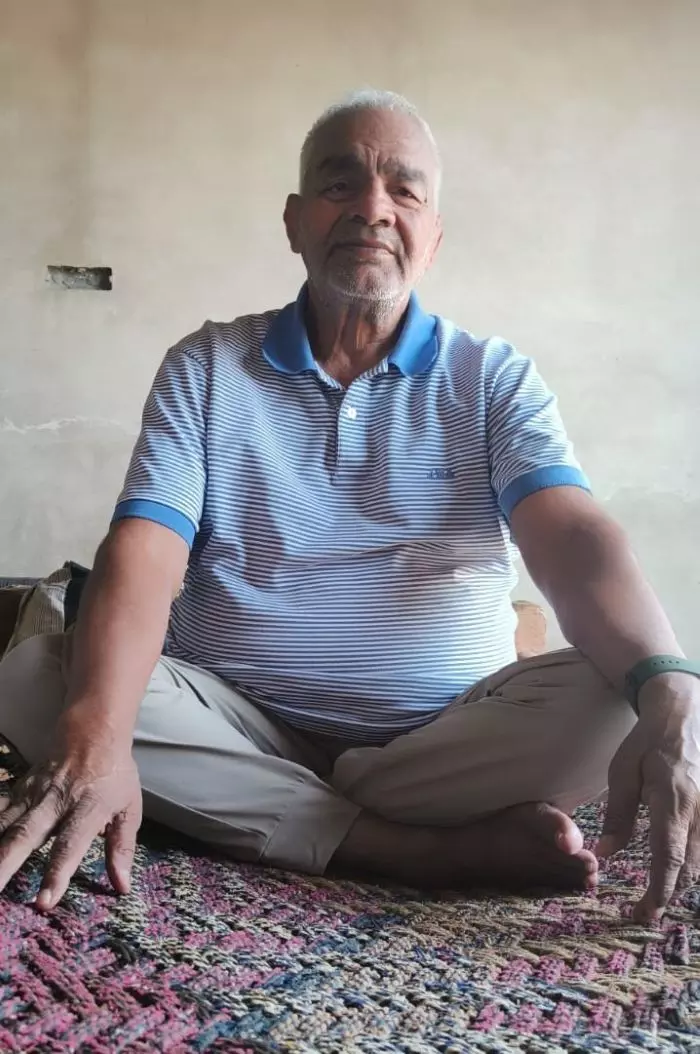
Mahavir Phogat at home in Balali. Photo: Sat Singh
While Babita had welcomed the Delhi high court order allowing Vinesh’s participation in the selections, back in Balali, Mahavir voices criticism of the Wrestling Federation of India (WFI), which had earlier barred Vinesh from participating in the trials, citing a mandatory notice period rule for athletes returning from retirement. Vinesh had been on maternity leave and was making a comeback with the event. On June 4, the Supreme Court dismissed a WFI petition against the Delhi High Court order allowing her participation, stating that it had become "infructuous because of subsequent developments”.
Talking about the issue, Mahavir says a wrestler preparing for selection trials requires complete focus and uninterrupted training. Instead, he felt Vinesh had been forced into repeated legal battles and unnecessary distractions.
The Federal has reached Ramesh Bohar, working president, WFI (Haryana) for comment. The article will be update if a response is received.
Also read: Why Google’s new AI Mode search engine is good news for users, not for businesses
The story goes that Mahavir, who himself had trained at Delhi's famous Chandgi Ram Akhara, had dreamt of making his children wrestlers and seeing at least one of them win international honours. The dream was dreamt with a son in mind, but when he and his wife were blessed with four daughters and no son, that dream underwent a slight tweak.
The rest, as they say, is history, with the Olympian coach training not one, but six champions at different levels and tournaments. The journey inspired the 2016 Aamir Khan-starrer Bollywood hit, Dangal.
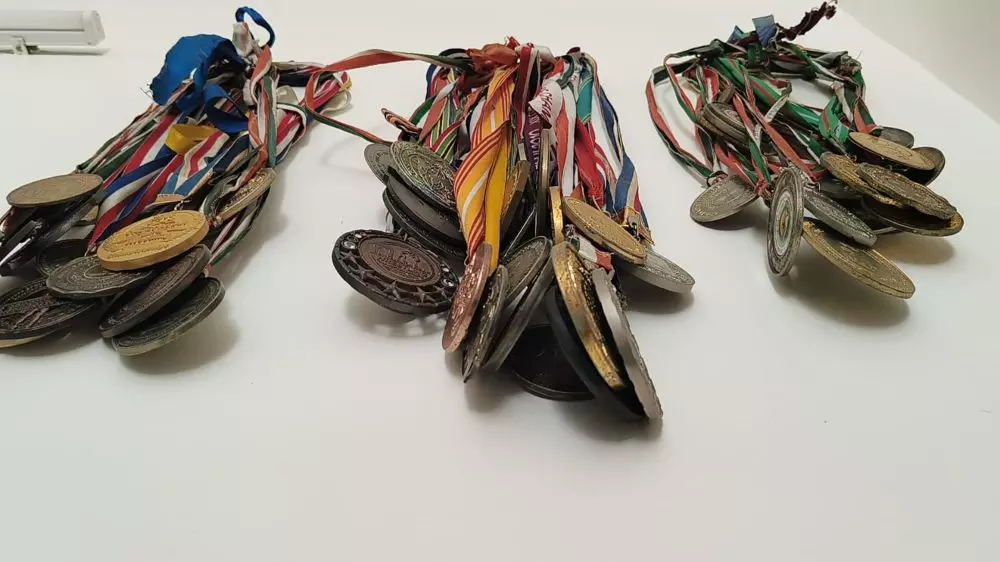
Medals won by the girls kept at the family home in Balali. Photo: Sat Singh
Looking back, Mahavir’s face assumes a far-off expression, as if travelling in time to recall those origin years.
“At the time [when he started training his daughters], only boys from the village were in wrestling. The girls were restricted to the four walls of the house and to doing household chores. A career in sports, or wrestling, was something not only unheard of for girls, but beyond imagination; it did not even exist in dreams,” says Mahavir.
He adds: “I had to make a mud pit on my farm because the girls weren’t allowed in the village akhara. People would mock Geeta-Babita for their short hair, ridicule them when they saw them running through the fields to train in their salwar-kameez.”
Over the years, the girls have learnt to make light of the opposition, though it lives on in their memory.
“The hostility towards us was far worse than what is shown in the film Dangal, but father prepared us in such a way that nothing could deter us,” says Babita.
She adds: “Geeta, our cousins and I would train with boys to prepare us to pin down our opponents quickly.”
The breakthrough came in 2010 when Geeta won a gold medal at the Commonwealth Games (CWG) in Delhi, becoming the first Indian woman wrestler to achieve the feat. Babita followed with international success of her own.
“That first medal not only proved me right, but those who would mock me for being too harsh on the girls started queuing up outside our house with their daughters, asking me to train them in my akhara. It opened doors for girls in the village and also changed the mindset of our male-dominated society,” says Mahavir.
For Daya Kaur, Mahavir’s wife, the medal seemed like an answer to the family’s prayers. Talking about her role in the sisters’ journey, she says with a laugh, “My job was to keep them well-fed, with required quantities of ghee and milk. There was never any question of getting them involved in household chores; they had to always remain focused on their training.”
Also read: Why sprinters Gurindervir and Vishal’s record-breaking runs hint at a bigger shift in Indian athleti
The family's rise also put Balali village on the sporting map.
“Newspapers in those days would be full of the skewed sex ratio when it came to news on Haryana. The Phogat sisters’ medals changed the perception regarding girls in the minds of parents as well as the picture of Haryana to outsiders,” says Dr Om Prakash, a resident of neighbouring Kalali village, who has been a witness to the journey of the Phogat family.
Adds professor Rajender Prasad Garg, an Olympic-level wrestling referee: “Chandgi Ram [a wrestler who had won a gold medal in the 1970 Asian Games] was the pioneer, who brought his daughter Sonika Kaliramana to the wrestling akhara. But back then, there was little media coverage. Geeta Phogat’s 2010 CWG victory put the spotlight on women’s wrestling in Haryana. For the media, the story of Mahavir Phogat, who trained his daughters in a village akhara without any financial support and social support, achieving such a feat, had all the necessary masala. It worked like magic and women’s wrestling also got a boost.”
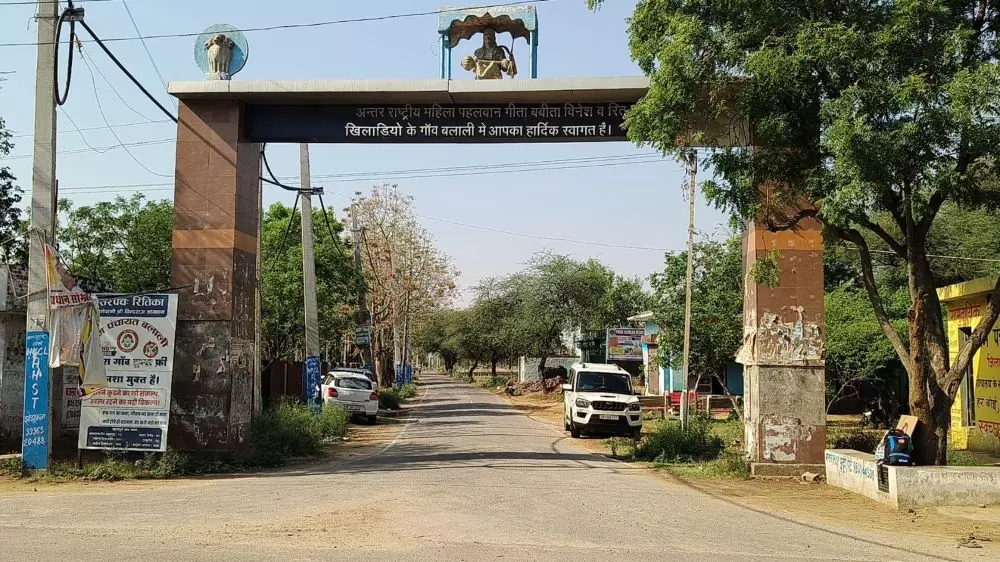
A gate at the entrance to Balali welcomes visitors to the village of sportspeople. Photo: Sat Singh
In the years since that CWG medal, Geeta has repeatedly credited her father for her win. “My father taught us to win and never to be scared of anything,” she had once said.
Following in the footsteps of Geeta and Babita, sisters Sangeeta and Ritu, along with cousins Vinesh and Priyanka Phogat, were competing at national and international levels.
Over the years, however, the family seems to have scattered, no longer bound by the tight discipline and looming influence of Mahavir.
The Phogat wrestling dynasty emerged from a large joint family. Mahavir is one of six brothers, born to Maan Singh Phogat. The eldest brother, Rajinder Phogat, worked as a teacher in Rajasthan. Krishan Phogat and Rattan Singh Phogat served in Haryana Roadways. Rajpal Singh Phogat, father of Vinesh and Priyanka, died when the girls were young. The youngest brother, Sajjan Singh Phogat, remained active in local politics and served as sarpanch of Balali village.
Following Rajpal's death, Mahavir assumed a larger role in raising and training his daughters, Vinesh and Priyanka, alongside his own daughters.
While every member of the family carved out a place in the sport, Vinesh emerged as perhaps the most successful internationally, having represented India at multiple Olympics and won medals at major international events.
But then came the wrestlers' protest of 2023.
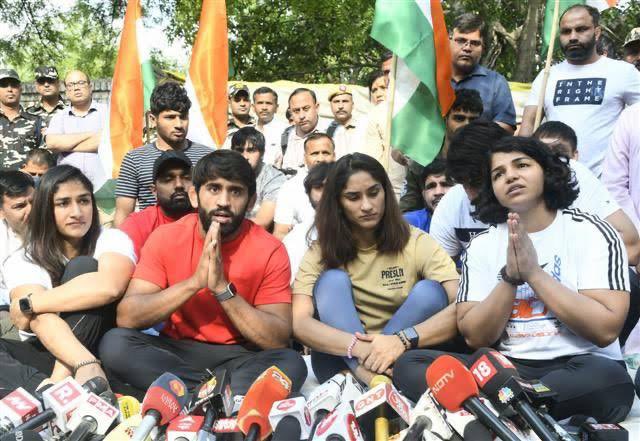
File photo of the protest.
Vinesh became one of the leading faces of the movement against former Wrestling Federation of India president Brij Bhushan Sharan Singh, whom they accused of sexual misconduct. Wrestler Bajrang Punia, who is married to Sangeeta Phogat, was also part of the protest. While initially both Geeta and Babita too had supported the protestors, Babita, a BJP leader, later accused the Congress of using the protest for political gains.
The stand was seen as a sign of a rift between the cousins. In the months following the protest, Vinesh contested the 2024 Haryana assembly elections on a Congress ticket and won from Julana.
Rahul Phogat, son of Mahavir's youngest brother Sajjan, however, denies any difference between the siblings and cousins. "All the Phogat sisters have stood for each other in all crisis situations. They share mutual respect for each other and for wrestling, they all still share the same vibes,” he insists.
The Federal has also reached Vinesh for comment. The article will be updated if a response is received.
With time, age, injury and other commitments, however, wrestling seems to have taken a backseat for most of them.
Today, the Phogat sisters are spread across different professions, cities and political affiliations.
While Vinesh is a Congress MLA, Babita remains associated with the BJP. Geeta serves as a deputy superintendent of police posted in Sonipat district. Sangeeta is married to Olympian wrestler Bajrang Punia, while Ritu has shifted from traditional wrestling to Mixed Martial Arts. Priyanka Phogat moved away from competitive wrestling following injuries.
Also read: In Odisha’s Ganjam, how the dream of a better life is taking the youth to destinations near and far
In Balali now, few hang outside the Phogat residence waiting to catch a glimpse of the sisters at practice.
There is a community wrestling academy run with state government support, but locals claim it lacks even basic infrastructure like electricity, drinking water and proper wrestling mats.
“Every girl in this village wants to become like the Phogat sisters, but the wrestling academy in the village lacks basic facilities. Most of those who are serious about the sport move outside for training. Others quit owing to non-availability of resources,” claimed a Balali resident speaking on condition of anonymity.
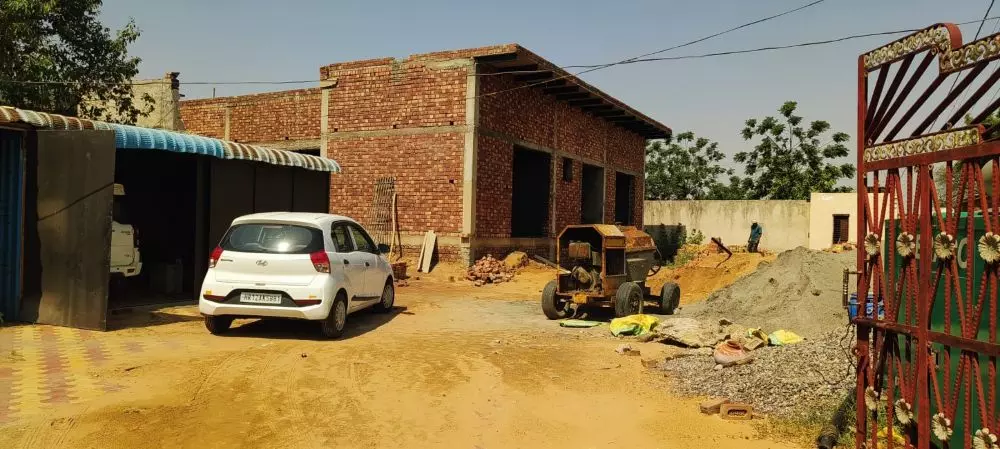
Ongoing construction at the site which used to have the mud pit to train the girls. Photo: Sat Singh
Mahavir, meanwhile, has largely stepped away from active coaching. “The youngsters I coached would either quit wrestling [because of his tough training] or quit after a small achievement. I had many wrestlers whose only goal was to secure a government job, not an Olympic medal. This is unacceptable to me. I want to dedicate my time and energy to a gold medal in the Olympics, not for getting them a government job through wrestling,” he fumes.
For a time at least, there seems to be no obvious successor in Balali to carry on the Phogat legacy. A few interested fans still travel to the village, which had scripted one of the biggest success stories in women’s sports in India in recent times. But the action here is largely missing. Replaced by the everyday scenes of the Phogat’s domestic life.