- Home
- India
- World
- Premium
- THE FEDERAL SPECIAL
- Analysis
- States
- Perspective
- Videos
- Sports
- Education
- Entertainment
- Elections
- Features
- Health
- Business
- Series
- In memoriam: Sheikh Mujibur Rahman
- Bishnoi's Men
- NEET TANGLE
- Economy Series
- Earth Day
- Kashmir’s Frozen Turbulence
- India@75
- The legend of Ramjanmabhoomi
- Liberalisation@30
- How to tame a dragon
- Celebrating biodiversity
- Farm Matters
- 50 days of solitude
- Bringing Migrants Home
- Budget 2020
- Jharkhand Votes
- The Federal Investigates
- The Federal Impact
- Vanishing Sand
- Gandhi @ 150
- Andhra Today
- Field report
- Operation Gulmarg
- Pandemic @1 Mn in India
- The Federal Year-End
- The Zero Year
- Science
- Brand studio
- Newsletter
- Elections 2024
- Events

Why DU protest ban and police action against Youth Congress leaders have libertarians concerned
The two incidents are neither identical in nature nor consequence. Yet, taken together, they reaffirm and expose the irony of a regime that is obsessed with projecting itself as self-assured and aligned with the ideals of India’s Constitution, but has no stomach for dissent, say critics.

On February 17, the Delhi University placed a blanket ban on protests, demonstrations and gatherings on campus for a month, citing administrative and security considerations. Days later, the Delhi Police began a nationwide crackdown against members of the Indian Youth Congress (IYC), the youth wing of the Congress party, for their ‘shirtless protest’ at the AI Impact Summit which concluded...
On February 17, the Delhi University placed a blanket ban on protests, demonstrations and gatherings on campus for a month, citing administrative and security considerations. Days later, the Delhi Police began a nationwide crackdown against members of the Indian Youth Congress (IYC), the youth wing of the Congress party, for their ‘shirtless protest’ at the AI Impact Summit which concluded in Delhi last week. Nearly a dozen IYC members, including the outfit’s president Uday Bhanu Chib, are currently in police remand and being probed for a “pre-planned larger conspiracy” to shame India at the global stage.
The two incidents are neither identical in nature nor consequence. Yet, taken together, they bring forth the same question that Indian libertarians have increasingly grappled with over the past 12 years of Prime Minister Narendra Modi’s regime — how much further will the space for dissent shrink in the Indian democracy?
For activist and documentary filmmaker Sohail Hashmi, seen together, the protest ban at DU and the overzealous persecution of IYC members, “covers the entire spectrum of reasons that are symptomatic of India’s democratic backsliding”.
“You want neither students nor public intellectuals to think and speak freely even at a university campus, because you are afraid that their views may not align with yours. You harass and persecute young political activists because they are affiliated with your principal rival and are questioning the Prime Minister’s decisions. You have absolute control of institutions and law enforcement agencies, which you press into service to crush any dissenting opinion and then you use this fake bogey of protecting the nation’s honour and integrity to justify the act. What this government simply does not get is that criticism of its policies, politics or the Prime Minister does not mean criticism of the country,” says Hashmi.
Banning protests and gatherings at a varsity campus or slapping absurd charges of criminal conspiracy and promoting enmity in the country against the IYC members aren’t incidents that merely serve as a reminder of India’s worsening performance on the indices of liberty, free press and freedom of speech; published annually by international bipartisan think-tanks and dismissed regularly by the Indian government as propaganda. They also expose the irony of a regime that is, on the one hand, obsessed with projecting itself as one that is self-assured, fully aligned with the ideals of India’s Constitution and unfazed by criticism, but, on the other hand, can’t stomach dissent.
Also read: Why DU’s 1-month ban on protests may not be part of ‘broader cross-campus shift against dissent’
“Over the past 12 years of Modi’s rule, if there is one message that the BJP [Bharatiya Janata Party, the main constituent of the ruling National Democratic Alliance] has relentlessly hammered into the Indian psyche aside from its ‘Hindu khatre mei hain’ pet peeve, it is that ‘sattar saal mei pehli baar’ [for the first time in 70 years] the country has a strong Prime Minister who is unafraid of taking the right but tough decisions unfazed by his critics. Yet, try to criticise anything that Modi and his government do and you will have the full force of the government come after you — the Enforcement Directorate, Central Bureau of Investigation, Income Tax, police, BJP workers, trolls, everyone. You will have cases slapped against you in every BJP-ruled state and, God forbid, if you get arrested, the courts will not grant you bail,” says Pawan Khera, chairman of the Congress party’s media department.
He adds: “This is not how democracies work; it is the result of the country being ruled by one insecure and cowardly man who is too scared to face his political rivals, critics and the media.”
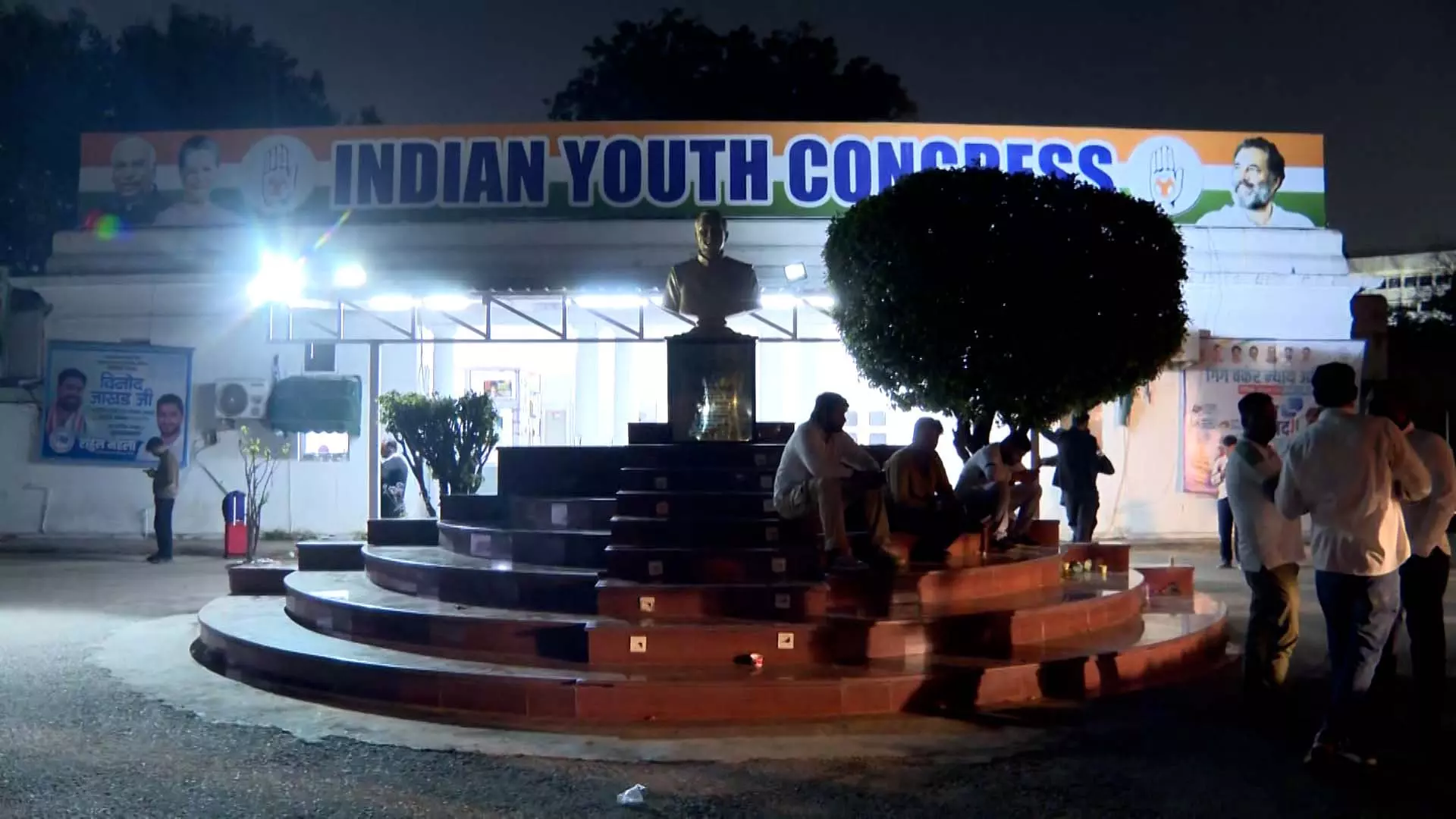
Nearly a dozen IYC members, including the outfit’s president Uday Bhanu Chib, are currently in police remand and being probed for a “pre-planned larger conspiracy” to shame India at the global stage. File Photo
Over the past decade, take any report ranking countries on various indicators of a healthy democracy and there is evident one constant pattern — that of India’s freefall on the index of free speech. Last March, India ranked 24th among 33 countries analysed by the US-based Vanderbilt University in its Future of Free Speech Index; scoring an aggregate that was only marginally better than countries such as Lebanon, Turkey, Jordan, Malaysia and India’s very own favourite punching bag for all things bad — Pakistan.
Then there was the much more exhaustive Human Freedom Index, compiled by the America-based Cato Institute and the Fraser Institute of Canada in collaboration with partner organisations and published in December 2025, which placed India at the 110th spot, down from her previous rank of 107, among 165 countries. In the personal freedom index, which was part of the same report, India’s performance was even poorer — a rank of 115 among 165 countries — with researchers noting particularly worrying concerns on markers such as rule of law, freedom of movement, freedom of religion and freedom of expression and information.
The Democracy Report, 2025, by the Swedish Varieties of Democracy (V-Dem) Institute called India an “electoral autocracy” yet again, while commenting: “India’s episode of autocratisation led to a descent into electoral autocracy. From 2015 to 2018, there was still some uncertainty about the classification of India... India declined to ‘grey zone’ electoral democracy in 2015, moved further down to ‘grey zone’ electoral autocracy in 2017, and descended to confirmed electoral autocracy by 2019, after which there is no uncertainty about India’s regime type.”
That the Centre had deployed its most garrulous ministers and BJP spokespersons to diss the Democracy Report and a pliant mainstream media obediently ignored the damning conclusions only reaffirmed what the V-Dem researchers had concluded – that “among the worst offenders of freedom of the media are Afghanistan, El Salvador, India, and Myanmar”. The report had also noted, “Self-censorship among journalists when reporting on politically sensitive issues is becoming more common” in countries like India, Burundi and Nicaragua.
Noting that democracy had “broken down” in India, the V-Dem report said, “The ruling anti-pluralist, Hindu-nationalist Bharatiya Janata Party (BJP) and Prime Minister Modi’s derailing of democracy is thoroughly documented, including deteriorations in freedom of expression and independence of the media, harassments of journalists critical of the government, attacks on civil society and the Opposition using laws on sedition, defamation, and counterterrorism.”
The government’s standard response to any of these annual reminders from overseas bipartisan think-tanks has been that these are either “motivated” by vested interests or are simply “misleading”. In 2024, the Centre had even indicated its intent to come up with its own democracy rankings, but these have yet to see the light of day. Perhaps, the democracy auditors the government had in mind were found wanting; failing to match up to the lofty standards that the Centre has set in departments that compute India’s performance on subjects such as the GDP, employment, poverty, and so on and routinely come up with flattering figures that are hard to reconcile with the lived experiences of real people.
The Prime Minister can dub India the “mother of democracy” ad nauseam but it is impossible to reconcile the claim with reality when you see campuses across the country embroiled in unrest, Opposition leaders routinely targeted by central investigative agencies (and allowed to go scot-free after defecting to the BJP), the judiciary more committed to the Executive than to the Constitution and the mainstream media reduced to a BJP echo chamber.
Also read: A decade after the 2016 event which saw JNU being branded ‘anti-national’, what's changed on campus
“What democracy are we even talking about? Article 19(1)(a) and 19(1)(b) guarantee the right to free speech and assembly; the right to freedom of religion is enshrined in the very basic structure of the Constitution and the Constitution recognises the right to equality before the law. Can anyone, including our honourable judges in the Supreme Court, today place their hands on the Constitution and say that these rights or any other fundamental right guaranteed by the Constitution is being upheld without any discrimination,” asks Anas Tanwir, a Supreme Court lawyer and founder of the Indian Civil Liberties Union (ICLU).
Tanwir adds: “Every other day you have examples from across the country of Muslims being terrorised by the BJP; sometimes even by the party’s Union ministers and MPs. Students and scholars who ask tough questions of the government or simply ask for their rights under the Constitution to be protected get jailed for non-bailable offences under draconian laws like the UAPA and the courts tacitly endorse such persecution by denying bail to the accused even when there has been no new material brought on record in such cases for over five years.”
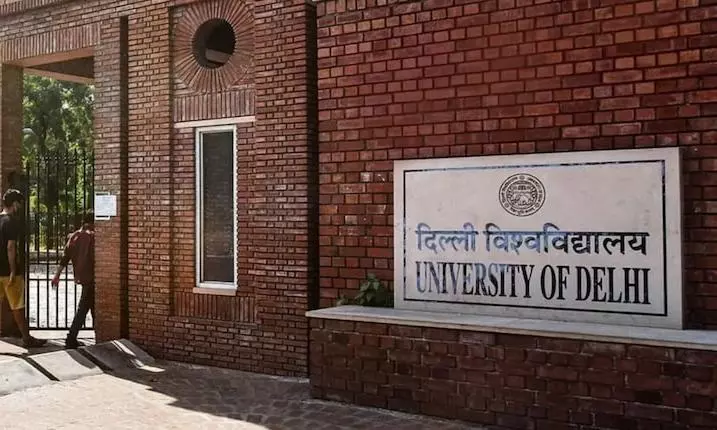
On February 17, the Delhi University placed a blanket ban on protests, demonstrations and gatherings on campus for a month, citing administrative and security considerations. File photo
The lawyer cites the example of Umar Khalid and Sharjeel Imam, who have been in custody since 2020 for alleged links to the 2020 Delhi riots, triggered by protests against the Citizenship Amendment Act (CAA). The Supreme Court last month denied bail to the two.
“When the Opposition, whose description itself says to oppose, protests against the government’s decisions, their leaders are also slapped with a variety of cases (sic)... I understand that the Constitution places ‘reasonable restrictions’ on free speech, but what we have been witnessing since 2014 is a democracy being run on unreasonable restrictions,” alleges Tanwir.
Senior advocate Dushyant Dave, who quit his legal practice last year, while lamenting the state of both the Indian democracy and the goings-on in the judiciary, had once remarked that “democracy cannot function if dissent is labelled anti-national”.
However, over the past decade, “anti-national” has become central to India’s political lexicon, with the government and its cheerleaders stridently dubbing any criticism of government policy as being inimical to national interest. The Opposition, whose job it is to raise these issues in Parliament, has been painted with the same brush, with the Lok Sabha’s Leader of Opposition Rahul Gandhi routinely accused by the BJP of “colluding with anti-India forces” to “destabilise the country”.
Also read: 10 years of Constitution Day: Why it risks becoming a masking ritual for a backsliding democracy
For retired Supreme Court judge, Justice Deepak Gupta, though, “there can be nothing more anti-national in a democracy than eliminating the space for dissent”.
Meanwhile, even as this report is being submitted for publication, a posse of Delhi police personnel have descended at the Jawaharlal Nehru University (JNU) campus to crack down against students demanding, among other things, implementation of the University Grants Commission’s Equity Regulations, 2026. Hail Democracy! RIP Dissent.