



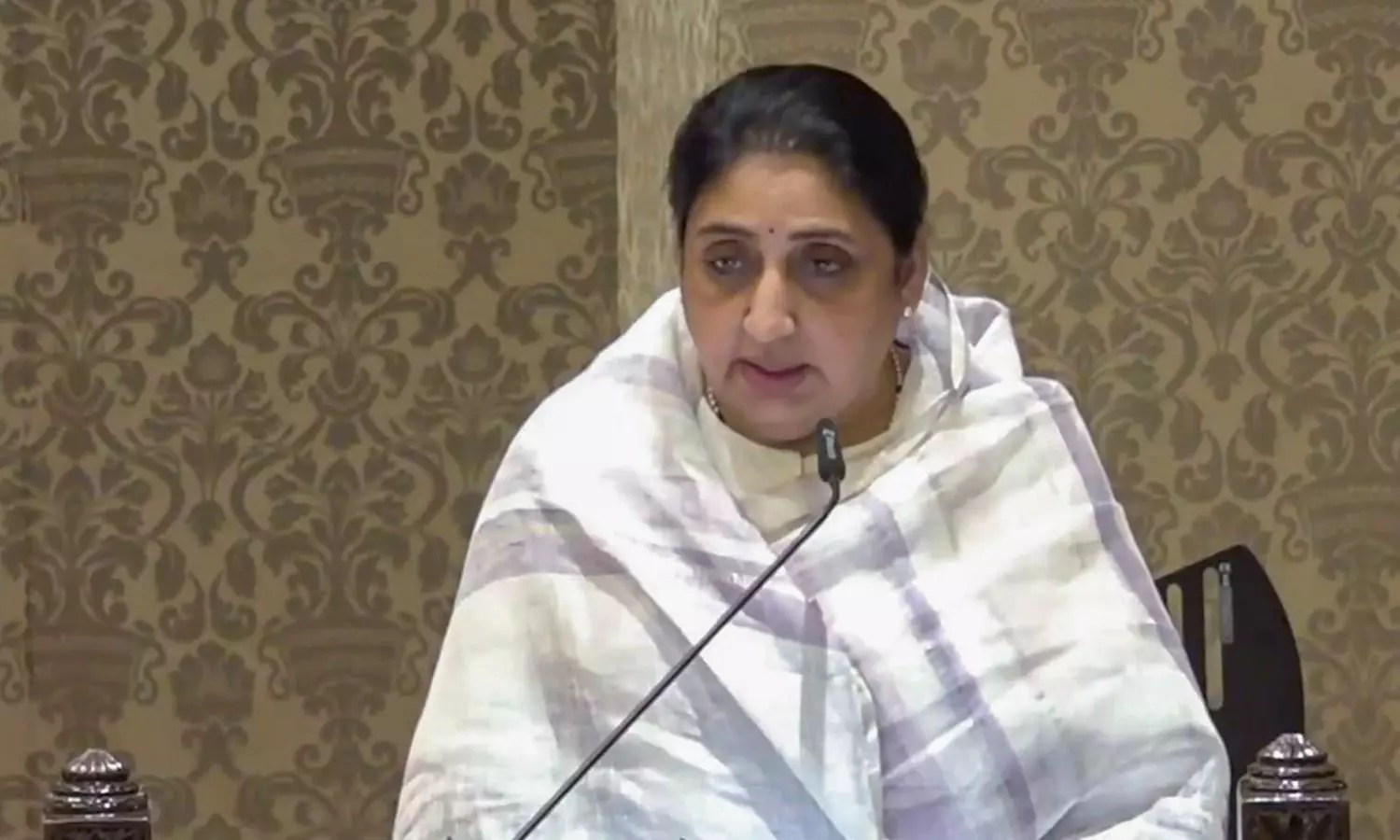
Rajya Sabha MP Sunetra Pawar, wife of late NCP chief Ajit Pawar, takes oath as Maharashtra's first woman Deputy Chief Minister during a ceremony at Lok Bhavan, in Mumbai, on Saturday (January 31). (Screengrab/@SunetraA_Pawar/X via PTI Photo)
Who is Sunetra Pawar, NCP’s new Deputy CM in Maharashtra?
From a late entry into electoral politics to the Rajya Sabha and now the deputy CM’s post, tracing Sunetra Pawar’s political journey

Nationalist Congress Party (NCP) leader and Rajya Sabha MP Sunetra Pawar on Saturday (January 31) took oath as the first woman Deputy Chief Minister of Maharashtra.
Earlier in the day, she was unanimously elected as the leader of the NCP legislature party, three days after the death of her husband and Deputy Chief Minister Ajit Pawar.
Also read | Baramati talks, Mumbai moves: NCP factions diverge over Sunetra Pawar’s elevation
Sunetra's name as the NCP's legislature party leader was proposed by senior leader Dilip Walse Patil and seconded by Food and Civil Supplies Minister Chhagan Bhujbal.
She was elected during a meeting of the party's legislature wing, held at the office of late Ajit on the ground floor of the Vidhan Bhavan complex in south Mumbai.
Reunification versus control
Speaking to The Federal, political analyst Abhay Deshpande said the Sharad Pawar-led NCP had been pushing for reunification, but the sudden elevation of Sunetra reflected the Ajit camp’s urgency to retain control of the party, as a merger could have diluted its influence, an outcome the faction was unwilling to risk.
He added that from the BJP’s perspective, dealing with the Ajit faction is far more manageable than engaging with a reunited NCP under the leadership of party patriarch Sharad Pawar.
According to Deshpande, the dynamics were different when Ajit was alive, as he was the undisputed leader and would likely have retained that position even after a merger of the two factions. “That equation has now changed,” he said.
On Sunetra’s elevation as deputy chief minister, Deshpande noted that while she may not command the same stature as Ajit, she represented the only viable option for keeping the party intact. On the question of reunification, he said the Sharad camp remains keen, but leaders such as Praful Patel in the Ajit faction show little enthusiasm for such a move.
Expanding footprints in politics
Sunetra stepped into active politics later than many in her family. In 2024, she contested the Baramati Lok Sabha seat, long a Pawar stronghold, but lost to her sister-in-law Supriya Sule of the rival NCP (SP). Despite the defeat, the campaign established her as a prominent political figure.
Soon after, she was elected unopposed to the Rajya Sabha, replacing Praful and consolidating her presence in both state and national politics. According to data from the Rajya Sabha website and PRS Legislative Research, her parliamentary record offers an insight into her engagement. She has so far raised 126 questions, well above the national average of 92, largely centred on practical concerns such as agriculture, conservation of the Western Ghats, railway projects, and preparations for the 2027 Nashik Kumbh Mela.
Roots in public life
Born in 1963 in Dharashiv (formerly Osmanabad), Sunetra’s association with public life began well before her marriage into the Pawar family. Her father, Bajirao Patil, was a senior regional leader, while her brother Padamsinh Bajirao Patil was an influential presence in district politics in the 1980s. She was raised in an environment where political and public engagement were a regular part of daily life.
Also read | Will back any move on Sunetra Pawar if family, party agree, says Fadnavis
A commerce graduate from SB College in Aurangabad, Sunetra went on to play a key role in managing large industrial initiatives, including the Baramati High-Tech Textile Park, where she was involved in decision-making related to production, investment, employment generation, and women’s empowerment.
Known for her clean image, she has often been seen involved in social service activities. According to information on her website, she founded the Environmental Forum of India (EFOI), under which she played a key role in transforming Katewadi village into India's first ‘eco village’, a model for water conservation and solar energy. Her role in education is equally significant, as she serves as a trustee of Vidya Pratishthan, an institution that caters to tens of thousands of students.