



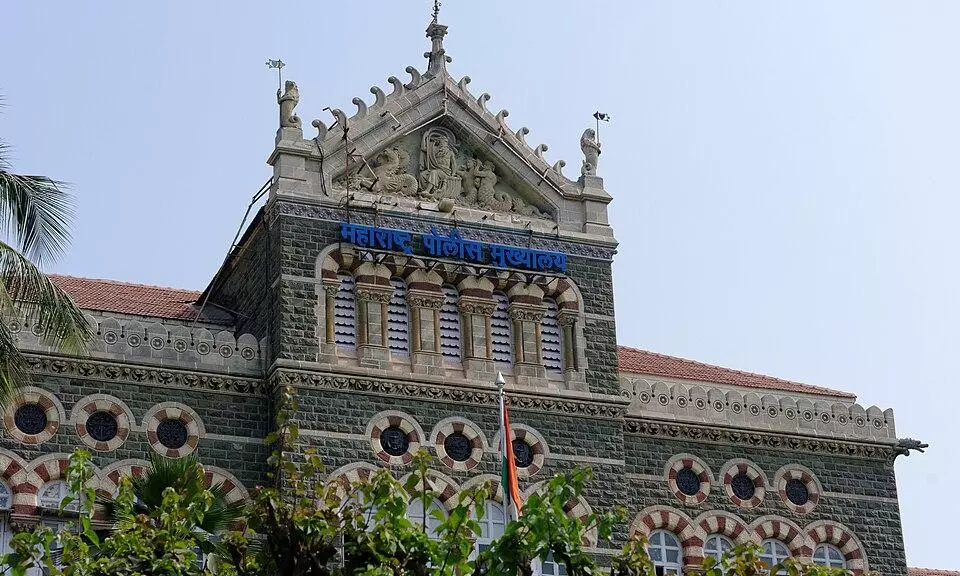
The alleged racket was detected during an internal audit by the Mumbai Police's North Regional Division. Representative image of Maharashtra police headquarters: Wikimedia commons
Mumbai Police payroll scam: Rs 6.41 crore paid to 10 'ghost' employees over two years
Five former administrative staff have been booked, two suspended, as investigators trace the bank accounts that received the fraudulent salary payments

A major payroll fraud involving the Mumbai Police has come to light, with officials uncovering a Rs 6.41-crore scam in which salaries were allegedly disbursed to 10 ‘ghost’ employees over two years. The fraud, dating back to 2019-20, surfaced during the migration of payroll records from the old Sevaarth salary portal to the state's new Integrated Financial Management Information System (IFMIS).
The alleged racket was detected during an internal audit by the Mumbai Police's North Regional Division, which found that the beneficiaries existed only on paper despite drawing regular salaries and arrears.
How the scam worked
According to the FIR, ministerial-level staff allegedly manipulated attendance records, forged official documents and created fake Service IDs and Defined Contribution Pension Scheme (DCPS) accounts to insert the ‘ghost employees’ into the payroll system. Monthly salaries were then credited into bank accounts linked to these fabricated identities.
Also read: Top 6 scams that have rocked Bihar and its elections over the decades
The 10 fictitious names listed in the FIR are Ramdas Bhogle, Sudhakar Kadam, Sarju Yadav, Bhagwat Bhosale, Gunaji Khavkar, Mahadev Haldankar, Rajendra Sonar, Uttam Thorat, Suryakant Patil and Pandurang Kadam.
Police said the unauthorised salary payments were largely made during two periods —between December 2019 and February 2020, and again from June to September 2020.
Case registered, officers suspended
A case has been registered at Samta Nagar Police Station against five former administrative staff members under provisions of the Bharatiya Nyaya Sanhita (BNS) related to cheating, forgery, criminal breach of trust and criminal conspiracy.
Those named in the FIR include former administrative officers Ramkishan Goswami, Nagesh Talvadekar and Vijaya Chavan, along with Head Clerk Ajay Rathod and Senior Clerk Amol Meshram.
Following the probe, the Mumbai Police suspended Office Superintendent Vijaya Ashok Chavan and Senior Clerk Amol Meshram. The suspended officials have been barred from leaving the Brihanmumbai limits without prior permission, prohibited from taking up private employment or business, and directed to regularly report their status while drawing subsistence allowance.
Also read: Ladki Bahin scheme scam: 'Biggest bribe paid in history of Maharashtra'
Investigators are now tracing the bank accounts used to receive the fraudulent salary payments and conducting a forensic financial audit to identify the individuals who ultimately controlled the siphoned funds.
Similar cases
This is not an isolate case. Officials said the migration to the IFMIS platform has also flagged similar, though smaller, payroll irregularities in Maharashtra's Dhule and Latur districts, prompting a broader review of salary processing systems across the state.
In another case highlighting systemic loopholes, a police constable from Madhya Pradesh's Vidisha district allegedly received nearly Rs 28 lakh in salary over 12 years despite never reporting for duty or completing police training.
Also read: Maharashtra govt employee loses Rs 1.9 lakh to WhatsApp wedding card scam
According to officials, administrative lapses and manipulated attendance records continuously marked the constable as being "on duty" between 2012 and 2023. The irregularity surfaced only during a comprehensive departmental records review.
Separately, an Aadhaar-linked forensic audit undertaken by the Maharashtra government has reportedly identified more than 7,000 suspected "ghost employees" across various government departments, local bodies and public sector organisations.