Save Aravallis: Why Gujarat activists are wary despite govt assurances
The BJP govt has always been pro-industry and pro-mining at the cost of the livelihood of tribals, says AAP leader Vasava

Even after the Union government imposed a complete ban on new mining leases across the Aravalli Range following days of protest over a revised definition of the hills, campaigners remain unconvinced.
Activists behind the ‘Save Aravalli’ movement in Gujarat fear the changes could still undermine the fragile ecology of one of the world’s oldest mountain systems. The range, which extends from Delhi to Gujarat, covers the latter's Sabarkantha, Patan, Mehsana, Aravalli and Banaskantha districts.
Also read: Aravallis controversy: PM Modi doesn’t walk the talk, says Congress
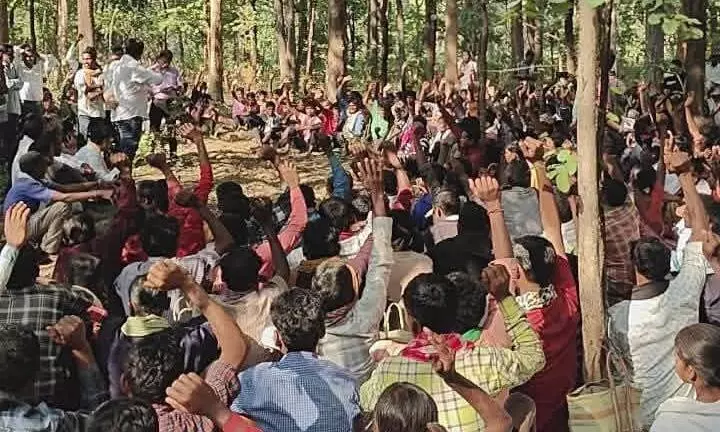
Earlier this week, the campaign reached the state capital, Gandhinagar, where people from diverse groups came together to meet Gujarat’s Forest and Environment Minister Arjun Modhwadia. The volunteers included people from the neighbouring Rajasthan.
Devotees, priests, tribals converge
Among those who gathered to express concerns over the hills’ well-being were priests and devotees of the twin temples of Menal in Rajasthan — Mahanaleshwar and Suhaveshwar — that are located in the lap of the Aravallis; members and supporters of Dhamma Aravalli, a centre for Vipassana meditation in the Aravalli district of Gujarat; priests from the Dr Paulos Mar Gregorios Retreat Centre, a centre for spiritual solace affiliated with Christianity in the Aravallis; devotees of the Shamlaji Temple located on the border of Gujarat and Rajasthan where the Aravalli Range enters Gujarat, and tribal activists led by AAP MLA from Dediapada, Chaitar Vasava.
After meeting the protesters, Modhwadia told the media that the Gujarat government has not permitted anyone to carry out mining in the Aravallis and its forest areas. “Our government would never agree to this,” he said.
Also read: Modi govt has 'nearly signed death warrant' for Aravalli hills: Sonia Gandhi
His clarification came a day after Vasava, a tribal leader, accused the BJP-led government at the Centre of rolling out a red carpet for the mining mafia and inviting them to mine in the Aravallis by altering the definition of 'mountain ranges'.
Complete prohibition
On Thursday (December 25), the state government reaffirmed the minister's promise and emphasised that mining will be completely prohibited in the core and inviolate zones across the eco-sensitive zones, reserve areas, wetlands, and CAMPA (Compensatory Afforestation Fund Management and Planning Authority) plantation sites across Gujarat.
Meanwhile, the Union government issued an order protecting the Aravallis and banning new mining leases in the ecologically sensitive region.
While assurances came from the governments led by the BJP at both the Centre and state on securing the Aravallis’ future, the reactions among the protesters were mixed.
Also read: Congress accuses Centre of pushing ‘flawed’ Aravalli redefinition
Rev Father Thomas Maveli, one of the activists, called the Union government’s move a welcome one, saying the hills are not only significant due to ecological reasons but also because they are home to religious institutions and spiritual centres.
“The Supreme Court order threatened the existence of these institutions as well which have been here for many years,” he told The Federal, referring to the apex court’s acceptance of the recommendations of a committee under the Union Environment Ministry on the definition of mountain ranges.
AAP leader not convinced
Vasava was not among those who felt assured by the government’s new order. “The BJP government has always been pro-industry and pro-mining at the cost of the livelihood of the tribals. This is just another instance of anti-tribal policy of the government," he told The Federal.
"Owing to a nationwide protest, the decision has been withdrawn for now but we aren’t fooled by it. How long till the government comes up with another new law or decision in favour of mining and industry in areas that have been home to tribals for ages?” he added.
Also read: No tampering with Aravallis to be allowed, warns Rajasthan CM Bhajan Lal Sharma
The AAP leader had been organising protests across Sabarkantha and Aravalli districts since Tuesday on the issue.
The Aravalli Hills are home to tribal communities such as the Bhils, Meenas, and Garasias, who live across districts along the range between Rajasthan and Gujarat.
'Matter put to rest for now'
“The matter has been put to rest for now, but it hardly assures us. The Aravalli Range has been under judicial scanner since 1985, with environmentalists demanding stricter rules against mining activities while parties with vested interests eyeing a fortune in mining across the Aravalli range from Delhi to Gujarat,” Rohit Prajapati, an environmentalist who was part of the protests, told The Federal.
Also read: No mining relaxation, 90 pc of Aravallis to stay protected: Bhupender Yadav
“Apart from being home to rich flora and fauna, the Aravalli Hills are the source of both the Sabarmati and Meshwo rivers. It acts as a natural barrier and stops the Thar Desert from extending beyond North Gujarat. The hill range also blocks the hot desert winds from entering central Gujarat.
"Districts across central Gujarat, like Sabarkantha and Aravalli, that are dominated by tribals will suffer the most if the hills below 100 meters were ever removed,” he added.
Several legal cases
There have been several legal cases related to unchecked mining in the Aravalli range by various NGOs since the early 1990s. One most significant of them were filed by Alwar-based NGO Tarun Bharat in 1990 that challenged the limestone mining and falling groundwater levels around the Sariska National Park in Rajasthan.
After the apex court ruled in favour of the NGO and the Union government brought in the Aravalli Notification in 1992, which was one of the first guidelines for the protection of the Aravallis and for restraining unchecked mining. The same year, the Union government formally defined the Aravalli range for the first time.
“In 1992, the government defined the Aravalli range by its terrain, land type and kind of vegetation and not its elevation. The entire range was demarcated in three categories based on the above criteria – gair mumkin pahad (uncultivable hilly land), banjan beed (uncultivable common land) and rundh (forested or protected land),” Parajapati told The Federal.