



Widening revenue deficit, growing debt: TVK white paper signals TN fiscal crisis
Finance minister warns state can’t meet daily expenses from revenue; debt at 28.3 pc of GSDP, highest among peers, with PSU losses deepening fiscal stress

Tamil Nadu Finance Minister N Marie Wilson has sounded an alarm on the state’s finances, noting that the government can no longer meet its daily expenses using ordinary revenue.
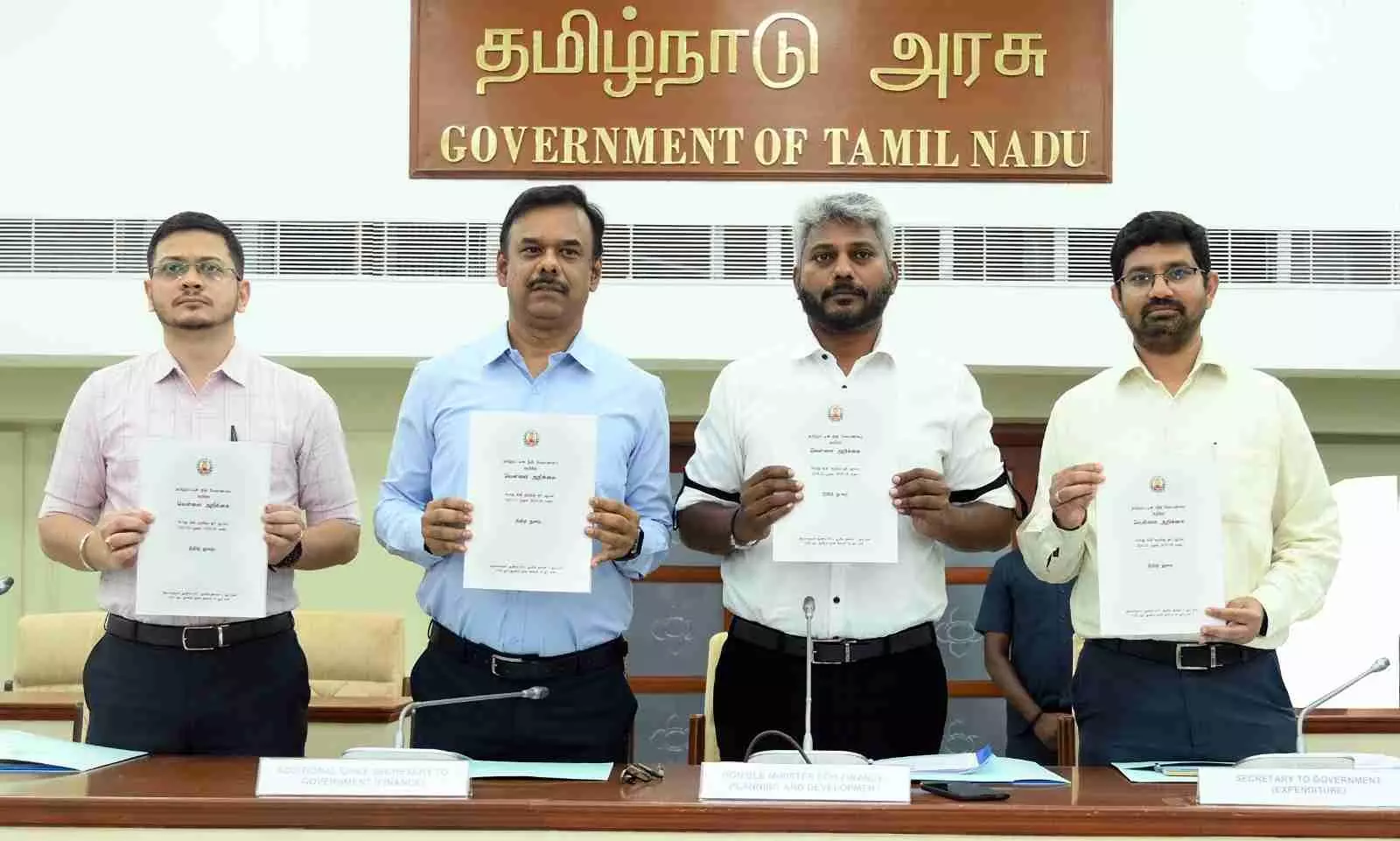
The state’s revenue deficit has widened sharply and its debt burden has climbed to 28.3 per cent of its Gross State Domestic Product (GSDP), according to a white paper released by the newly elected TVK government on Tuesday (June 16).
A revenue deficit means the government is borrowing even to pay for its everyday expenses. Persistent revenue deficit is seen as a sign of fiscal stress because it leaves less room for productive investment. The government has argued that years of rising borrowings and slowing revenue growth have weakened the state’s fiscal position.
Debt burden highest among comparable states
The white paper, released by Wilson, fulfils a commitment made by Chief Minister C Joseph Vijay during his oath-taking ceremony last month to place the state’s finances before the public ahead of major policy initiatives.
Also read: TN govt raises farmer crop loan waiver limit to ₹75,000 after widespread protests
According to the document, Tamil Nadu’s outstanding liabilities stood at about Rs 10 lakh crore in 2025-26, equivalent to 28.3 per cent of GSDP, the highest among comparable southern and western states, including Karnataka, Maharashtra and Gujarat.
The state’s fiscal deficit stood at 3.8 per cent of GSDP in 2025-26, above the 3 per cent ceiling prescribed under fiscal responsibility norms. The revenue account deficit was estimated at a historic high of Rs 78,324 crore or 2.2 per cent of GSDP, compared with 0.8 per cent for Karnataka, 0.7 per cent for Maharashtra, and a surplus of 0.8 per cent for Gujarat.
Weakened revenue position
The report said Tamil Nadu’s broader debt obligation rises to Rs 13.18 lakh crore when liabilities of public sector undertakings and other off-budget obligations are included. It estimated outstanding debt of state-owned enterprises at Rs 3.18 lakh crore as of March 2026, with the power sector accounting for the largest share.
The white paper said the state’s revenue position had weakened over the past five years. Revenue receipts as a share of GSDP fell to 8.32 per cent in 2025-26 from nearly 10 per cent in 2021-22. It attributed part of the decline to slower growth in transfers from the Centre and a reduction in Tamil Nadu’s share in central tax devolution over successive Finance Commission awards.
Increasing burden of debt servicing
Tamil Nadu’s share in the divisible pool fell to 4.097 per cent under the latest Finance Commission from 6.64 per cent under the 10th Finance Commission, according to the document.
Also read: Is Tamil Nadu losing investments to Andhra? Here are facts behind project claims
Debt servicing has become an increasing burden on state finances, the report said. Interest payments are projected at about Rs 67,050 crore in 2025-26, up from Rs 38,740 crore in 2021-22. Interest payments alone account for 22.8 per cent of total revenue receipts, significantly higher than peer states.
Salaries, pensions and interest payments together amount to Rs 1.89 lakh crore, or 64.4 per cent of revenue receipts, leaving limited room for discretionary spending.
State-owned entities under financial stress
The government also highlighted financial stress among state-owned entities. Tamil Nadu’s power utilities have accumulated debt of Rs 2.47 lakh crore and losses of Rs 1.82 lakh crore, while state transport corporations have accumulated losses of Rs 72,667 crore. The white paper said government guarantees had nearly tripled to Rs 1.8 lakh crore over the past five years.
Also read: TN will create transparent, policy-driven environment for energy investors: Minister
The TVK government said the white paper was intended to provide an assessment of the fiscal position inherited from the previous DMK administration. The DMK had previously argued that its borrowing programme remained within Finance Commission limits and was necessary to fund welfare programmes and infrastructure investments.