



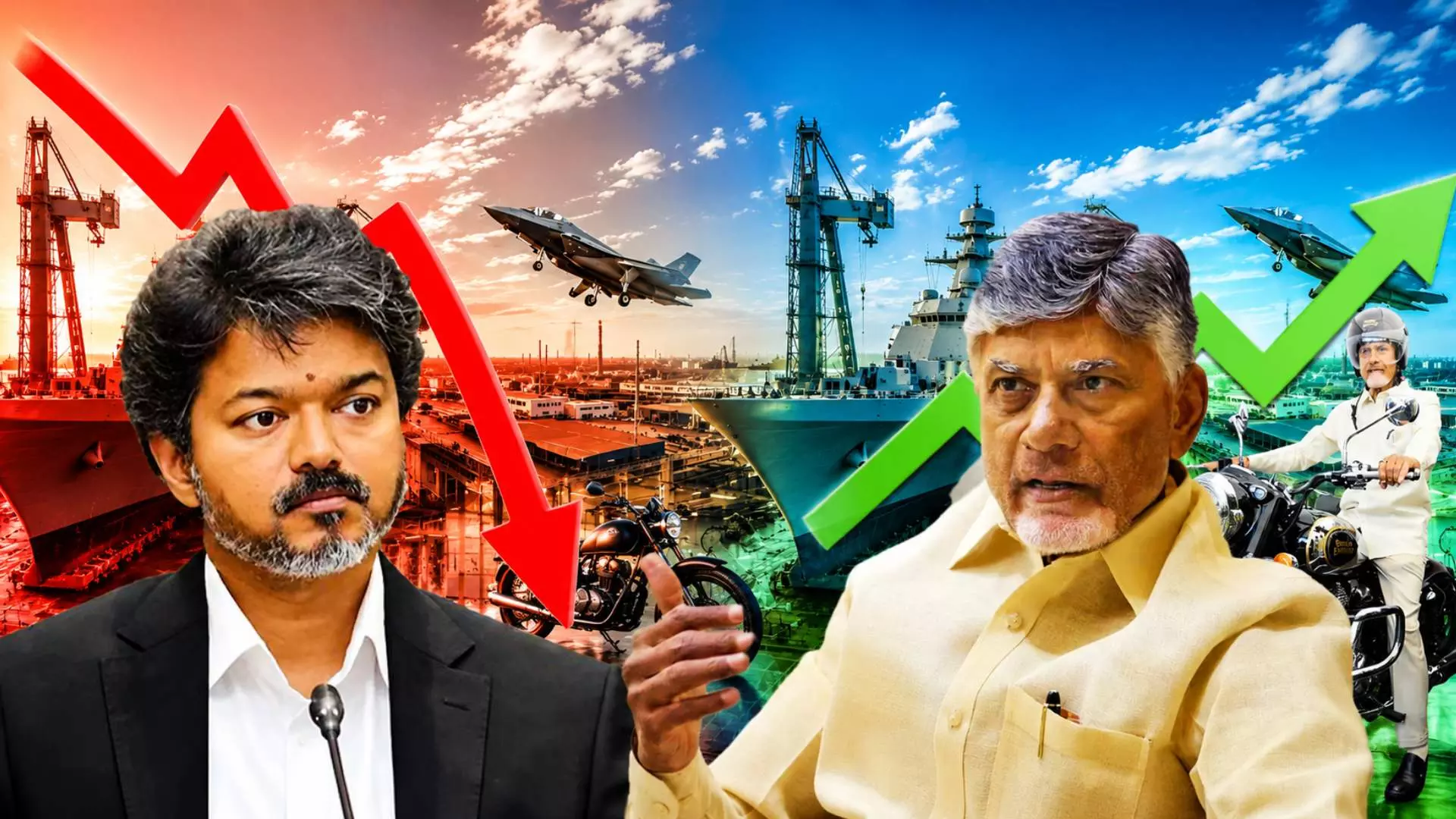
Is Tamil Nadu losing investments to Andhra? Here are facts behind project claims
Opposition alleges Tamil Nadu lost major projects after TVK came to power

The Opposition in Tamil Nadu has accused the government led by actor-turned-politician C Joseph Vijay and his Tamilaga Vettri Kazhagam (TVK) of failing to retain major industrial investments, claiming that several high-value projects have shifted to Andhra Pradesh within weeks of the new administration taking office.
However, officials in the Tamil Nadu Industries Department have rejected these allegations, arguing that most of the projects cited by the Opposition were committed to Andhra Pradesh months or even years before the change of government in Tamil Nadu.
Also read: Royal Enfield’s Andhra investment sparks debate over TN’s industrial strength
The debate has sparked a political war of words over industrial growth, investment attraction and the state's ability to compete with neighbouring Andhra Pradesh for large-scale projects.
Claim versus reality
Vijay assumed office as Chief Minister on May 10, 2026, after the Assembly elections. Since then, Opposition parties have claimed that Tamil Nadu has witnessed an exodus of industrial investments to Andhra Pradesh.
A closer look at the timelines of the projects in question, however, suggests that many of these investments were already earmarked for Andhra Pradesh long before the new government took charge in Chennai.
Also read: Vijay govt 1-month report card: Coalition stability offset by fiscal strains | Interview
The Tamil Nadu Industries Department maintains that several of the projects now being highlighted as "lost opportunities" were never under active consideration for Tamil Nadu in the first place.
Project timelines
The first project under scrutiny is the Agneyastra Energetics project, valued at Rs 1,500 crore. According to officials, the Andhra Pradesh government signed a Memorandum of Understanding (MoU) for the project on September 4, 2025. The project was subsequently inaugurated in Andhra Pradesh on May 15, 2026.
Officials contend that Tamil Nadu was never in contention as a location for the project.
The second project frequently cited by critics is the Reliance Solar Battery project worth Rs 56,300 crore. The MoU for this investment was signed with the Andhra Pradesh government on November 14, 2025.
Also read: TN CM Vijay makes strong pitch for funds and projects, backs cooperative federalism
The Andhra Pradesh government approved the project on May 6, 2026 — four days before Vijay assumed office as Chief Minister.
Royal Enfield project
Another project highlighted in the controversy is the Adani pumped storage hydro project, estimated at Rs 12,000 crore.
The MoU for this project was signed with the Andhra Pradesh government on May 23, 2022. Final approval came on May 20, 2026.
Industry officials point out that the project had been in the pipeline for nearly four years and that the timing of the final clearance should not be interpreted as evidence of an investment shift from Tamil Nadu.
Also read: Aavin denies Green Magic Milk discontinuation
Similarly, Royal Enfield's proposed expansion, worth more than Rs 2,200 crore, received Andhra Pradesh government's approval for a large land parcel on May 6, 2026. An MoU was subsequently signed on May 18.
Officials describe the project as a strategic expansion that had been planned in Andhra Pradesh from the outset.
Older commitments
Apollo Tyres' expansion project, estimated at Rs 5,000 crore, is another case cited in the debate.
Records indicate that the original MoU was signed in 2016, while approval for the expansion layout was granted in February 2026.
This approval was secured before the Tamil Nadu Assembly election process had concluded, making it difficult to link the project to the political transition in the state.
The same argument applies to the Google investment in Visakhapatnam and the Green Energy Wave project.
Google signed an MoU worth Rs 1.5 lakh crore with the Andhra Pradesh government in April 2025, while Green Energy Wave entered into an MoU worth Rs 2 lakh crore in 2024.
Both projects, according to officials, were committed well before the formation of the new government in Tamil Nadu.
Mazagon issue
One project that appears to have a stronger connection to Tamil Nadu is the proposed Mazagon Dock Shipyard investment.
The DMK government had signed an agreement for the proposed Rs 15,000-18,000 crore shipbuilding project in Thoothukudi in September 2025.
However, the project reportedly faced hurdles, including delays in land allocation, the absence of an Expression of Interest (EoI), and allegations that preference was being shown to a foreign player, Hyundai.
The project eventually moved to Andhra Pradesh, raising questions about administrative delays and decision-making during the previous regime.
DRDO controversy
The Defence Research and Development Organisation (DRDO) project has also become a point of contention.
According to claims made in the ongoing political debate, DRDO sought land for a defence aircraft-related project in 2023.
The allegation is that the then DMK government failed to provide the required land within the stipulated timeframe.
On May 6, 2026, Andhra Pradesh reportedly allocated 600 acres for the project and secured the investment.
Sources indicate that several states were competing for the project and that Andhra Pradesh succeeded because it moved quickly to meet the land requirement.
What next?
While the Opposition continues to attack the TVK government over the alleged loss of investments, officials argue that the available timelines do not support the narrative that projects began leaving Tamil Nadu after Vijay assumed office.
The new government has pointed to its own early investment efforts, including a Rs 18,600 crore agreement signed with engineering major Larsen & Toubro.
The broader question, however, is why Andhra Pradesh has been able to attract such a large number of industrial investments in recent years.
Industry observers point to a combination of faster clearances, readily available land, policy continuity, aggressive incentives and strong coordination with the Union government under Chief Minister N Chandrababu Naidu's administration.
The state's emphasis on execution speed and ease of doing business has emerged as a major selling point for investors.
As political accusations continue to fly, the focus will increasingly shift to whether the Vijay government can attract fresh investments and demonstrate its own industrial strategy in the months ahead.
(The content above has been transcribed from video using a fine-tuned AI model. To ensure accuracy, quality, and editorial integrity, we employ a Human-In-The-Loop (HITL) process. While AI assists in creating the initial draft, our experienced editorial team carefully reviews, edits, and refines the content before publication. At The Federal, we combine the efficiency of AI with the expertise of human editors to deliver reliable and insightful journalism.)
