







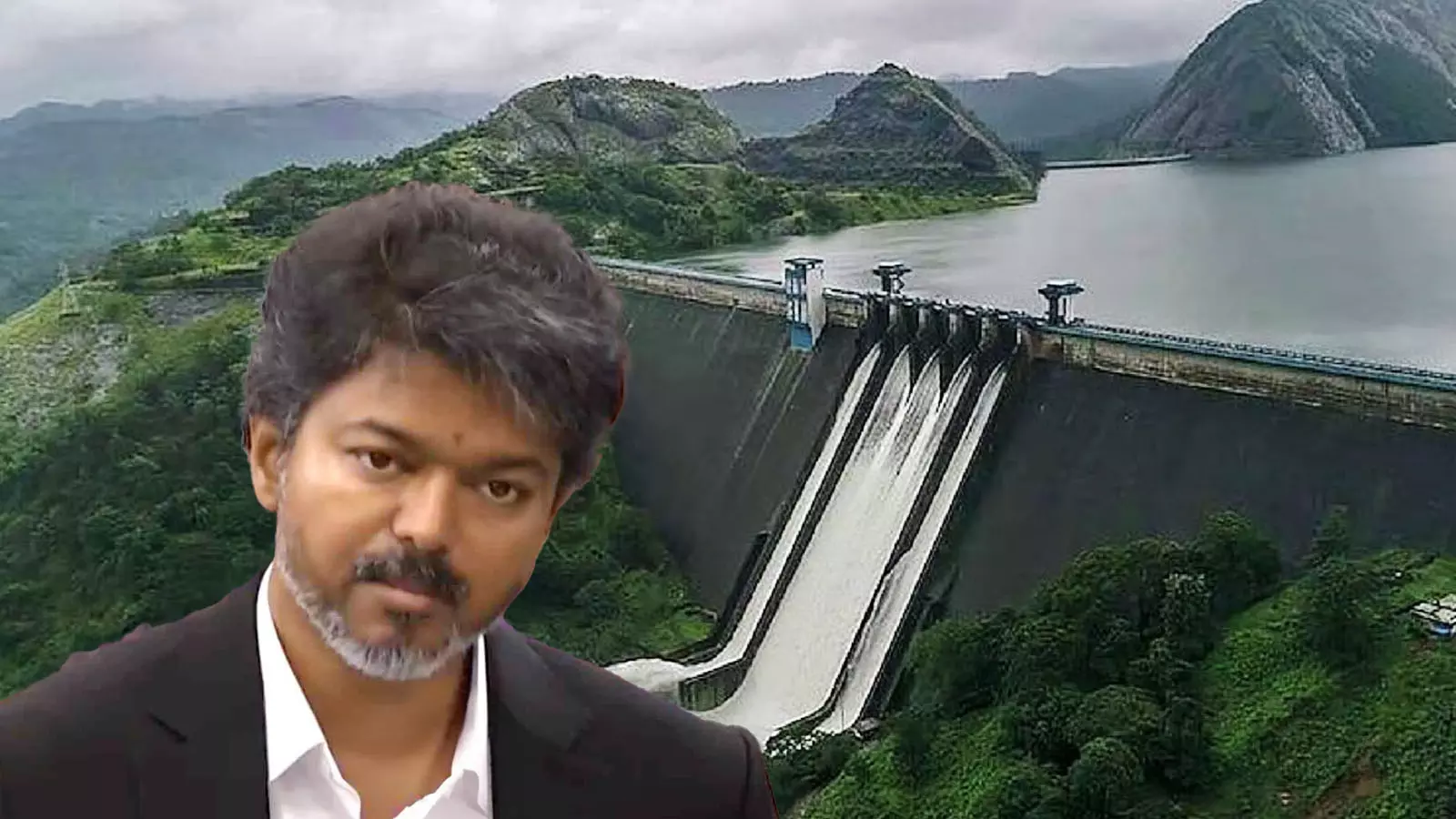
Will Mullaperiyar dam keep TVK's Kerala expansion at bay?
Vijay's TVK eyes Kerala, but Mullaperiyar stands in the way
By reviving the Mullaperiyar debate, TVK's first policy declaration has complicated Vijay's potential Kerala expansion

When Tamil Nadu's new Governor, Rajendra Vishwanath Arlekar, rose to address the state legislature for the first time, the occasion was notable less for what he said than for how he said it. Unlike his predecessor RN Ravi, who repeatedly clashed with the previous DMK administration and once walked out mid-address, Arlekar read the TVK government's prepared text without deviation, without drama, without edit.
But more than the new smooth relationship between the new TVK government and the new governor, what became a matter of consequence within the delivered policy declaration was a line with consequences that extend well beyond Tamil Nadu's borders.
The TVK government, the address made clear, would not permit a new dam at Mullaperiyar. It would actively resist Kerala's efforts to build one. It would push to raise the water level of the existing structure and carry out maintenance work.
In a single paragraph, Vijay's government had stepped into one of South India's most complicated interstate disputes — and without apparent hesitation.
Dam older than independence
The Mullaperiyar Dam was built in 1895, during British rule, on land that is now part of Kerala. It is operated by Tamil Nadu, which uses the Periyar river's waters to irrigate five southern districts — Theni, Dindigul, Madurai, Sivaganga and Ramanathapuram. For farming communities in these areas, the dam is not a piece of ageing colonial infrastructure, it is all about agriculture.
However, Kerala sees it differently. The dam is over 130 years old, constructed with lime and surkhi mortar, and sits in a seismically sensitive zone. A structural failure, Kerala has long argued, would submerge at least five of its districts downstream, including Ernakulam, home to Kochi, the state's commercial capital. Its consistent demand has been the construction of a new dam to replace the existing one.
Also Read: TN white paper’s bigger warning is not debt, but revenue slump: Economist
Tamil Nadu has resisted that position with equal consistency. Its argument is that the dam is structurally sound and that the focus should be on raising the water level. In 2014, the Supreme Court permitted a rise to 142 feet, with scope for a further increase to 152 feet following strengthening work. Kerala has since blocked that strengthening, holding firm on its new dam demand.
The result is a deadlock that has resisted resolution for decades. The TVK government's policy declaration has now formally staked out Tamil Nadu's position — and in doing so, complicated Vijay's relationship with a state that has an ardent fanbase which is as frenzied about him as his Tamil fans, who are now his vote base too.
Expansion already underway
Long before the assembly session, the signs of TVK's Kerala ambitions were visible to those paying attention.
In Vengappally, a small border town in Wayanad, a group of young IT professionals and commerce graduates had put up TVK flex boards and begun registering members through the party's official app. Unofficial WhatsApp groups purporting to be TVK district committees had been active in Kozhikode, Ernakulam, Malappuram and Alappuzha since as early as September 2025 — none of them followed by the party's official handle, but active nonetheless.
A source close to the Kerala unit told The Federal that informal discussions had been held in Palakkad and Wayanad, and that an official announcement on expansion was expected within two months. "Clarity will emerge sooner or later," the source said.
Why Kerala matters to TVK
The logic of a Kerala expansion is straightforward, almost compelling.
TVK won 108 seats in the April 2026 Tamil Nadu elections, a remarkable debut, but fell ten short of an outright majority. Congress's five MLAs provided the margin. Rahul Gandhi attended the swearing-in on May 10, a symbolic gesture that signalled the alliance had substance.
Simultaneously, Congress swept Kerala. The United Democratic Front won 102 of 140 seats, its best result since 1977, ending a decade of Left Front rule. Congress alone won 63 seats. Two election victories, one shared ally, two states that share a border.
The ideological fit is also genuine. TVK's platform — secular, socially progressive, centre-Left — aligns naturally with Kerala's political culture, arguably more so than with parts of Tamil Nadu. And Vijay's fan organisation, the Vijay Makkal Iyakkam, has operated in Kerala for years, running disaster relief, social welfare and charity programmes. It already functions in many respects like a political cadre, waiting only for an official signal.
Vijay's relationship with Kerala as an entertainer reinforces all of this. His films open there with the same anticipation as a Malayalam superstar's release. In Jilla, he starred alongside Mohanlal. In Theri, he played Joseph Kuruvilla, a character explicitly from Kerala. These gestures have built a reservoir of affection that most politicians would envy.
Dilemma the dam creates
The problem is that many of those fans live downstream of Mullaperiyar. For residents of Ernakulam, Idukki and the other districts Kerala identifies as being at risk, the dam is not a symbolic issue or a point of interstate pride. It is a question of physical safety. A government that has declared its intention to block a new dam is, from their point of view, defending a position that puts it at risk.
Also Read: Vijay govt 1-month report card: Coalition stability offset by fiscal strains | Interview
TVK cannot step into Kerala's politics by being the party that stood against a new Mullaperiyar dam. But it equally cannot govern Tamil Nadu by being seen as soft on a water rights issue that southern districts have depended on for over a century. The two positions are not easily reconciled, and the policy declaration has made the tension explicit.
There is also the question of Congress. Fresh from a landslide in Kerala, the party has no obvious incentive to encourage a new entrant that could eventually compete for the same young, aspirational voters TVK is designed to attract. Whether Congress views TVK in Kerala as an allied force deepening the anti-BJP blocor as a long-term complication remains a calculation not yet made public.
Fertile ground, unresolved tension
TVK has not announced a Kerala expansion. It has a first term to consolidate, a coalition to manage, and governing priorities that will not wait. The flex boards in Wayanad and the WhatsApp groups in Ernakulam are more about intent, or testing the waters.
Also Read: Why Vijay govt’s move to empower CMDA must come with transparency checks
But the underlying conditions — the fanbase, the Congress alliance, the ideological alignment, the border geography — are real, and they may not remain this favourable indefinitely. The question is not whether TVK could expand into Kerala. The question is whether the Mullaperiyar declaration has made that possible expansion significantly harder to execute.