VB-G RAM G wages: Has Tamil Nadu been ‘penalised’ for its performance?
Tamil Nadu to bear Rs 5,057 crore under VB-G RAM G, as protests erupt over perceived wage disparity and capped allocations

Tamil Nadu, one of the country’s best-performing states under the rural employment guarantee programme, is set to shoulder a significantly higher financial burden as the Centre rolls out the Viksit Bharat-Guarantee for Rozgar and Ajeevika Mission (Gramin) (VB-G RAM G) Act, 2025 from Wednesday (July 1), replacing the two-decade-old Mahatma Gandhi National Rural Employment Guarantee Act (MGNREGA).
The Union government on Tuesday notified wage rates for unskilled manual workers under the new law, fixing daily wages between Rs 300 and Rs 409 across states. While workers in several northern and north-eastern states received wage hikes of more than 15 per cent, southern states, including Tamil Nadu, Karnataka, Andhra Pradesh and Telangana, saw an increases of only around 3 per cent or less.
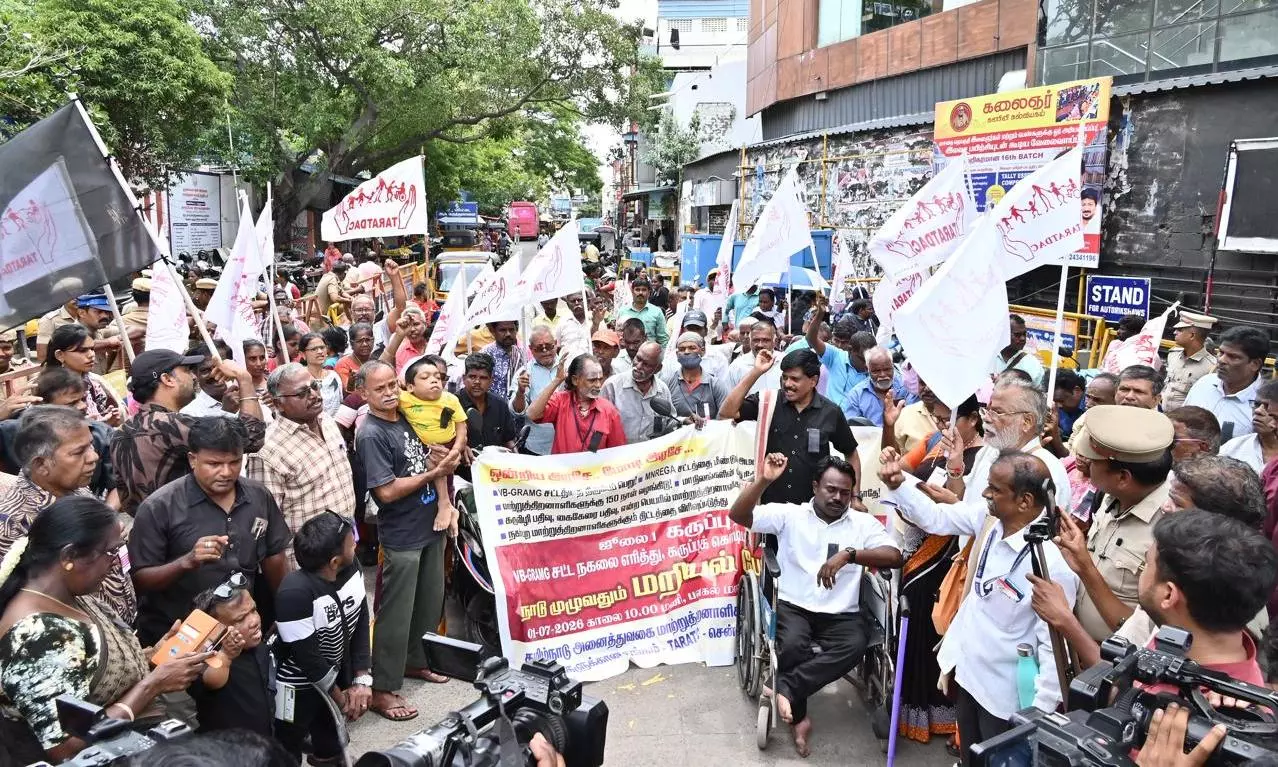
The rollout has triggered protests across Tamil Nadu, where workers and activists fear that the new funding model could weaken the country’s most successful rural employment programme in the long run. Under the new framework, the guaranteed number of workdays has been increased from 100 to 125 days a year for rural households willing to undertake unskilled manual work.
The extra burden on states
In the previous MGNREGA, the Union government bore 100 per cent of the unskilled labour costs and 75 per cent of material costs, while the states contributed around 10 to 25 per cent of material costs. Whereas, the new scheme mandates a 60:40 funding ratio, with states expected to contribute 40 per cent of the total expenditure.
Also read: Why NDA chose Railway Koduru for VB-G RAM G launch
For Tamil Nadu, officials estimate that the state government will have to contribute Rs 5,057 crore, while the Union government’s share will be Rs 7,585 crore, taking the total outlay under the scheme to Rs 12,642 crore.
Officials said the state government has already cleared the decks for implementation after the scheme was notified in the Gazette. The funding shift sparked widespread protests on Tuesday.
Protests in Tamil Nadu
The Tamil Nadu Association for the Rights of All Types of Differently-abled and Caregivers (TARATDAC) staged demonstrations at more than 100 locations across the state on Wednesday, demanding that the Centre retain the earlier funding pattern.
TARATDAC state president T Wilson said that while increasing the guaranteed employment from 100 to 125 days appeared beneficial on paper, the financial restructuring could severely affect implementation.
Speaking to The Federal, Wilson said, “The Bill increases the guaranteed workdays, but it also raises the states’ financial burden from 10 per cent to 40 per cent. More importantly, VB-G RAM G shifts the programme from a demand-driven framework to a supply-driven scheme. Allocations will now be capped within a fixed budget determined by the Union government, limiting the flexibility that existed under MGNREGA.”
Workers’ organisations also expressed concern that poorer states may struggle to mobilise their increased financial contribution, potentially reducing employment opportunities over time.
Why the disparity
The big question is why did southern states receive smaller wage hikes? According to the notification, Haryana continues to have the highest wage rate at Rs 409 per day, although it registered only a 2.25 per cent increase.
Also read: Suvendu flexes double-engine muscle, rolls out VB-G Ram G in Bengal
Northern and north-eastern states, including Arunachal Pradesh, Nagaland, Himachal Pradesh, Uttar Pradesh, Uttarakhand, Bihar, Jharkhand, Assam, Tripura, Sikkim and West Bengal, recorded wage hikes exceeding 15 per cent. Tamil Nadu’s increase, however, is around three per cent. Due to this poor hike, workers in Tamil Nadu would receive Rs 345 as their wage per day.
Unfair to South?
Explaining the apparent disparity, Nandhakumar Siva, vice-president of Thannatchi, a voluntary organisation that has worked with MGNREGA workers in Tamil Nadu for over a decade, said the Union government’s statement related to the hike is misleading.
“While the wage rates notified under the VB-G RAM G Act appear higher than the prevailing MGNREGA wages, this is largely because the Centre did not revise MGNREGA wages for 2026-27. The last wage revision was notified in March 2025 for the 2025-26 financial year, and those rates continued even during April-June this year. Had MGNREGA wages been revised for the current financial year, the percentage increase under the new Act would have been almost the same,” he told The Federal.
He added that the Centre's claim that southern states already have relatively higher wage rates, making percentage increases appear smaller, is misleading. “The Centre says since wage rates in southern states are already higher in absolute terms, the percentage increase looks lower, and that factoring in inflation has led to regional variations,” he said, adding that it is not true.
Tamil Nadu a top performer
Several independent studies have consistently identified Tamil Nadu as one of India’s best-performing states under the rural employment guarantee programme. The state regularly ranks among the top three in expenditure under MGNREGA and provides more employment days per household than the national average.
Also read: MGNREGA vs VB-G RAM G: What changes for states and workers | Interview
Women account for nearly 86 per cent of total person-days generated in Tamil Nadu, compared to the all-India average of 57 per cent. Around 30 per cent of workdays are generated by Scheduled Caste and Scheduled Tribe households, exceeding their share in the state’s population. Tamil Nadu also records the country’s highest participation of differently abled workers, accounting for 1.4 per cent of total workdays.
Studies also show that before the Covid-19 pandemic, Tamil Nadu provided an average of 44 days of employment annually per working household. This increased to around 50 days during and after the pandemic. The number of participating households also rose from an average of 57 lakhs before Covid-19 to 67 lakhs thereafter.
Penalised for performance?
“With huge disparity, the hike given to southern states and particularly to Tamil Nadu is unjustifiable. Tamil Nadu has been penalised once again for its performance,” Nandhakumar Siva told The Federal.
Advocate S Malathi pointed out that while the new law allows the Centre to prescribe different wage rates for different regions, the methodology adopted has not been disclosed. “The Union Ministry of Rural Development has not explained how it arrived at the state-wise wage rates. It appears that the prevailing MGNREGA wage rates have been used as the benchmark,” she told The Federal.
She noted that Section 10 of the VB-G RAM G Act empowers the Centre to notify different wage rates for different areas but also makes it mandatory that these rates should not be lower than those notified under Section 6 of the MGNREGA Act, 2005.
Question of sustainability
Although the new law promises expanded employment opportunities through 125 guaranteed workdays and focuses on water conservation, rural infrastructure, livelihood assets and climate resilience, activists remain apprehensive about its long-term sustainability.
Also read: Why VB-G RAM G raises fears over future of rural jobs in Andhra Pradesh
They argue that shifting a larger financial burden to states while introducing capped budget allocations could eventually reduce employment generation, especially in states like Tamil Nadu where demand for rural employment has historically remained high.
“VB-G RAM G marks a shift from a demand-driven framework to a supply-driven scheme. Under the new system, allocations will be capped within a fixed budget determined by the Union government based on objective parameters. MGNREGA empowered people to demand work. The new VB-G RAM might result in driving away workers from participation,” Malathi said.