‘Political poaching not a new trend in TN’; will TVK resist or fall prey?
While accusation of poaching bid on a TVK MLA against DMK has shown fragile state of TVK in Assembly, it is also a reminder of the intrinsic nature of defections in TN politics

The currently raging political storm in Tamil Nadu over allegations of horse-trading brought forth by a TVK MLA against the DMK, has highlighted the fragile number game in the Assembly, while also underlining how the trend of defections is deeply embedded in the state’s political fabric.
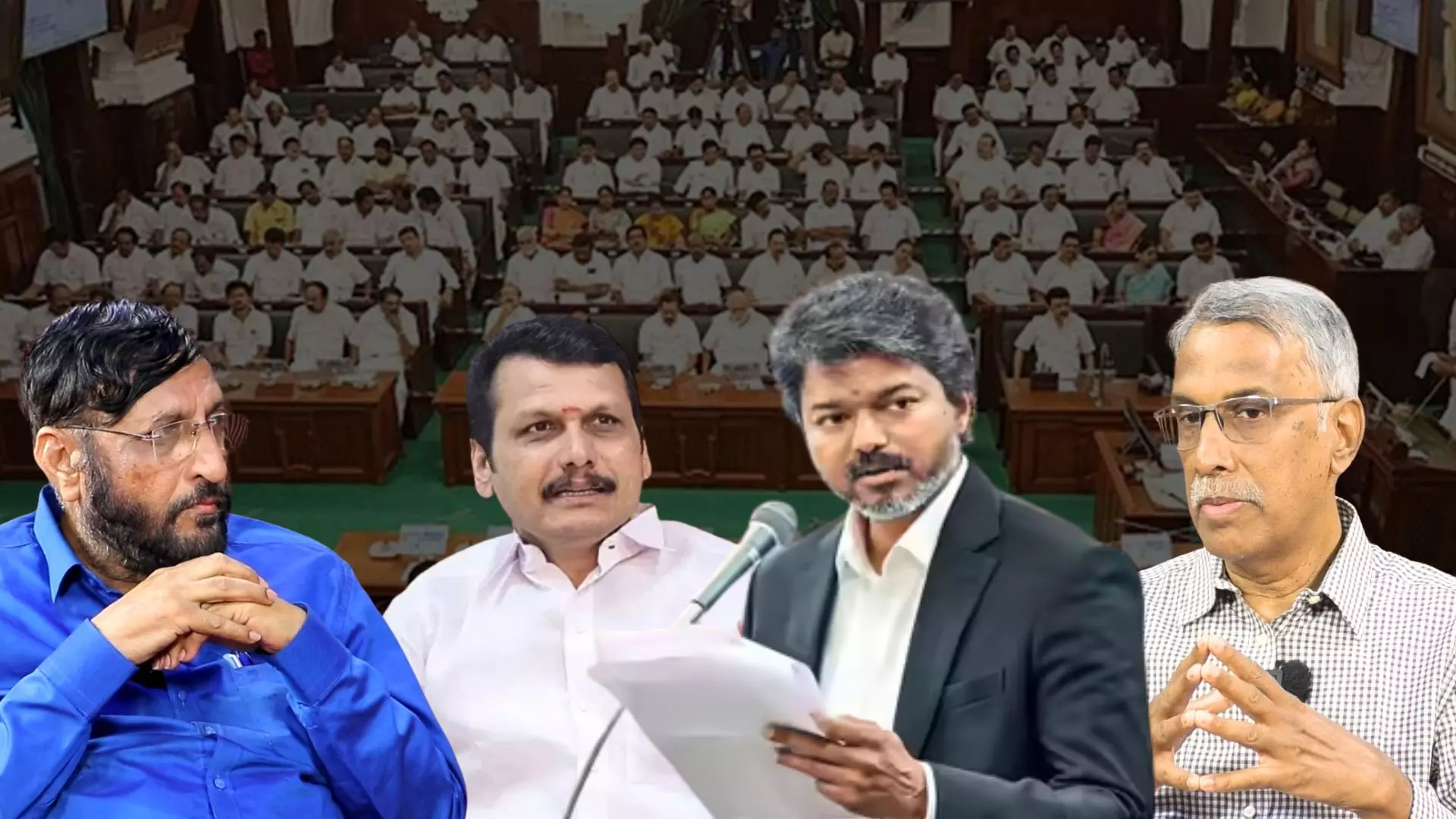
In a discussion, The Federal’s editor-in-chief S Srinivasan and senior journalist R Rangaraj dissected the political crisis, Tamil Nadu’s history of horse-trading and why the allegations of horse-trading threaten to erode the credibility of the MK Stalin-led DMK.
What is the row?
The controversy erupted when TVK MLA N Elaiyaraja filed a formal complaint alleging that he was offered an astronomical bribe of Rs 35 crore to vote in a specific manner inside the state Assembly. The swift intervention of the Tamil Nadu police led to the pre-emptive arrest of three individuals. As the investigation intensified, law enforcement named former DMK minister V Senthil Balaji and his brother RV Ashok Kumar in the case, significantly raising the political stakes.
Also read: 'Rs 35-cr plot to topple Vijay govt': 3 arrested, Senthil Balaji's brother absconding
While the opposition DMK has vehemently denied any wrongdoing and levelled counter-allegations against the ruling TVK, the incident is proof of the vulnerable position of the Vijay-led government which had failed to secure a majority in the recent state elections and came to power only after stitching together an alliance. Currently, in the 234-seat Assembly, the ruling party holds 106 MLAs of its own, excluding the Speaker's chair and a vacant seat because Vijay contested and won from two separate constituencies. With external support from seven additional MLAs, TVK’s total strength stands at 113, leaving it exactly five seats short of securing a simple majority on its own.
Unstable numbers
This narrow margin has created an intense, high-stakes tug-of-war within the Tamil Nadu assembly. According to Srinivasan, what the public is witnessing is a classic see-saw battle where the ruling faction is scrambling to establish long-term stability while the opposition attempts to pull the government down. This friction has taken an exceptionally ugly turn with the latest bribery allegations and subsequent police operations.
Adding to the complexity is a highly unusual situation where elected MLAs from opposition parties, particularly the AIADMK, have been resigning one by one to join the TVK. Nearly seven legislators have already made this transition, forcing them to face upcoming by-elections. While political analysts debate whether these defections are driven by genuine ideological alignment or opportunistic calculations, the opposition alleges that it points to a wider culture of political poaching.
Also read: AIADMK: Will demand CBI probe if TVK continues 'horse-trading'
Conversely, the opposition's counter-strategy appears to revolve around attempting to bring down the newly formed government by moving a no-confidence motion against the Assembly Speaker. Under this alleged plan, specific ruling party MLAs would be induced to abstain during the crucial voting process, ensuring that the motion passes and plunges the government into a constitutional crisis.
Historical defection trends
Responding to whether such political manoeuvers are unprecedented in Tamil Nadu, Rangaraj pointed out that horse-trading and high-profile defections have a long historical lineage in the state. He recalled the dramatic events following the 1980 Lok Sabha elections when the AIADMK was heavily battered by the DMK-Congress alliance. At that time, many believed that the legendary MG Ramachandran (MGR) was politically finished.
In a stunning turn of events, five senior ministers from MGR’s own cabinet—including stalwarts like GR Edmund and Nanjil K Manoharan—resigned overnight to join M Karunanidhi’s DMK. This mass defection threatened to reduce the MGR government to a minority within months. However, in his haste to reclaim the chief minister's chair, Karunanidhi engaged with Sanjay Gandhi to have the state government dismissed entirely rather than waiting for it to collapse organically.
Also read: TVK alliance meeting charts three-point roadmap; final call in next round
Rangaraj noted that during those early decades, there was no Anti-Defection Act in place to penalise politicians switching sides, making "Aaya Ram Gaya Ram" politics a frequent reality. Even after the initial anti-defection framework was introduced, it permitted a party split if one-third of the legislative members moved together. Later modifications tightened the rules further, requiring a two-thirds majority along with a merger of the principal political party to escape disqualification.
Circumventing current laws
Despite the stringent legal updates, political parties have consistently found innovative loopholes to bypass anti-defection mechanisms. Rangaraj highlighted that the modern template for bypassing these laws was effectively demonstrated through ‘Operation Lotus’ in Karnataka, where opposition MLAs were convinced to resign from their seats entirely, safely side-stepping the defection clause before re-contesting under a different party banner.
Srinivasan added that similar tactics are playing out in other states like Telangana and West Bengal. In some instances, legislators join rival political organisations without formally resigning from their assembly seats because the Assembly Speaker deliberately delays taking any punitive action under the Anti-Defection Act. By the time the courts choose to intervene or the Speaker makes a formal ruling, the entire five-year legislative term often draws to a close.
Also read: MK Stalin has a question: Will Vijay's TVK govt last three months?
This tactical manoeuvring reflects a deep-seated political immorality that has seeped into the democratic process. Candidates run campaigns and appeal to the electorate based on a specific party manifesto, only to switch allegiances immediately after securing their victory. The panellists emphasised that strengthening the wording of the law matters very little when political actors remain determined to undermine its spirit.
Senthil Balaji factor
The unfolding drama in Tamil Nadu carries a deeply personal and local political subtext. The central figures named in the ongoing investigation are linked to V Senthil Balaji, a highly influential political strongman hailing from the western region of Karur. The ruling TVK, alongside leaders like P Nirmal Kumar, has openly maintained an adversarial relationship with Senthil Balaji, even deposing before the CBI regarding his alleged involvement in a past stampede incident.
While the CBI investigation into that previous case is still pending and the current bribery allegations remain unproven, the timing of this scandal is highly significant. The entire episode feels remarkably calculated, almost mirroring a cinematic script. It remains to be seen how the ruling party handles its presence in Karur, a region that Vijay has notably not visited since taking office.
Also read: Vijay govt 1-month report card: Coalition stability offset by fiscal strains | Interview
The situation also raises fundamental questions regarding the internal cohesion of the newly formed TVK legislative unit. Because the TVK is a relatively new organisation that achieved massive success in its very first Assembly election. Its structural roots are still fresh. The party is viewed by many as a post-ideological formation where the primary binding force is the personal charisma of Vijay rather than a deeply-rooted organisational doctrine.
Establishing the proof
The diversity of the TVK's legislative wing presents its own set of administrative challenges. Many of the newly-elected MLAs come from economically weaker sections and humble backgrounds. Before the elections, several political commentators expressed scepticism about whether these grassroots representatives would be able to withstand immense financial inducements and pressure from established political heavyweights.
However, executing a mass crossover is legally challenging. If individual MLAs choose to defect to the DMK camp, they are legally bound to resign their seats and face the electorate again, which carries significant political risk. Rangaraj stressed that for the police investigation to hold any real weight in a court of law, they must conclusively establish a clear, physical, or digital money trail.
Also read: Reality check for TVK’s clean politics pitch as ED targets another DMK leader
Without definitive proof of financial transactions, the entire controversy risks dissolving into a game of mutual recrimination. Historically, cases like the JMM bribery scandal or the dramatic instance of LK Advani presenting cash packets on the floor of the Lok Sabha during the nuclear deal confidence motion involved tangible evidence. In the current Tamil Nadu case, if no money trail is uncovered, it remains one politician's word against another's.
Regardless of the eventual judicial outcome, the scandal has dealt a severe blow to the public image of the DMK. This is particularly damaging because DMK chief MK Stalin had publicly committed to a six-month grace period during which his party would not disrupt or aggressively criticise the newly-formed government. The swift exposure of this alleged plot sends a strong signal to the public that the established Dravidian parties are struggling to come to terms with sitting in the opposition benches.
The content above has been transcribed from video using a fine-tuned AI model. To ensure accuracy, quality, and editorial integrity, we employ a Human-In-The-Loop (HITL) process. While AI assists in creating the initial draft, our experienced editorial team carefully reviews, edits, and refines the content before publication. At The Federal, we combine the efficiency of AI with the expertise of human editors to deliver reliable and insightful journalism.