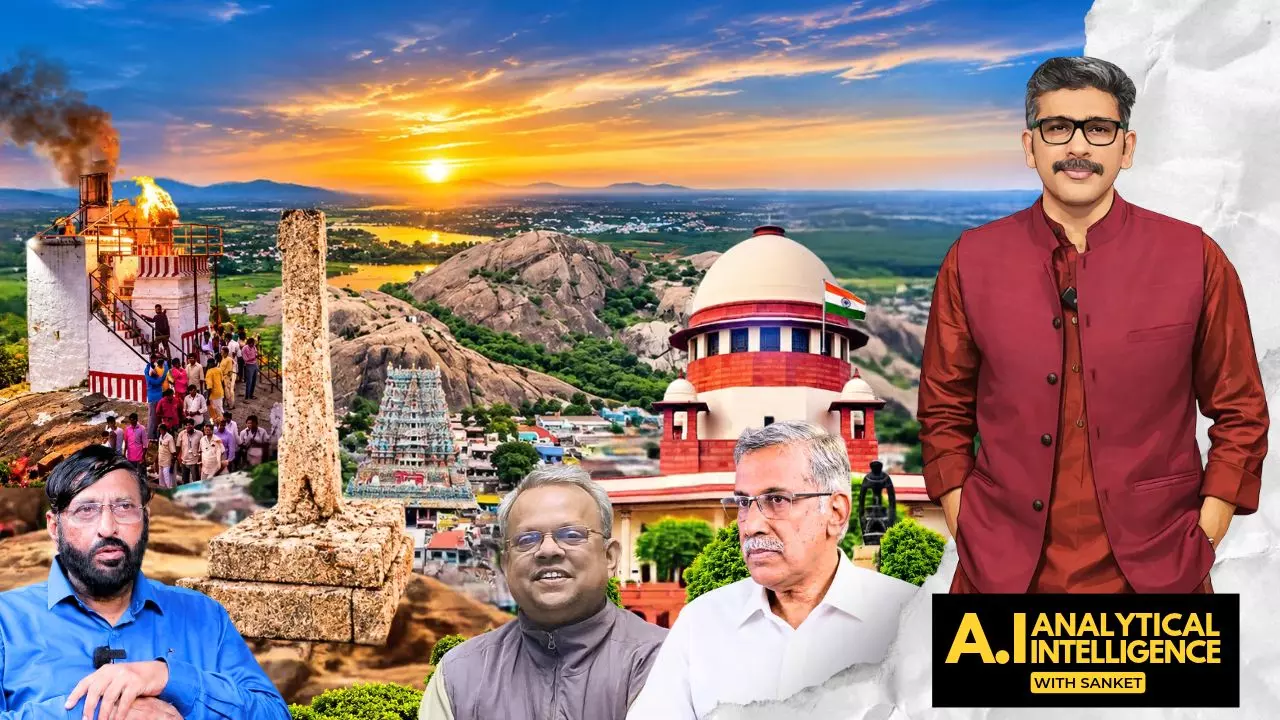
Thirupparankundram row : Why it is a big test for Vijay's TVK govt
Experts examine the legal, cultural and political fallout of the Supreme Court's contempt order in the Thirupparankundram temple lamp row

The Supreme Court's directive to light a ceremonial Karthigai lamp at a disputed stone pillar on the Thirupparankundram hill in Madurai has drawn sharp reactions, with commentators calling it everything from judicial overreach to a political test for Tamil Nadu's new government.
The court termed the state administration's failure to follow its earlier order an aggravated case of contempt. It ordered the lamp to be lit on November 28 under CRPF protection and suspended the temple's board of trustees. Contempt notices have also been issued to the Chief Secretary, the DGP and the District Collector, who have been summoned to Delhi on December 15.
'Classic case of judicial overreach'
Senior journalist R Rangaraj said the Supreme Court's move was, to his mind, "a classical case of judicial overreach". He argued that successive governments led by J Jayalalithaa and M Karunanidhi had maintained the lamp should be lit only at the traditional mandapam near the Ganesha temple, in line with Agama rituals followed for over 150 years.
"Can the court interfere with the Agama practices of the temple administration," Rangaraj asked, criticising the court for directing trustees to alter customary worship without deciding the core dispute. He also noted that Tamil Nadu's counsel had questioned the absence of contempt action during the Sabarimala protests.
Also Read: Deepathoon row: Why interim orders at disputed shrines seldom stay interim
Rangaraj said the political dimension overshadows the legal one. He observed that the BJP and RSS have long seen Tamil Nadu, with its 39 Lok Sabha seats, as a critical frontier, and warned that a lamp near the dargah risks creating a communal flashpoint in Madurai. He suggested a compromise may eventually emerge, with traditional rituals continuing at the Uchi Pillaiyar mandapam while a small group performs a symbolic lighting at the upper pillar.
A test for the TVK government: Srinivasan
S Srinivasan, Editor-in-Chief of The Federal, said the issue poses a significant challenge for the ruling TVK government led by Vijay. Unlike the Jallikattu agitation, when Tamil Nadu's parties stood united, this dispute has divided the major players.
According to Srinivasan, the DMK has stayed largely silent on the government's predicament, hoping to show minority voters that it handled similar situations better while in power. He added that the DMK also faces wider calculations ahead of the parliamentary session on the delimitation bill, amid central agency investigations involving several senior leaders. The TVK government, he said, is expected to comply with the November 28 mandate while framing its earlier resistance as adherence to Agama traditions.
Legal questions
Senior journalist V Venkatesan noted that the court treated the non-compliance as aggravated criminal contempt and lifted an earlier interim stay on the Madras High Court's order solely on contempt grounds, without deciding whether the pillar is a religious structure or a survey marker. The fresh directive also allows all devotees to take part, raising crowd-management concerns near the dargah. The court described the lighting as a one-time measure that cannot serve as precedent, though Venkatesan cautioned that interim arrangements in sensitive religious disputes often shape the long-term course of litigation. Questions under Articles 25 and 26 remain unresolved.