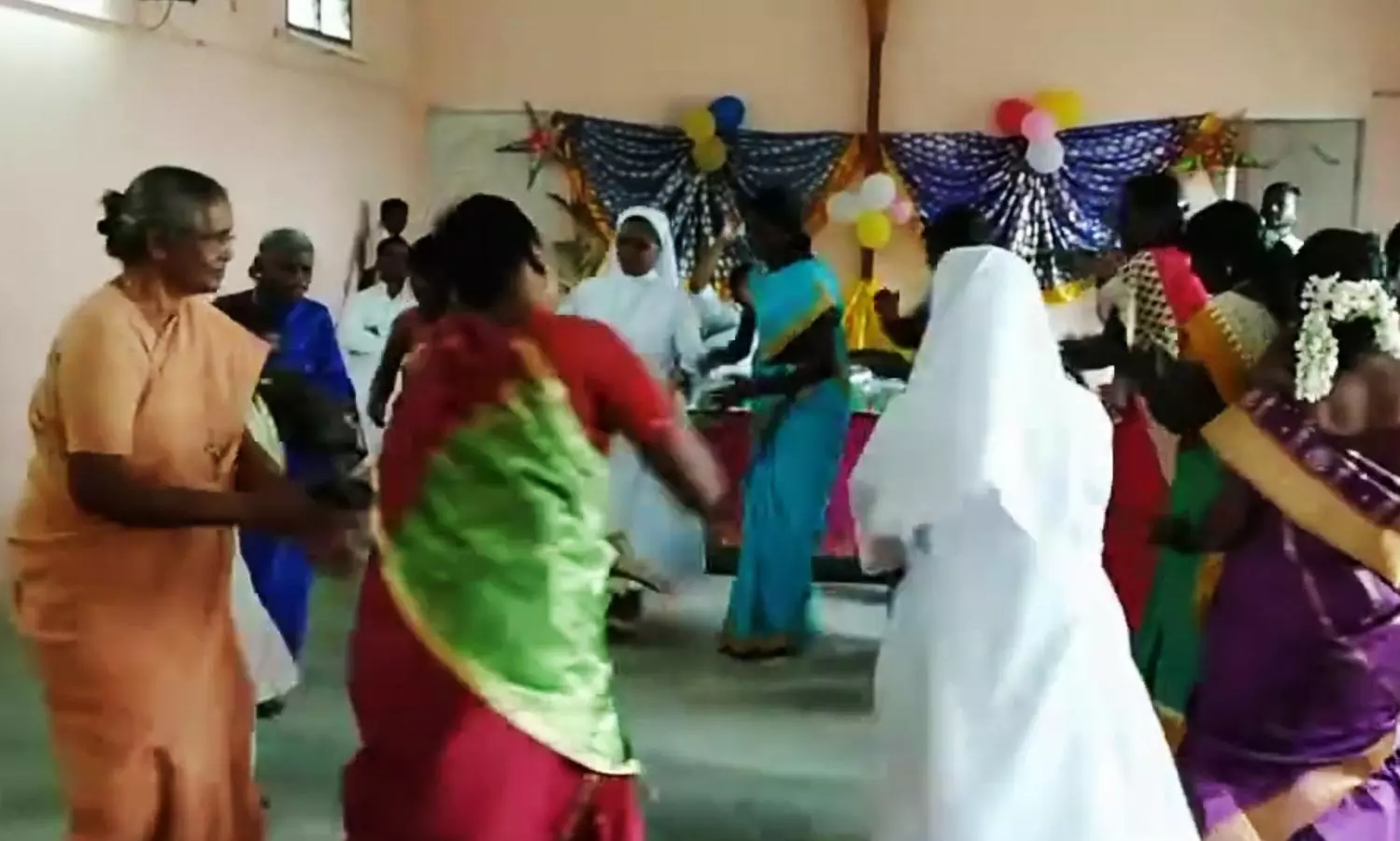
Tamil Nadu folk dance Kummi finds new life in Christmas celebrations
Churches embrace traditional dance and rhythmic hand-clapping to root worship in local culture; social media helps revive poet Vedanayagam Sastriar’s legacy

The Kummi, a traditional folk song and dance form once closely associated with village temple festivals in Tamil Nadu, is finding renewed expression in church cultural programmes during Christmas.
In the run-up to the festival, several Kummi songs with Christian themes have been released by devotees on YouTube, signalling a growing embrace of indigenous art forms in church celebrations.
What is Kummi?
Kummi dance is performed by groups of people who form a circle or a straight line and clap their hands and change the rhythm while singing the song. In some cases, a team of singers stands close by as the dancers move to the beat.
Among the most popular performances are those by devotees of the Arokiya Matha Church (Our Lady of Good Health) in Thoothukudi, where Kummi dances praising Arokiya Matha have become a favourite among church choirs.
Also read: Legend, Nandi and a city’s nostalgia: Why Bengaluru still throngs to Kadalekayi Parishe
While Kummi songs date back to the pre-British era, their circulation and popularity have expanded significantly in the age of social media. Central to this revival is the legacy of poet-lyricist Vedanayagam Sastriar, the court poet of Thanjavur king Serfoji II. His compositions remain an inalienable part of Christian worship in South India and among Tamil Christian congregations in the diaspora. Of the more than 100 works attributed to him, a four-part collection of Kummi songs titled Gnana Kummi is especially revered for its rich Tamil idiom and deep religious fervour that continues to inspire devotion. Today, many young performers are rediscovering Sastriar’s verses and reworking them into contemporary musical renditions.
Clapping, a core element
Folk arts researcher and trainer MV Adalarasan explained that rhythmic clapping is the core element of Kummi.
“In many churches, devotees are asked to clap at the end of prayers, which creates a sense of collective energy. In Kummi songs, the claps blend seamlessly with the tunes and lyrics used by choirs. By varying clapping patterns, singers can easily draw in the audience and reinforce devotional messages,” he said.
Also read: The Sanskritisation of Tamil Nadu's village gods
“As Christmas celebrations increasingly blend faith with local cultural expressions, the revival of Kummi within churches reflects a broader effort to root worship in familiar, community-driven traditions,” said Adalarasan. “The form’s collective singing and rhythmic clapping help congregations connect naturally with the performance. In this way, ancient folk rhythms find a place within contemporary sacred spaces,’’ he added.
Yesu Pirandhar Kummi being performed in Advent Christian Church, Chennai
Intergenerational appeal
Folk singer and churchgoer Stephen Raj told The Federal that he has composed two Kummi songs, Bethlehem Kummi and Kuzhandhai Yesu Kummi, which narrate the birth of Jesus and highlight his teachings.
“Our songs praise the Lord while also creating awareness among youth about Christian principles. Kummi is a simple form; it can be performed with a small group and does not require musical instruments. We include questions in the lyrics, invite responses from the audience, and encourage them to join by clapping,” he said.
Also read: Amid deepam row, Thiruparankundram goes the extra mile to celebrate unity
The intergenerational appeal of the form is also evident. A Mercy (19) encouraged her mother, A Priya, to perform a Kummi dance at cultural programmes organised by their Advent Christian Church in Chennai last year. “We wanted our mothers to be part of the celebrations. Instead of western tunes, they were keen to dance to a Kummi song. Our choir wrote a three-minute song quoting the Commandments. The mothers were trained for just three days and performed with great joy,” Mercy told The Federal.
Blend of folk and Christmas
Reflecting on the blending of folk traditions with Christmas celebrations, Father John Churchill, a resident of Kanyakumari district, said the form resonates deeply with coastal communities. “I work closely with fishermen families here. Singing is part of their everyday life, while learning to sail boats or cast nets, both men and women sing from a young age. During Christmas, they narrate their devotional experiences through songs, and using native folk forms like Kummi naturally energises the crowd,” he said.
Father Churchill recalled that earlier, churches often hired drama troupes to stage plays after Christmas prayers. “Now, many young men and women perform Kummi dance themselves. The form allows performers to sing, dance and pause for dialogue, making it very engaging. Some even weave short skits into their performances. With many youngsters active on social media, these performances are recorded, shared as reels and gain recognition both on and off the stage. Some performers also incorporate Bible verses into their songs,” he added.