‘Can’t be wiped out in 50 years’: Is TN’s debt really out of control as finance secy says?
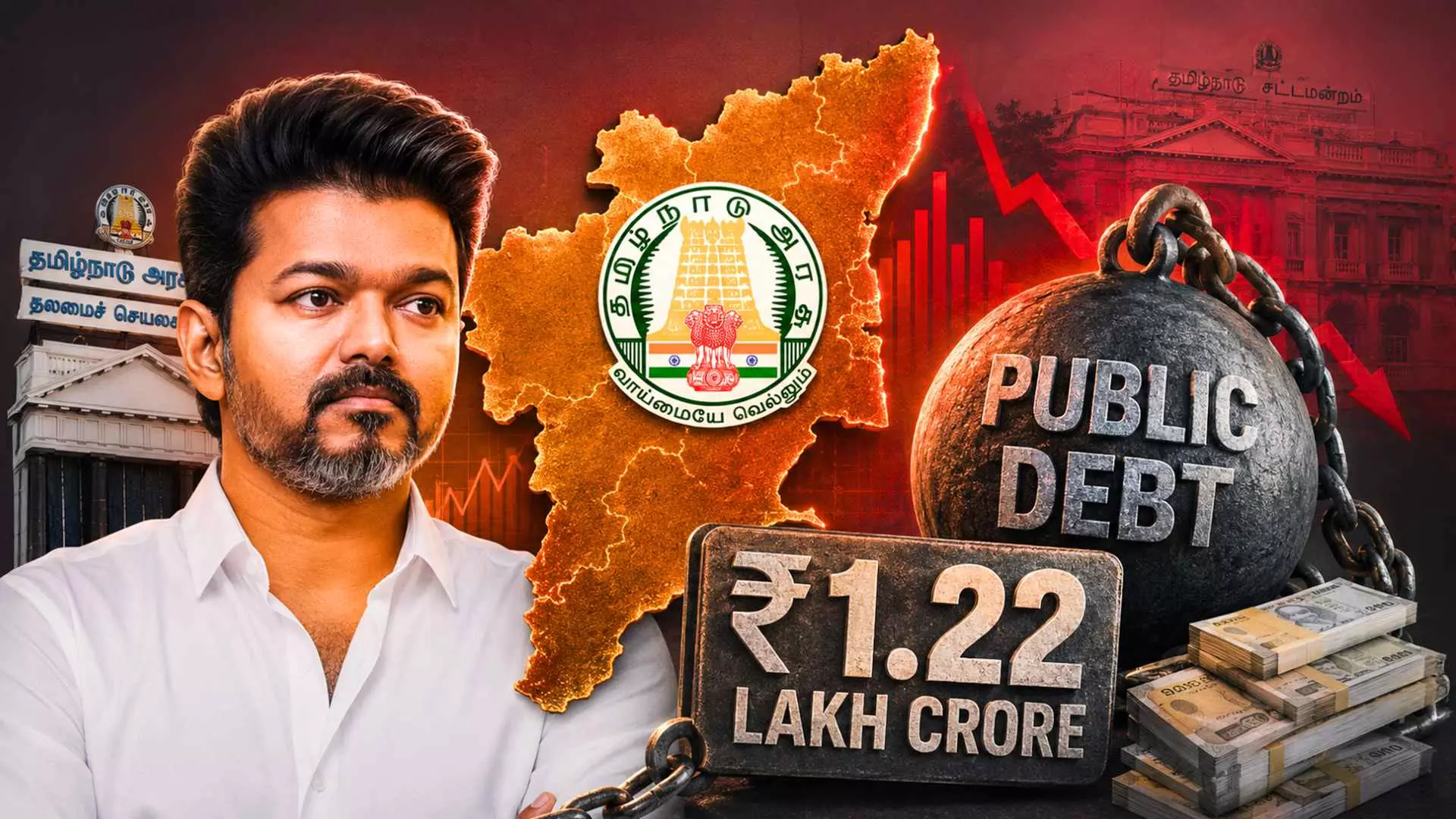
Finance secretary’s remark that debt cannot be reduced even in 50 years fuels DMK-TVK clash, as TVK government plans to borrow Rs 1.22 lakh crore in 2026-27

Tamil Nadu's public debt is once again at the centre of a political storm after the state's Finance Secretary said the debt cannot be wiped out even in the next 50 years. The remark has triggered a fresh war of words between the ruling Tamilaga Vettri Kazhagam (TVK) and the Opposition DMK.
The TVK-led government has announced plans to borrow Rs 1.22 lakh crore in 2026-27 to bridge the gap between its income and expenditure. Tamil Nadu Finance Secretary MA Siddique made the remark on the state's debt situation, saying, "Even in the next 50 years, we cannot reduce the debt."
But is Tamil Nadu's debt really out of control? Or is borrowing an unavoidable part of running a welfare-oriented state? Here's a breakdown.
Why the borrowing
According to the Tamil Nadu Budget for 2026-27, the borrowing is aimed at financing welfare schemes, infrastructure projects and capital expenditure while sustaining economic growth. This isn't unique to Tamil Nadu.
Also read | TN Budget: TVK govt charts four-pillar plan to fix fiscal challenges
Every state government borrows money through State Development Loans, subject to limits fixed by the Union government under fiscal responsibility norms. The real question is not whether a state borrows, but how much it owes compared to the size of its economy.
Political observers say Tamil Nadu's debt has been a recurring political issue for decades. During the governments of MG Ramachandran, M Karunanidhi, J Jayalalithaa, MK Stalin and now Vijay, every ruling party has defended borrowing as essential for development, while parties in Opposition have criticised mounting debt.
Not a new debate
Budget experts often point out that debt alone does not determine a state's financial health. Economists usually track three key indicators: the debt-to-GSDP ratio, the fiscal deficit, and interest payments as a share of revenue. If these remain within sustainable limits, borrowing is generally considered manageable.
Tamil Nadu budget documents has noted that the state's debt ratio has broadly remained around 28 per cent in recent years, even though the outstanding debt has continued to rise in absolute terms. While the ratio has not risen sharply, it is notably higher than that of states with comparably sized economies.
Tamil Nadu’s debt as a percentage of GSDP stood at 28.8% in 2021–22 and at 28.3% for 2025–26. While the ratio has remained fairly flat, it is still significantly higher than peer states like Karnataka, Maharashtra, and Gujarat.
So, is Tamil Nadu's debt a ticking time bomb? The answer is yes. The share of revenue that goes towards just paying interest on past debt has been rising steadily, leaving the government with less money for either welfare or capital expenditure.
Back in 2021–22, Tamil Nadu spent 20% of its total revenue receipts on interest payments. By 2025–26, that figure is projected to reach 22.8%. That is significantly higher than states like Karnataka, Gujarat, and Maharashtra, which spend far less of their revenue on interest.
The political fallout
The controversy erupted after Siddique's remark on the 50-year debt timeline. The DMK quickly seized on the statement, accusing the TVK government of abandoning its election promise to reduce debt. The Opposition also pointed out that within three months of assuming office, the new government had borrowed more than Rs 20,000 crore, claiming this exceeded the pace of borrowing under the previous administration.
Also read | Vijay govt prioritises Gen Z in debut Budget, nearly doubles youth welfare funds to Rs 1,051Cr
The DMK says this exposes a contradiction between Vijay's campaign speeches and the government's actions after coming to power. The ruling side, however, argues that it inherited a difficult financial situation, and that borrowing is necessary to sustain welfare programmes while pursuing its ambitious goal of transforming Tamil Nadu into a $1.5 trillion economy by 2031.
Targets ahead
Finance Minister N Marie Wilson has promised that the debt-to-GSDP ratio, which stood at 28.3 per cent for 2025-26, will be brought down to 26.57 per cent in 2027-28 and 26.10 per cent in 2028-29.
As the political blame game intensifies, the bigger question remains: will the borrowed money generate enough economic growth to repay tomorrow's debt, or will future governments inherit an even heavier financial burden? This debate is likely to shape Tamil Nadu's politics well beyond this budget.