



By welcoming tainted Vijaybaskars, is Vijay soiling his claim of clean politics?
2 former AIADMK ministers with corruption cases have joined TVK; critics say Vijay's party is fast morphing into the very system it promised to replace

Barely two months into power, Tamil Nadu Chief Minister C Joseph Vijay’s Tamilaga Vettri Kazhagam (TVK) is confronting a serious credibility challenge to its core ‘clean government’ brand.
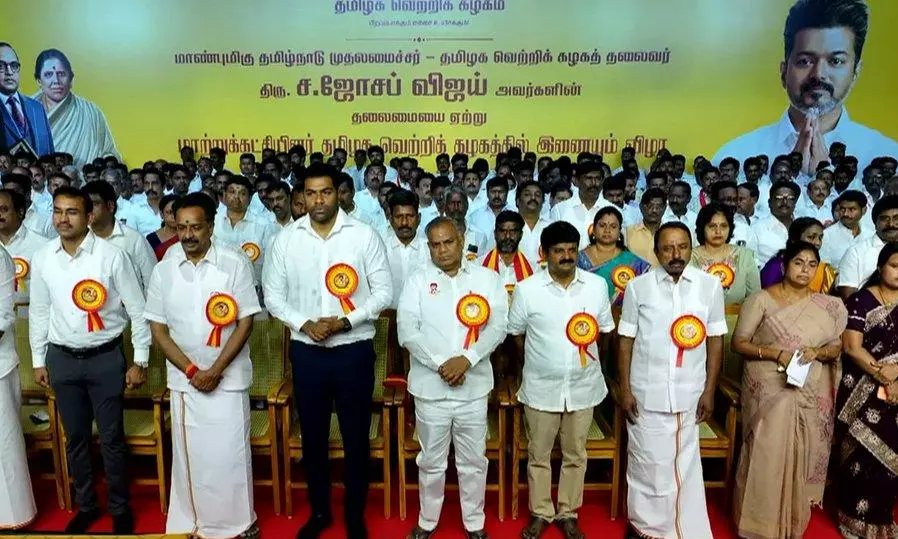
On Thursday (July 2), AIADMK leaders C Vijayabaskar, a former Health Minister, and MR Vijayabhaskar, a former transport minister, along with several other ex-ministers, ex-MLAs and thousands of cadres, formally joined the TVK at a high-profile event in a private resort in Mamallapuram.
The optics were striking: both leaders, who carry multiple serious corruption cases, were given prominent stage presence while TVK ministers praised the move as a victory over “money politics”.
Clean, corruption-free image
The development has triggered sharp criticism from DMK and AIADMK leaders, and anti-corruption activists, who argue that the TVK is fast morphing into the very system it promised to replace.
Since its launch in 2024 and a spectacular victory in the 2026 Assembly elections, the party positioned itself as a break from Dravidian party politics. Actor-turned-politician Vijay’s personal brand, projected as corruption-free and principled, was central to the party’s appeal, especially among youth and first-time voters weary of 'commission culture.'
Also read: TVK alliance meeting charts three-point roadmap; final call in next round
The early months of the TVK government reinforced this narrative. Ministers repeatedly highlighted the end of alleged 20-40 per cent cuts in public works, transparent administration in the first 50 days, and a stated commitment to thooya sakthi (pure/clean power). Until recently, the party appeared cautious: reports indicated the TVK had deliberately avoided inducting leaders facing serious cases to protect its clean image. However, that caution appears to have been set aside on July 2.
Criminal antecedents
The new joiners have a criminal baggage worth noting.
C Vijayabaskar faces at least 12 cases. Among them are:
Gutkha scam: He, along with other former ministers, former IPS officers, and officials of the Greater Chennai Corporation Department and Commercial Taxes wing, was accused of taking bribes to the tune of Rs 39.91 crore to facilitate the storage, transportation and sale of gutkha in Chennai. The CBI named him as an accused in its charge sheet after a thorough investigation.
Disproportionate assets case: In 2021, he and his wife Ramya were booked by the Directorate of Vigilance and Anti-Corruption for alleged amassing of assets worth Rs 35.79 crore disproportionate to his known source of income.
Illegal sand mining case: He is alleged to have received Rs 85 crore from a mining company (as per Income Tax findings cited in court).
MR Vijayabaskar reportedly faces over 10 cases. Among them are:
Disproportionate assets case: In 2021, he was booked for possessing assets disproportionate to his known source of income.
Rs 100 crore land-grab case: He was accused of forgery, kidnapping, assault and criminal intimidation to grab around 22 acres of land in Karur valued at Rs 100 crore. He was arrested in 2024 by the CB-CID, but was later granted bail.
Illegal sand mining case: He was booked in 2026 for possessing around 12 units of river sand without valid documents on a family plot.
Others who joined the TVK in the Mamallapuram event are former ministers S Valarmathi and MSM Anandan. Valarmathi, speaking at the event, praised Vijay’s “corruption-free rule” as the reason for switching sides.
DMK questions Vijay on funding
In its editorial, DMK mouthpiece Murasoli sharply questioned whether Vijay has any moral authority to speak about corruption. It dismissed his “Thooya Sakthi” slogan as a “fake mask”. Vijay had promised not to touch government money and vowed not to spare those who did, the newspaper article recalled.
Watch/Read: ‘Political poaching not a new trend in TN’; will TVK resist or fall prey?
The paper challenged Vijay to disclose the huge sums spent by his party in its two years of existence and who funded them. It reminded readers of his own income-tax cases.
DMK MP Kanimozhi was among the first to strike. “I heard that a ‘washing machine’ of the kind the BJP used in the North has now arrived in Tamil Nadu too. They say this new Tamil Nadu model machine can even remove gutka stains… Is that true?,” she posted on X, taking a jibe at C Vijayabaskar’s gutka case and the broader perception that the TVK is sanitising tainted leaders for political gain.
Arappor Iyakkam, a prominent anti-corruption NGO, was even more blunt: It listed the specific allegations against C Vijayabaskar and accused the TVK of giving a red-carpet welcome to those facing serious charges while sidelining clean grassroots workers.
‘Wrong message being sent’
AIADMK leader Gayathri Raguram told The Federal that inducting leaders with corruption cases sends the wrong message and robs opportunities from honest party workers who believed in change.
Senior journalist TN Raghu noted that while C Vijayabaskar is politically savvy and popular in his constituency, the corruption baggage could still damage TVK’s image. The question, he said, is whether political utility outweighs the reputational cost.
CPI(M) state secretary P Shanmugam expressed strong displeasure over the continuing influx of AIADMK MLAs into TVK, calling it “unhealthy politics”. He said he had earlier publicly warned against encouraging such actions and had directly conveyed his concerns to the TVK leadership.
Also read: 'Rs 35-cr plot to topple Vijay govt': 3 arrested, Senthil Balaji's brother absconding
When TVK leaders responded that the MLAs were resigning on their own and joining voluntarily, making it impossible to stop them, Shanmugam countered that Vijay's party should not admit those who quit, as the very belief that another party would shelter them is what prompts AIADMK members to resign. He reiterated that the CPI(M) remains firm in its consistent stand on the issue.
AMMK leader TTV Dhinakaran criticised those who left the AIADMK for TVK, warning that Vijay would soon leave them stranded. He dismissed their demand for a change in Edappadi K Palaniswami’s leadership as mere drama to cover up their own mistakes. Dhinakaran urged the defectors to return to the parent AIADMK party and said he is ready to discuss the matter with the leadership if necessary to facilitate their homecoming.
Emphasis on performance: TVK
TVK ministers present at Thursday’s event, including Aadhav Arjuna, framed the induction as proof that the party has “thrown out 75 years of money politics.” They argued that joining the party does not mean past cases are forgotten or condoned.
Minister KG Arunraj later clarified that even if leaders with cases join TVK, Vijay will not tolerate corruption in the government. The emphasis, TVK leaders say, is on performance and future conduct rather than past allegations.
Also read: MK Stalin has a question: Will Vijay's TVK govt last three months?
A key aspect to note is that both C Vijayabaskar and MR Vijayabhaskar had been actively trying to join TVK for several weeks. Initially, the induction was delayed because the party feared it would damage its carefully cultivated “clean image”. The joining finally happened today.
However, the two leaders had expressed a strong desire to join the party under Vijay’s direct leadership. Vijay reportedly refused.
Credibility at stake
Will the latest induction damage TVK’s clean image? The party is rapidly consolidating power by absorbing experienced leaders and large chunks of the AIADMK’s organisational base, further weakening the main opposition.
Core supporters who voted for 'change' and anti-corruption may feel disillusioned if they perceive TVK as no different from traditional parties that rehabilitate tainted leaders.
The party's credibility now hinges on how it handles pending cases fast and whether the ‘tainted’ leaders are given positions of power in the form of tickets, ministries, or key organisational roles – things that may amplify the damage. Consistent anti-corruption messaging backed by visible governance results could blunt the criticism.
