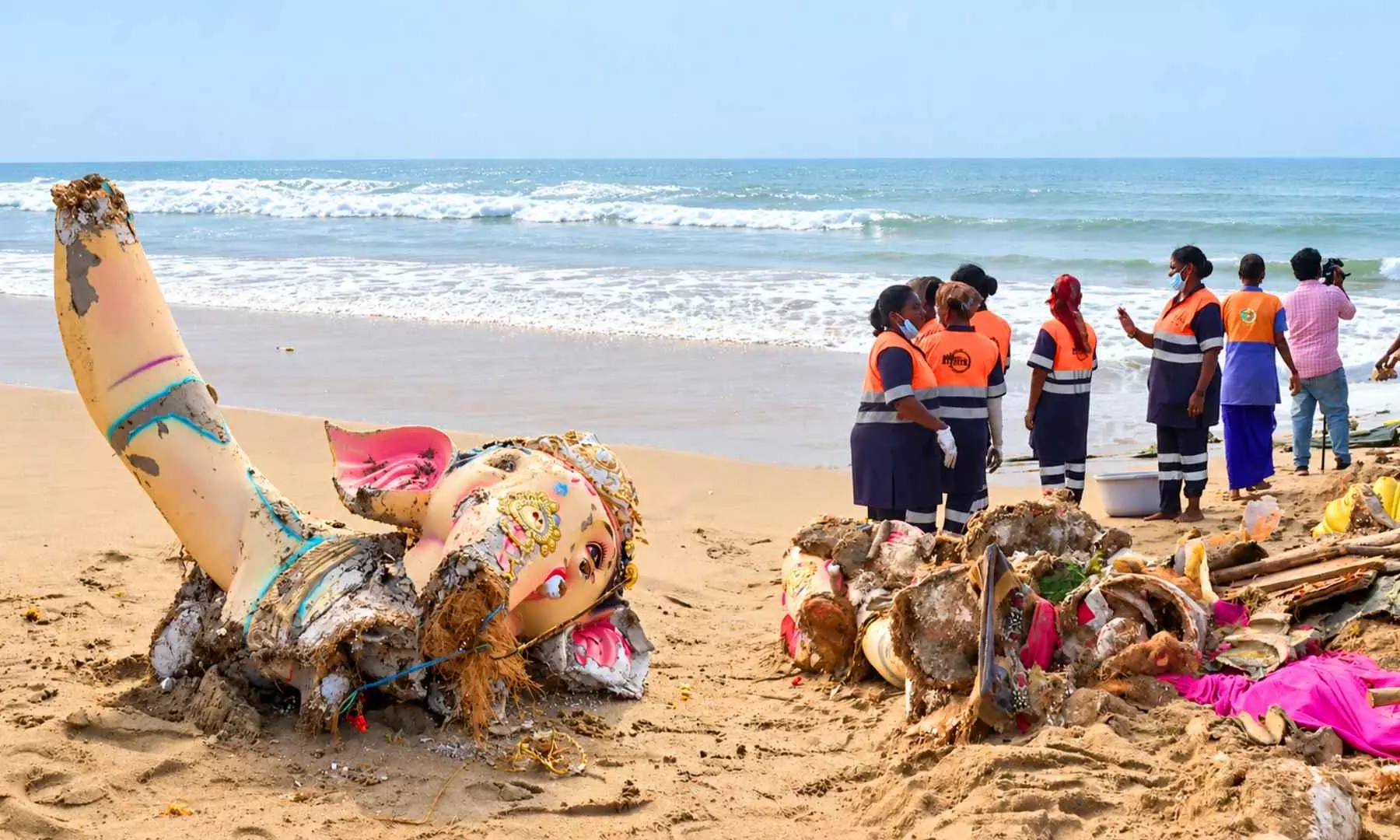
A total of 1,562 Ganesha idols were installed at public places across Chennai, of which 1,247 were immersed at Pattinapakkam beach.
Ganesha immersion leaves 930 tonnes of waste | Why do broken idols return to shore?
Broken idols, wooden frames and debris washed up at Pattinapakkam and Kasimedu after immersion. Does the problem lie in the immersion process or the idols?

A week after people celebrated Ganesh Chaturthi, it was time to bid farewell to the elephant god. On Sunday (September 20), several beaches and water bodies across cities witnessed immersion processions of Ganesha idols.
Chennai’s Pattinapakkam and Kasimedu beaches were no exception. The shores were littered with broken Ganesha idols, wooden frames and other debris after the immersion processions.
Rough waves later pushed several of the immersed idols back onto the shore, leaving the beaches strewn with remnants of the celebrations. Debris was reported along the stretch from Pattinapakkam to Nochi Kuppam and across Kasimedu beach.
Also read: Ganesh Chaturthi: How Indian states celebrate birth of Lord Ganesha
A total of 1,562 Ganesha idols were installed at public places across Chennai, of which 1,247 were immersed at Pattinapakkam beach. Several idols were not taken to a sufficient depth before being released into the sea.
PoP idols return
The problem was particularly with idols made from plaster of Paris (PoP) and chemical paints. Unlike clay idols, these materials do not dissolve easily in water.
Instead, they can break apart and wash back onto the shore, adding to the waste already present on the beaches. Wooden structures used to construct the idols were also found scattered along the sand.
The issue comes despite arrangements for clearing the waste. Greater Chennai Corporation sanitation workers began clean-up operations at around 10 pm on September 20, with nearly 80 sanitation workers working in shifts.
930 tonnes cleared
The debris was cleared promptly, and by the following morning, there was no significant accumulation of idol waste on the beach. Notably, nearly 930 metric tonnes of solid waste was removed following the immersion operations between September 19 and September 20.
Also read: Shivakumar says no curbs on Ganeshotsava amid BJP charges of police restrictions
Chennai had designated multiple locations for idol immersion, including Srinivasapuram in Pattinapakkam and the Kasimedu Fishing Harbour. Police had also deployed cranes and boats to assist with the immersion process.
But the waste washing back onto the shore raises a larger environmental question - what happens during immersion and what the idols are made of?
The larger question
Every year, Ganesha idols are reported to wash back onto beaches after immersion in different parts of India. The beaches may be cleaned by morning, but the waste brought back by the waves points to a problem that cannot be solved by clean-up operations alone.
Despite guidelines on the use of eco-friendly Ganesha idols and arrangements made for immersion, the return of broken idols with the waves raises questions on who is accountable for this — those conducting the immersion, those making the idols, or the authorities overseeing the process?