Is Diwali losing its light in Tamil Nadu? Loud crackers, smog spell death of a tradition
Tamil Nadu’s Diwali celebrations now leave behind toxic air and health hazards as the festival of lights gets increasingly disconnected from its roots

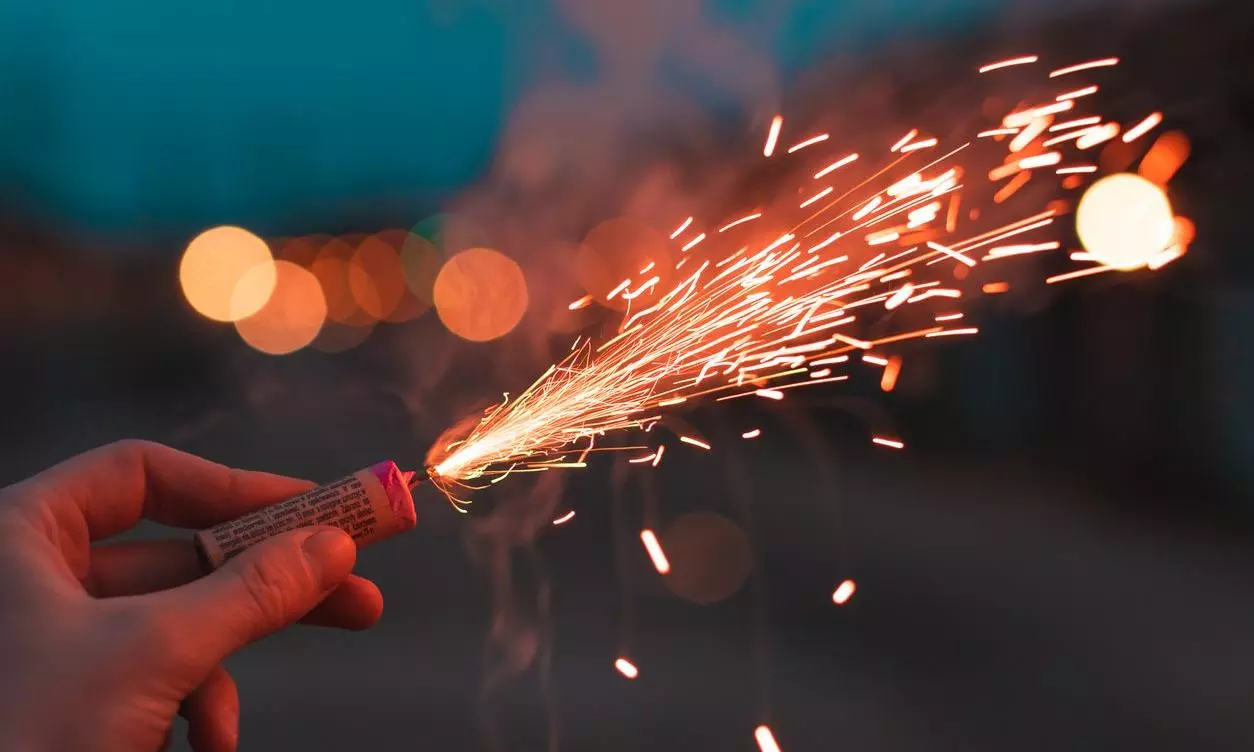
For ages, Diwali in Tamil Nadu was all about the glow of lamps, sharing sweets, and the joy of togetherness. But things are a-changing, like most other parts of the country; nowadays, the “festival of lights” seems to begin and end with a contest of how loudly the crackers can explode.
“There are no historical inscriptions or other evidence to suggest that bursting crackers was part of traditional Tamil celebrations,” historian Komagan pointed out. “Today, however, social pressure and commercial interests have made firecrackers almost compulsory during festivals. And the essence of Diwali has gradually been diluted,” he added.
The result was evident in how Tamil Nadu celebrated Diwali this year. Chennai burst crackers through the night, seemingly oblivious to the consequences. The roads were shrouded in a thick blanket of smog that motorists struggled to navigate, a tennis final had to be postponed, and the ailing and elderly struggled to breathe. Long after the fireworks faded, the city choked on the fallout of hours of relentless bursting of firecrackers.
Vehicles move along a road enveloped in thick smog caused by firecracker bursting during Diwali celebrations in Chennai on Sunday, November 8. PTI Photo
Shift from tradition
Ironically, even today, Diwali or Deepavali is celebrated the world across as the “festival of lights”. The name comes from “deep” or lamp, and fireworks were never a central part of the festival. In fact, fireworks, though known to India for several centuries, remained largely confined to royal celebrations and select urban festivities even during the colonial era.
Also read: No crackers, just sweets for Diwali: How a TN village makes room for migratory birds
The association of firecrackers with Diwali grew gradually from the 19th century onwards and accelerated after Independence, when government policies and expanding domestic production enabled Tamil Nadu’s Sivakasi to emerge as India’s firecracker hub. By the 1980s, rising incomes, urbanisation and mass availability had transformed bursting crackers from a limited spectacle into a widespread Diwali tradition across the country.
“Tamil festivals have traditionally never involved practices that harm people, animals or the environment, Komagan pointed out. “Tamil culture, in fact, emphasises that festivals should not harm anyone. There is no historical record of crackers being burst on such a scale, with such little regard for public health and the environment,” he added. “We should also think about the waste they generate, the burden of cleaning it up and the trauma caused to animals.”
Chennai among most-polluted cities on Diwali night
However, revellers in Tamil Nadu did not seem to think of any of these while celebrating Diwali this year. The scale of pollution in Chennai was particularly alarming, even though a post-Diwali deterioration in air quality is expected. Unexpectedly, Chennai topped the list of most polluted cities in the world on AQI.in for a major part of Diwali evening, with the score going up past 1000 after 9 pm. Chengalpattu was right behind.
According to a Tamil Nadu Pollution Control Board (TNPCB) survey across seven stations in Chennai, the city recorded an average AQI of 281.7 (poor) this year, compared to last year’s 259. Valasaravakkam recorded the highest AQI at 343, followed by Nungambakkam (332), Sowcarpet (311) and T Nagar (306), all falling under the very poor category.
Also read: Diwali toll: Fires, firecrackers, violence leave trail of deaths across country
With firecrackers being burst well beyond the prescribed hours, noise levels also increased, with Chennai recording its highest average decibel level since 2017. The average noise level stood at 83.8 dB(A), compared to 77.9 dB(A) in 2025. Valasaravakkam again recorded the highest level.
An analysis of AQI data for 2024, 2025 and 2026 across 39 monitoring locations in 17 districts of Tamil Nadu shows a continued deterioration in air quality. The average AQI rose from 143.46 in 2024 to 161.69 in 2025 and further to 168.97 in 2026, an increase of approximately 4.5% over the previous year.
Players, the match referee, medical officials, and tournament organisers discuss the playing conditions as thick smog engulfs the SDAT Tennis Stadium ahead of the singles final of the WTA 250 Chennai Open tennis tournament in Chennai on Sunday, November 8, which was Diwali. The match was eventually postponed. PTI Photo
How weather played spoilsport
The numbers reflect what residents experienced on the streets: Smoke that refused to clear and air that was increasingly difficult to breathe. The weather only compounded the problem. Brief morning showers did little to wash away pollutants, while light winds and overcast skies prevented the smoke from dispersing.
“The rain was brief and occurred only in the morning. There was no significant rainfall in the evening or at night to improve air quality. Smoke from firecrackers, coupled with light winds of less than 10 kmph, kept pollutants close to the surface, forming a thick haze,” VR Durai, head of the Regional Meteorological Centre (RMC), told The Federal.
“Overcast conditions throughout the day also restricted surface heating. Higher temperatures help increase the mixing height, allowing pollutants to disperse. But during winter, limited surface heating results in a lower mixing height, trapping pollutants closer to the ground,” he added.
No heed to SC-imposed curbs
What made the pollution worse was the utter disregard for the restrictions meant to contain it. The Supreme Court has stipulated two time windows for bursting firecrackers — 6am to 7am and 8pm to 10pm — but the curbs did little to prevent bursting crackers beyond the permitted hours.
“My 68-year-old mother had to endure the incessant noise of firecrackers throughout the day. By Monday morning (day after Diwali), she was complaining of heaviness in her chest and difficulty breathing,” complained R Srikanth, a Saidapet resident.
Also read: Indian cities dominate world’s most-polluted 150 on Diwali evening; 6 cross AQI 1000
The disregard for safety was equally disturbing. Some youngsters turned firecracker bursting into dangerous stunts, holding crackers in their hands and encouraging their peers to do the same. “Just imagine a child bursting a 100-piece cracker in his hand. It is only a matter of time before someone gets hurt,” grumbled S Subramani, another Saidapet resident.
The alarming health toll
The health toll was also reflected in hospital figures. The state health department recorded 1,322 outpatient cases and 430 inpatient cases related to burns. Doctors also reported an increase in consultations for respiratory complaints on Monday (November 9).
“There has been a 50% increase in the number of patients complaining of breathing difficulties. We even saw a 10-month-old child develop rashes, possibly after being exposed to pollutants through a towel that had been hung out to dry on a terrace. In countries such as Singapore, which also celebrate Diwali, the use of firecrackers is restricted to sparklers. While governments must do their part to enforce restrictions, people too must cooperate by adhering to them,” said allergist Dr Swasum Kamal.
The scale of the smog was impossible to ignore. Social media was flooded with videos and photographs of commuters struggling through roads with near-zero visibility in different parts of Chennai. The WTA Chennai Open singles final, scheduled at the SDAT Tennis Stadium in Nungambakkam, was postponed amid poor air conditions. Defending champion Janice Tjen of Indonesia also took to social media to share visuals of the thick smog engulfing the city.