







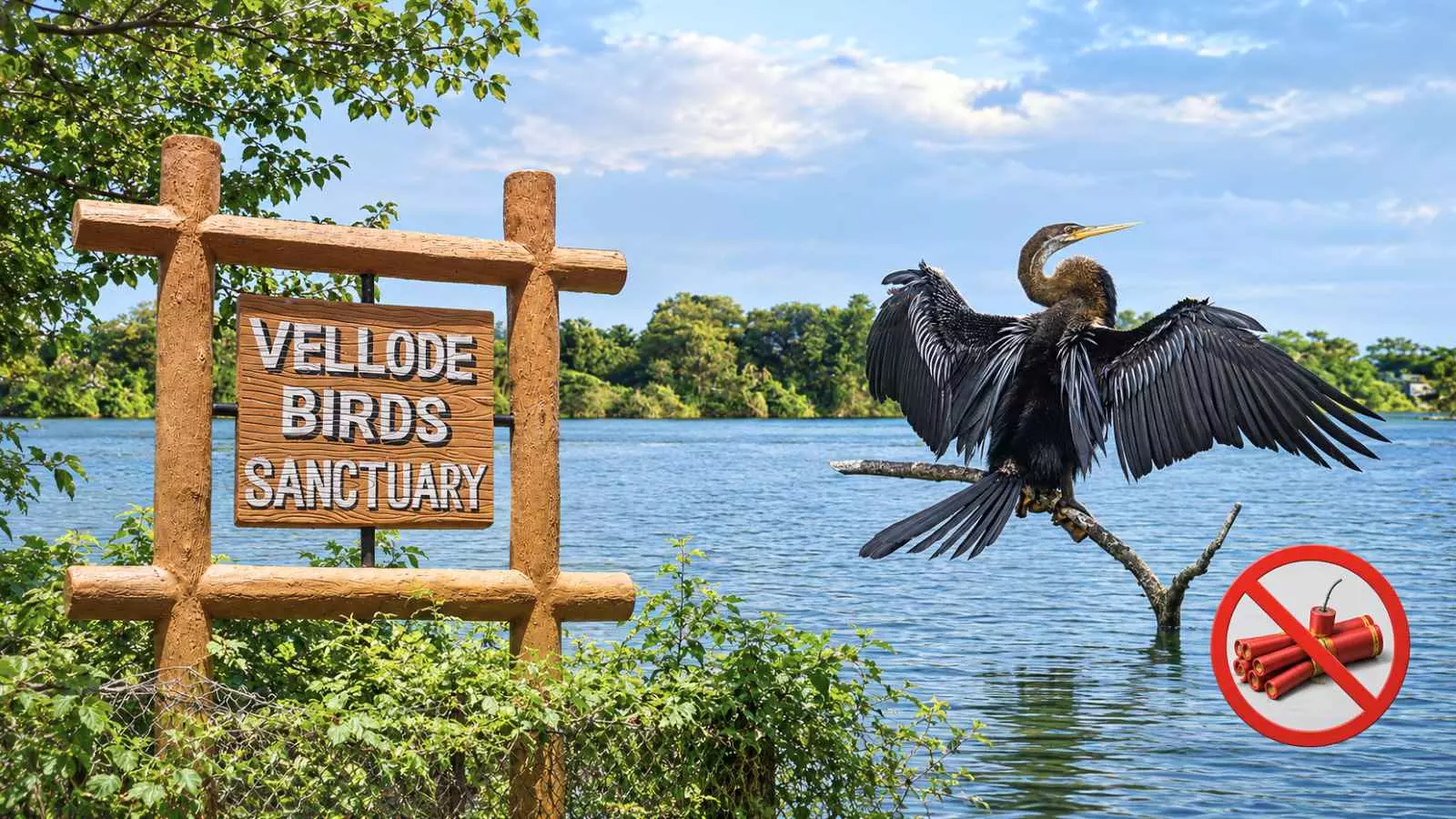
No crackers, just sweets for Diwali: How a TN village makes room for migratory birds
Over a dozen villages in Tamil Nadu's Erode have been celebrating a cracker-free Diwali to protect thousands of resident and migratory birds at Vellode Bird Sanctuary

Diwali without firecrackers? Yes. For the sake of migratory birds? Yes.
Welcome to a cluster of villages in Tamil Nadu’s Erode district.
Residents of more than 10 hamlets around the Vellode Bird Sanctuary have voluntarily given up bursting crackers to protect the birds that visit each year, a tradition they have upheld for 20 consecutive years.
Located about 10 km from Erode, the sanctuary becomes a haven for thousands of resident and migratory birds every year as the bird season begins in October. Painted Storks, Asian Openbills, Black-headed Ibises, Little Cormorants and Grey Herons arrive in large numbers. They are joined by migratory birds travelling from as far as Siberia, Russia, Australia and New Zealand, including Pelicans, Sandpipers, Caspian Terns and Black-necked Storks. Officially, there are over 100 bird species.
The birds feed on the fish in the sanctuary's pond, build nests and rear their chicks before eventually migrating back. With the bird season coinciding with Diwali, the villagers have chosen to keep the celebrations quiet, ensuring that the noise and smoke from firecrackers do not frighten the birds or disrupt their breeding.
Birds can stay, in peace
Residents of more than 10 neighbouring hamlets, including Mettupalayam, Pungambadi and Ellapalayam, instituted a voluntary ban on firecrackers two decades ago. For them, giving up one of the festival's most familiar traditions is a small price to pay for the thousands of birds that make the sanctuary their home during the season.
The villagers' decision to keep firecrackers away also reflects the impact that fireworks can have on wildlife. The sudden, loud and unpredictable bursts of sound can frighten birds, disrupt their resting patterns and trigger panic flights. Research has shown that fireworks can cause birds to abandon their usual roosting sites and experience stress.
The impact is not limited to noise. Firecrackers release fine particulate matter, sulphur dioxide, nitrogen dioxide and metals into the atmosphere, contributing to air pollution. Chemical residues can also settle on the ground and enter nearby water bodies, raising concerns for sensitive ecosystems such as wetlands.
Diwali with new attire, but no noise
Local resident Kalpana said the community made the decision willingly. "We willingly give up this joy so the birds are not frightened away by the noise of crackers. We want them to live and thrive here," she told PTI.
The Vellode Bird Sanctuary, spread across 240 acres, has a 50-acre pond that can hold water up to 30 feet deep. The waterbody is sustained mainly by seepage from the Lower Bhavani Project canal and monsoon runoff, providing habitat for the birds that arrive every year.
Efforts to preserve the sanctuary's avian visitors have also included habitat improvements. Following a severe dry spell a few years ago that left the area parched, the sanctuary was rejuvenated at a cost of Rs 2.35 crore. The upgraded facility now has strengthened bunds, miniature bridges, walkways, a butterfly park and designated selfie points, making it an eco-tourism destination in the region.
The absence of firecrackers, however, does not mean the festival loses its cheer.
Residents continue to celebrate Diwali by wearing new clothes and preparing sweets, while villagers in nearby areas such as Chellappampalayam, Koothampalayam, Vadagalpudur and Kalarpalayam continue with their traditional festivities.
"We celebrate joyously by wearing new clothes and making sweets. It is a sacrifice we gladly make for the birds. Seeing them arrive in such large numbers is a feast for the eyes," Kalpana added.
Also read: Environmental group demands firecrackers ban in Nilgiris to protect wildlife
For these villagers, Diwali is not about giving up celebrations, but about changing how they celebrate.
And for 20 years, that has meant keeping the crackers away so that the birds can continue to arrive, nest and thrive in peace.