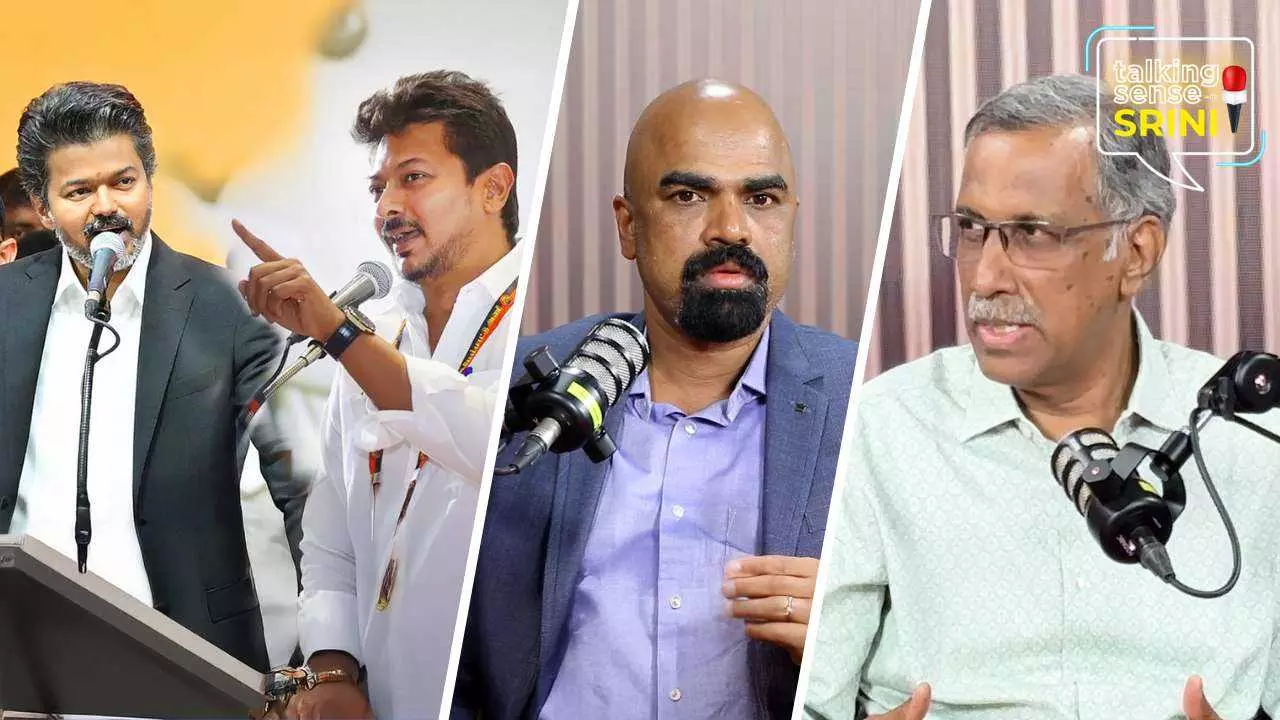
Did DMK leave Tamil Nadu in a debt crisis, as Vijay claims? | Talking Sense With Srini
Experts say Vijay’s victory reflects growing demands for jobs, dignity and economic opportunity, not necessarily a rejection of the Dravidian model itself

Tamil Nadu’s new Chief Minister C Joseph Vijay has begun his tenure with a familiar political refrain: accusing the previous government of leaving behind a financial mess. In his inaugural address at Chennai’s Nehru Stadium, Vijay alleged that the DMK regime had burdened the state with debt of nearly Rs 10 lakh crore, while promising a “white paper” on the state’s finances.
On Talking Sense With Srini, The Federal’s Editor-in-Chief S Srinivasan and economist Kalaiyarasan A argued that such accusations are common during political transitions, but warned against reducing Tamil Nadu’s economy to a debt narrative alone.
Fiscal debate meets politics
Srinivasan described Vijay’s speech as “extraordinarily different” and more theatrical than conventional political addresses. However, he noted that blaming predecessors for empty coffers has become routine. “When PTR Palanivel Thiagarajan became finance minister after the AIADMK government lost power in 2021, he made similar remarks and even released a white paper,” he said, adding that Tamil Nadu’s finances “aren’t that bad” despite continuing welfare commitments.
Also read | Free power, women’s safety, anti-drug push: Vijay's first orders as TN CM
Kalaiyarasan welcomed Vijay’s proposal for a white paper, calling it an exercise in transparency and “stocktaking” for a new government. According to him, the document should outline debt levels, fiscal liabilities, expenditure patterns and the status of government promises. “Citizens should know the condition the previous government left behind and the constraints within which the new government must operate,” he said.
Dravidian model at crossroads
But beyond the fiscal debate, the discussion centred on whether the 2026 mandate signals the end of the “Dravidian model”, Tamil Nadu’s long-celebrated combination of economic growth and social welfare.
Kalaiyarasan rejected the notion outright. “The Dravidian model is not tied to one party. It is an idea where growth happens alongside inclusion and development,” he argued. Tamil Nadu, he said, remains distinct from states that achieved industrial growth without strong human development indicators, or vice versa.
Also read | Why Vijay's TVK win doesn't mark the end of Dravidian politics in TN
Yet both acknowledged emerging fault lines, particularly among the youth. Despite Tamil Nadu’s high gross enrollment ratio in higher education and double-digit economic growth in recent years, many young people feel excluded from the benefits of growth. “The welfare state cannot compensate for the absence of decent jobs,” Kalaiyarasan observed, pointing to concerns over employability, stagnant wages and skill mismatches.
What next for Tamil Nadu?
Srinivasan echoed this concern, arguing that Tamil Nadu now faces “second-generation” challenges. “It’s no longer enough to compare Tamil Nadu with Bihar or Uttar Pradesh. The question now is: what next?” he asked.
The discussion concluded that Vijay’s victory may not represent a rejection of the Dravidian model itself, but a demand to reinvent it, shifting the focus from access and welfare to quality, dignity and meaningful economic opportunity.