Why Vijay's TVK win doesn't mark the end of Dravidian politics in TN
The right wing sees TVK's Tamil Nadu sweep as Dravidian politics' death knell. But Vijay's ideology, alliances, and first act tell a different story

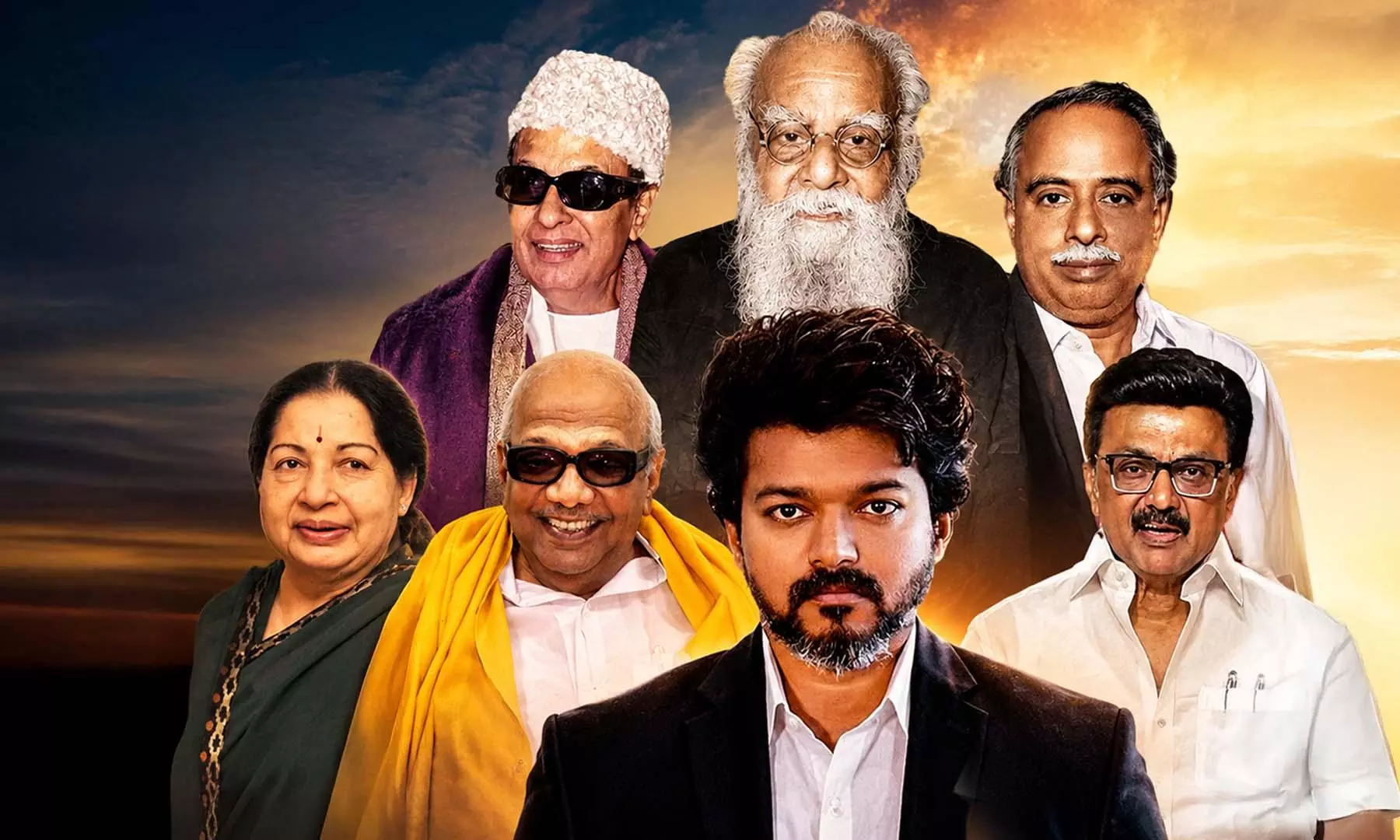
When Vijay's TVK swept Tamil Nadu's 2026 elections, winning 108 seats in its very first contest, shattering six decades of Dravidian duopoly, parts of the right were quietly celebrating. For the first time since CN Annadurai brought DMK to power in 1967, a party without "Dravida" in its name governs the state. Vijay positioned the DMK as the theeya sakthi, the dark force, and he won.
But declaring him anti-Dravidian would be jumping the gun.
Same politics, different face
Look at the schemes, because this is where the MGR-Jayalalithaa echo becomes impossible to ignore. MGR built his politics on one foundational idea: the state as protector of the poor. Jayalalithaa took it further, gold for brides, mixers and grinders, laptops, Amma Canteens.
Also Read: Vijay’s day out as TN CM; takes oath in Assembly, meets Stalin, Vaiko
Now look at Vijay's manifesto — Rs 2,500 every month for women heads of households, six free LPG cylinders a year, free electricity, 8 g of gold and a silk saree for brides from poor families, with the government explicitly cast as the elder brother stepping in for every girl's wedding, a gold ring for every newborn, 100 residential schools named after Kamaraj.
This is not a new politics. This is the same politics — wearing a new face, speaking a new language, but running the exact same operating system that Karunanidhi, Jayalalithaa, and Stalin perfected.
His alliances speak for themselves
The TVK won 108 seats, short of a majority. The parties that came to its aid are the Congress, VCK, CPI, CPI(M) and the IUML. A sizeable section of the AIADMK is keen to step in now.
Their support is not despite Vijay's politics, but because of it. At his swearing-in, he committed to delivering a "secular and socialist government." In an otherwise brief post-oath statement, those were the only words that carried ideological weight.
And what are the tenets of Dravidian politics? Social justice, secularism, women's empowerment. All squarely part of TVK's promises.
The Sangh may actually be celebrating the conspicuous absence of anti-Brahminical rhetoric in Vijay's speech and actions. The appointment of P Venkataramanan from Mylapore has only reinforced that reading. But one shouldn't forget that the AIADMK — a party founded on Dravidian soil — was headed by J Jayalalithaa, a Brahmin. The precedent for a non-stereotypical Dravidian leader is not new.
Vijay may have skipped "Dravida" in his party's name. That doesn't make his ideology less Dravidian. TVK's charter explicitly draws from Periyar, Ambedkar, and Kamaraj. He called the BJP his ideological enemy — not a rival, not an opponent, but an enemy.
Standing barefoot before the rationalist
In September 2024, before a single vote had been cast, Vijay walked into Periyar Thidal on the rationalist leader's 146th birth anniversary. He took off his slippers, garlanded the statue and stood in the afternoon heat and paid his respects, to a man who would have found such reverence deeply ironic.
Then, on May 10, after he was sworn in as Tamil Nadu's 13th Chief Minister, Vijay's first act was not a press conference or a policy announcement. He went back to Periyar Thidal.
Also Read: Vijay, the man who says very little: Is silence golden in politics too?
He had the entire symbolism of a historic electoral victory at his disposal. He chose to spend the first hours of his Chief Ministership standing barefoot before a rationalist who rejected all ritual.
That is not an accident or just optics. That is a man who has read Tamil Nadu's political grammar with absolute fluency. Because, in this state, visiting Periyar Thidal is not contradictory to faith. It is the secular Dravidian faith. And every serious chief minister has genuflected before it.
The rationalist who became ritual
The right's celebration over Vijay's triumph may be more premature than it first appears. This is, after all, the same Joseph Vijay who was visiting churches and temples in the run-up to the election. So how does one make sense of this irony — the co-existence of Dravidian ideas and personal spiritualism?
There is a frame from the Tamil film Meiyazhagan that offers the entire explanation: Periyar's photo, garlanded, placed right next to Murugan's. Both garlanded and honoured.
Periyar, for those who need a reminder, was a radical rationalist. A man who smashed idols in public and called God a fiction and religion a tool of oppression. He spent his entire life fighting the very impulse to worship. And yet — here he is, garlanded an almost deified.
This is the central irony of Tamil political culture. The man who fought idol worship has himself become an idol. The rationalist has been ritualised. And far from being a contradiction, this coexistence of Periyarist thought and folk faith — of Dravidian politics and temple bells — is not a glitch in the system. It is the system.
Tamil Nadu has always known how to hold its contradictions together. How to be rationalist and reverent. How to be anti-caste and yet temple-going. How to vote for secularism and still seek blessings.
Vijay didn't create that synthesis. He just stepped into the space it had always kept open.