


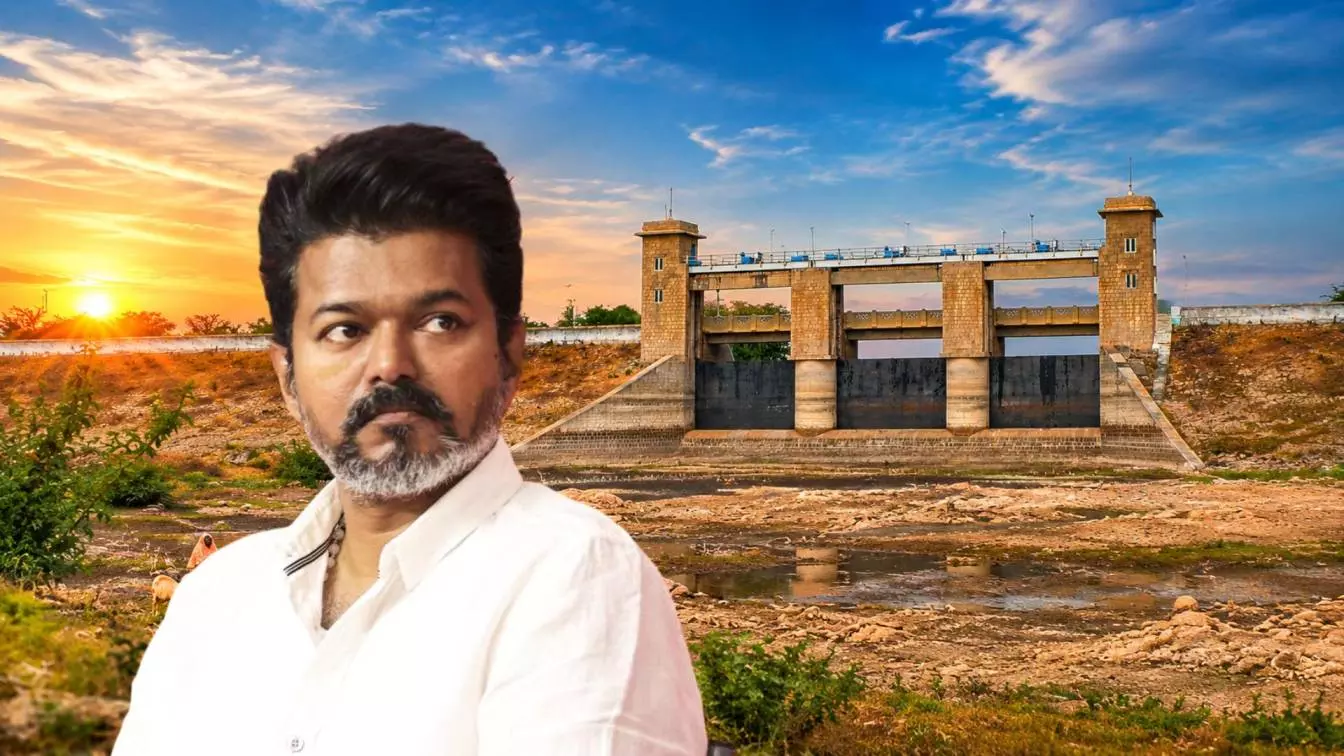
Uppar farmers say their dam has long been starved of water, while PAP farmers argue that their own command area cannot spare what little remains.
How a bitter water war is at the centre of Dharapuram bypoll
As Dharapuram votes on October 6, two farmer groups are locked in a water dispute over PAP surplus, Uppar dam and alleged canal pilferage

Water has emerged as a major issue in the Dharapuram bypoll, with two groups of farmers fighting over the same source. The dispute has now reached the Madras High Court.
The conflict pertains to the dry Uppar Dam, once built to store surplus water from the Parambikulam Aliyar Project (PAP). While Uppar Dam farmers have been demanding water from an alternative source, especially from the Thirumoorthy reservoir, farmers living about five kilometres from the dam are allegedly opposing the demand.
Uppar's needs
A board at the dam records that its catchment area is 34.95 square miles, its water spread is 1,000 acres and its full reservoir level is 906 feet. Construction began in January 1965 and was completed in September 1968 at a cost of around Rs 80.8 lakh.
The farmers use a different set of numbers to describe the dam. They say it can hold around 576 million cubic feet, or just over half a thousand million cubic feet (TMCft), and directly irrigate around 6,060 acres through its left and right bank canals.
Also read: Dharapuram bypoll: Why Arunraj insists TVK has an edge over AIADMK
They also claim that the dam indirectly benefits between 10,000 and 15,000 acres, mainly by recharging wells and also catering to the drinking water needs of villages along its stretch.
For two decades after its construction, surplus water from the Parambikulam-Aliyar Project was routed to Uppar Dam through the Arasur sluices, usually once a year. Farmers say this made paddy cultivation possible.
The command area was later widened, divided into zones and rotated. But Uppar Dam was excluded from it. Uppar Dam farmers allege that the supply of surplus water became intermittent and eventually almost negligible. They trace the prolonged dry spell to the 1990s.
They claim to have received irrigation water only two or three times over three decades. Farmers also say the dam received barely 10 days' worth of water last year.
PAP pressure
On the other side are farmers directly dependent on PAP. The Parambikulam Aliyar Project is an interstate irrigation project involving Kerala tunnels and a contour canal that diverts west-flowing rivers originating in the Anaimalai range towards Tamil Nadu.
Also read: Vijay storms AIADMK fortress, claims he alone fights DMK like MGR and Jayalalithaa
Under the agreement, Tamil Nadu is entitled to 30.5 TMC, with the project supervised by a Joint Water Regulation Board. The Thirumoorthy reservoir on the Palar river has a capacity of 1,935 million cubic feet, with most of its water coming from diverted sources rather than local rainfall.
The PAP command area is around 3.77 lakh acres and is divided into four zones of roughly 95,000 acres each. In a year, only two zones receive water.
The system was originally designed for a single seasonal crop, but agricultural patterns in the Kongu region have changed. Coconut, a major plantation crop, requires water every day. Farmers estimate the requirement at about 10,000 litres per acre.
As wells have gone deeper, the open canal has become a source of growing conflict. This season, farmer representatives say the PAP system held around 23 TMC at this time last year, compared with only about 8 TMC now.
To provide relief, the Tamil Nadu government on October 1 issued an order allocating Rs 14.9 crore for dredging PAP canals after the Election Commission cleared administrative sanction. The Water Resources Department expects water to reach the canals by the end of October.
Competing claims
The dispute has left the two groups making competing claims. One side argues that Uppar Dam is not receiving enough water to meet its needs, while the other says the PAP command area itself is short of water.
Farmers on the PAP side have demanded that dead ayacut areas be surveyed, water pilferage stopped and surplus water released to beneficiaries.
Also read: TVK accuses Stalin of ‘body-shaming’, asks EC to revoke his star campaigner status
One farmer argues that the existing PAP rotation is inadequate. The project provides four zones with nearly five irrigations per zone, but farmers say the cycles do not suit the region's changing agricultural needs.
The PAP side also points out that Uppar Dam was intended to receive only surplus water.
The Uppar farmers, meanwhile, point to the dam's long history of poor irrigation. They say that nearly 30 years after its completion, they have received full irrigation only two or three times.
Pilferage claims
The two farmer associations allege rampant pilferage from the PAP main canal, which is an open channel.
Uppar farmers point to quarry units and poultry farms, while PAP farmers allege unauthorised irrigation along the canal bank and say the use exceeds permitted irrigation capacity.
Farmers in tail-end villages of Dharapuram say they are the last to receive water and the first to be cut off.
Both Uppar and PAP farmers agree that groundwater alone is not enough to sustain coconut plantations when the canals fail. They also point to the same possible alternative: diverting surplus water from the Amaravathi river to Uppar.
Alternative link
Farmers say a seven- to eight-kilometre channel from the Amaravathi River could help meet the demand for surplus water.
The proposal is not new. During the earlier DMK regime, a draft Bill had proposed an allocation of around Rs 18 crore to convert PAP from a canal system into a pipeline on a pilot basis.
That proposal did not survive the change in government. Similar proposals involving alternative water sources also failed to move forward.
Uppar farmers have now approached the court. They say the PAP side has filed its counter-affidavit.
The court has sought a committee to measure irregularities in the PAP system and determine how much water could actually be saved. Farmers say the committee is yet to be constituted.
Bypoll factor
The timing of the dispute is politically significant. Dharapuram is voting in a bypoll on Tuesday (October 6) after former AIADMK MLA P Sathyabama resigned and joined the ruling Tamilaga Vettri Kazhagam (TVK). She is contesting the seat again as the TVK candidate.
Also read: Tamil Nadu bypolls will put political defections to the voter test
PAP farmers recently stopped Sathyabama at Kundadam and questioned why PAP water should be sent to Uppar.
PAP Project Committee chairman Medical K Paramasivam has said that releasing water would be justified only if there is a genuine purpose. Recent reporting also identifies Paramasivam as chairman of the Thirumoorthy Reservoir Project Committee.
Water Resources Minister N Anand visited Dharapuram during the bypoll campaign and asked officials to act on complaints related to PAP and take action against water pilferage.
Uppar farmers complain that no action has been taken so far. Senior TVK minister K A Sengottaiyan also promised farmers that an arrangement would be made, but farmers say nothing has been initiated.
Government's balancing act
The Tamil Nadu government has assured farmers that it is in talks with the Kerala government to obtain water from the Thirumoorthy reservoir.
Kerala's own claim over PAP water is part of a separate and older dispute. Unlike Tamil Nadu, which farmers say lacks a strong monitoring mechanism, Kerala requires any additional water to be released only with the agreement of the Joint Water Regulation Board.