AIADMK crisis: Can EPS stop exodus and revive party faith?
Built on the near-religious devotion of MGR and Jayalalithaa, the Dravidian heavyweight faces a terminal identity crisis as prominent names defect to other camps

For decades, the All-India Anna Dravida Munnetra Kazhagam (AIADMK) was more than just a political party. It was a movement built by former Tamil Nadu chief minister M G Ramachandran and later strengthened by J Jayalalithaa, another former chief minister, through a powerful emotional connection with supporters across the state.
Today, however, the party finds itself facing growing internal unease. Senior leaders have left, elected representatives have moved away from the party, and cadres are increasingly questioning its direction under Edappadi K Palaniswami (EPS), the outfit's general secretary and another former CM.
Also read: AIADMK split deepens as EPS faces rebellion after trust vote
The growing exodus from the AIADMK has reignited a debate within Tamil Nadu politics: Has EPS failed to protect and rebuild the party after Jayalalithaa's death a decade ago?
Deep loyalty
The AIADMK's strength was rooted in a level of emotional loyalty rarely seen in Indian politics.
Supporters tattooed the party's iconic two-leaf symbol on their bodies. Many cadres donated personal savings and even family property to support the movement.
Some supporters went to extraordinary lengths to express their devotion after MGR and Jayalalithaa passed away. The party became an emotional identity for lakhs of people across Tamil Nadu.
Leaders leave
The immediate trigger for the current debate is the growing number of leaders and party functionaries distancing themselves from the AIADMK.
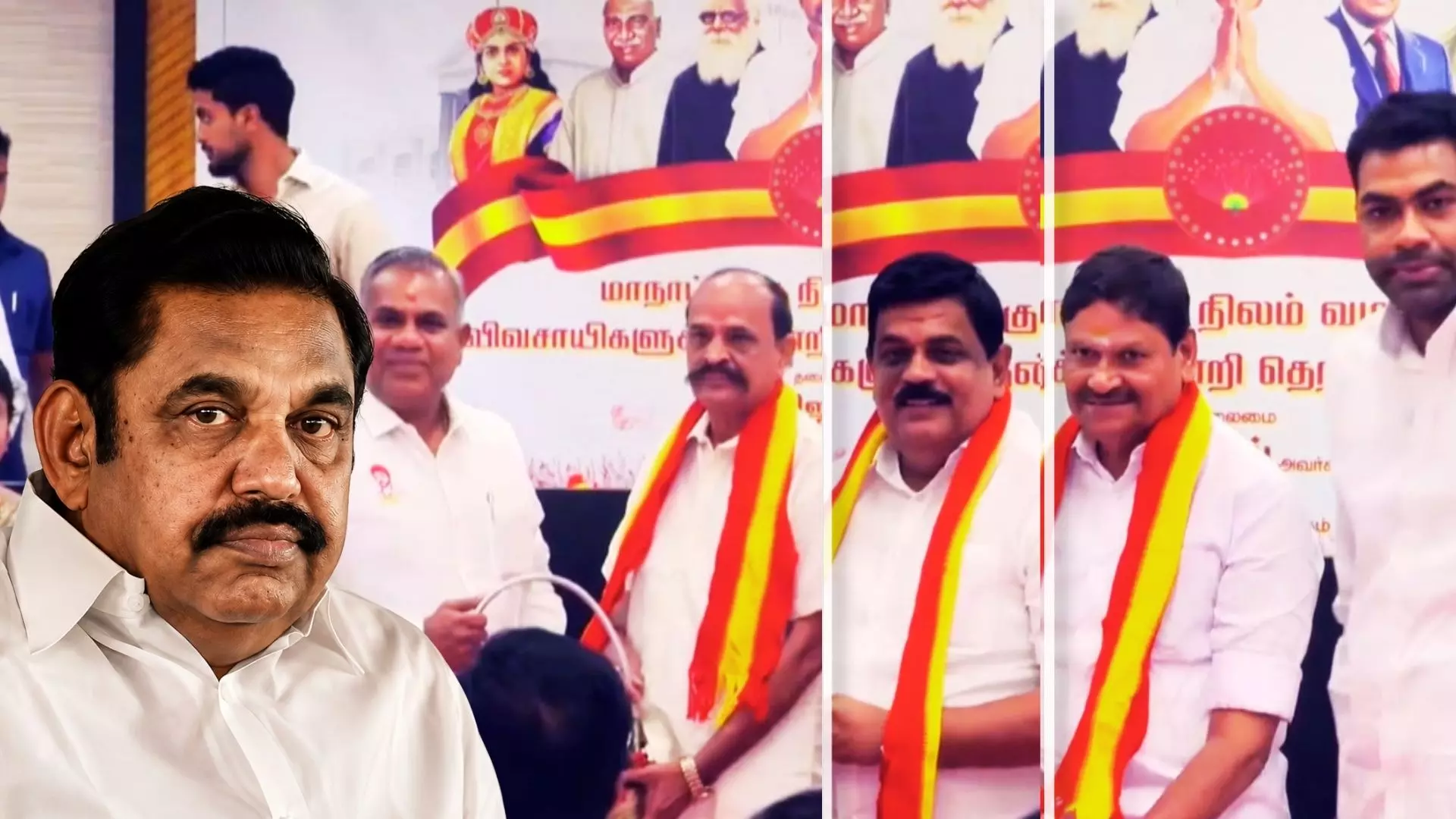
Several leaders and elected representatives have either left the party or joined actor-turned-politician Joseph Vijay's Tamilaga Vettri Kazhagam (TVK), which is currently leading Tamil Nadu's ruling coalition. Vijay is the chief minister of the new government that took over in May. Several even joined the Dravida Munnetra Kazhagam, which is known to be the AIADMK's arch-rival in Tamil Nadu politics.
For a party that once dominated Tamil Nadu politics, defections represent more than a numerical loss. They often signal changing levels of confidence within the organisation.
Many party workers privately acknowledge that morale inside the AIADMK is among the lowest seen in decades.
Electoral setbacks
Criticism of EPS has intensified because of the party's electoral performance in recent years.
Since taking full control of the AIADMK, the leader has overseen a series of setbacks in Assembly elections, parliamentary elections, local body polls and by-elections.
Also read: Vijay's floor test win: Is AIADMK going the Shiv Sena way?
Critics argue that he has not succeeded in rebuilding the party after Jayalalithaa's death. Supporters, however, maintain that he inherited a deeply divided organisation and managed to keep it functioning despite pressure from rivals and internal factions.
Political observers often judge leadership through electoral outcomes, and repeated defeats have weakened grassroots confidence.
TVK challenge
The rise of Vijay's TVK has emerged as a fresh challenge for the AIADMK. Many observers note that the new force attempting to occupy the same political space that once belonged almost exclusively to the AIADMK — charisma-driven politics backed by youth mobilisation and emotional appeal.
Nirmal Kumar, a minister in the current TVK-led government who was earlier a member of the AIADMK, was sharply critical of EPS's leadership.
"Today, EPS appears to be in a position where, if offered a ministerial post, he would sell the party to the BJP. If given a Rajya Sabha MP seat, he would align with DMK. It feels like there is neither trust in him nor the party. It is quite disheartening," he said.
Former AIADMK leaders who have moved to the TVK have also highlighted the attraction of Vijay's growing movement.
Also read: AIADMK tussle: Rebel group wants party chief Palaniswami to be disqualified as MLA
Former AIADMK minister Udumalai K Radhakrishnan said, "Today, the TVK has come as an alternative to the DMK. We aim to stand as a pillar and do good for the people."
Former AIADMK minister N R Sivapathi said, "Today, TVK is the only party with a large number of young people. That is why we are making use of the opportunities available within this party."
Emotional history
To understand concerns among AIADMK supporters, many point to the party's emotional history.
When MGR died in 1987, Tamil Nadu witnessed widespread public grief. Devoted supporters viewed him as more than a political leader, and many struggled to come to terms with his death.
The emotional bond continued during Jayalalithaa's leadership. Supporters referred to her as "Amma", while women cadres contributed jewellery and personal savings to strengthen the party.
Following the AIADMK's 2011 election victory, reports emerged of a woman supporter in Theni cutting her tongue as an offering to God in celebration.
Such incidents reflected the intensity of emotional attachment that existed between the party and its cadre base.
Identity crisis
Within the AIADMK, concerns extend beyond electoral defeats.
Many supporters fear the party may gradually lose the identity that distinguished it during the Ramachandran and Jayalalithaa eras.
Under Ramachandran, the party combined welfare politics with mass appeal and personal charisma. Under Jayalalithaa, it revolved around a central leader with unquestioned authority.
Following Jayalalithaa's death, the party entered a prolonged succession battle. Factions emerged, senior leaders competed for control, and the cadre base became increasingly fragmented.
Also read: Fresh setback for AIADMK as four MLAs join ruling TVK
EPS eventually established himself as the dominant leader. However, critics argue that he has yet to build the kind of emotional connection that Ramachandran and Jayalalithaa enjoyed.
Future battle
The central question confronting the AIADMK is whether EPS can successfully reinvent the party before the next major electoral battles. The party that governed Tamil Nadu for decades is now facing questions about its future relevance in a rapidly changing political environment.
If the party continues to weaken, Tamil Nadu's opposition landscape could undergo significant changes in the years ahead.
The stakes extend beyond one party's future. The outcome could reshape the balance of power in Tamil Nadu politics.
The content above has been transcribed from video using a fine-tuned AI model. To ensure accuracy, quality, and editorial integrity, we employ a Human-In-The-Loop (HITL) process. While AI assists in creating the initial draft, our experienced editorial team carefully reviews, edits, and refines the content before publication. At The Federal, we combine the efficiency of AI with the expertise of human editors to deliver reliable and insightful journalism.