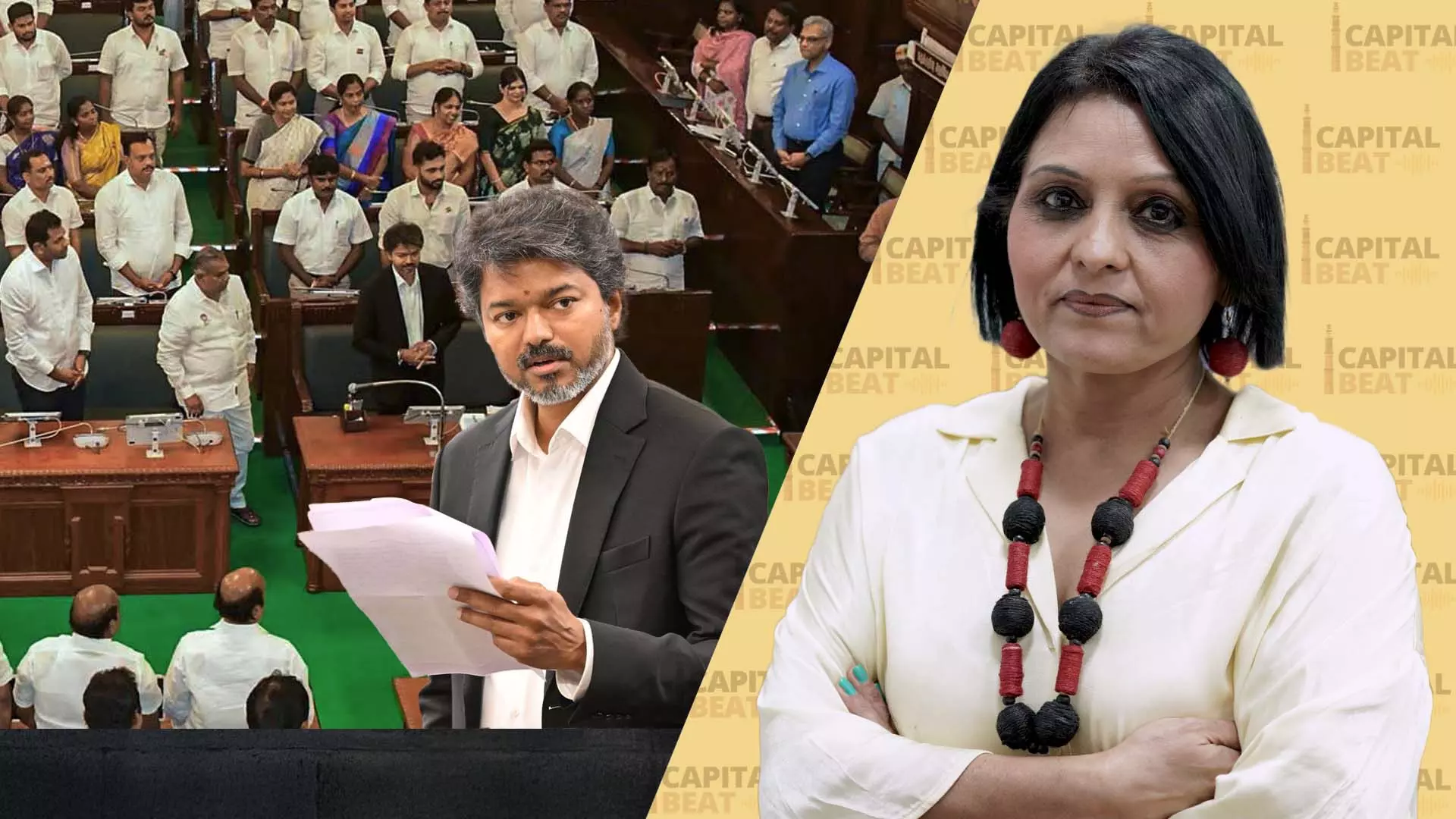
Vijay's floor test win: Is AIADMK going the Shiv Sena way?
Has the trust vote turned into a survival test for AIADMK, and has the party failed it completely? S Srinivasan, Editor-in-Chief of The Federal, shares his views

The four-day-old TVK government in Tamil Nadu crossed a major hurdle on Wednesday (May 13), sailing through the trust vote with the support of 25 rebel AIADMK MLAs. The Opposition DMK made allegations of horse-trading, but Chief Minister C Joseph Vijay denied them flatly.
The 25 AIADMK MLAs who supported the Vijay government are from the CV Shanmugam-SP Velumani camp. They rebelled against party chief Edappadi K Palaniswami (EPS) to help Vijay clear the test, though the TVK leader did have enough numbers even without their intervention.
The TVK government looks stable for now, but has it triggered a bigger political collapse — that of the AIADMK? “AIADMK certainly looks to be in a very difficult position. Yes, it seems that it's the beginning of the end of the road unless something drastic happens,” said S Srinivasan, Editor-in-Chief of The Federal.
The floor test not only secured Vijay’s position as Chief Minister but also exposed deep fractures within the opposition camp, he said.
Srinivasan spoke about the implications of the trust vote, the AIADMK split, the role of the BJP and DMK behind the scenes, and whether Tamil Nadu could head towards another election. Edited excerpts:
How do you view Vijay’s trust vote victory? What is the biggest takeaway from the floor test?
The floor test went more or less on expected lines. Vijay got a bigger majority than many expected, but by yesterday evening itself, it was becoming clear that the rebel AIADMK MLAs might back him.
What is really surprising is the stand taken by the five neutral MLAs — including the BJP’s lone MLA and the four PMK legislators — who neither voted for nor against the government.
But more importantly, this floor test has become as much a test for Edappadi K Palaniswami as it was for Vijay. The AIADMK has now vertically split inside the Assembly.
EPS gave a letter to the Speaker naming Agri Krishnamurthy as the party whip. At the same time, the rebel faction led by CV Shanmugam submitted another letter naming SP Velumani as their whip.
So now there are effectively two whips inside the House, and MLAs have voted accordingly. It is a very confusing situation.
Outside the Assembly too, both EPS and the rebel leaders held separate press conferences. Interestingly, neither side is openly talking about splitting the party. The rebels are saying they are trying to “unite” the AIADMK.
But the conditions they are placing are impossible for EPS to accept. They want all factions — including TTV Dhinakaran’s AMMK, VK Sasikala, and even leaders now aligned elsewhere to return to the fold. Their real target appears to be removing EPS from the leadership of AIADMK.
What political developments happened behind the scenes before the trust vote?
There were some very interesting revelations on Wednesday.
The rebel AIADMK MLAs claimed that a serious attempt was made to form an AIADMK government headed by EPS with DMK support. According to them, the rebels opposed this idea because they felt the AIADMK could not align with its natural rival, the DMK.
One rebel leader even said this proposal had “blessings from the top,” which clearly implied support from the BJP leadership in Delhi.
Later, another proposal was discussed — to make VCK leader Thol Thirumavalavan the Chief Minister with support from both AIADMK and DMK. The rebels claimed they were willing to consider that option, but EPS refused.
According to them, EPS insisted that if anybody from AIADMK became Chief Minister, it had to be him. Otherwise, he preferred to sit in the opposition.
The rebels say this was the point where they decided to back Vijay instead.
So there are multiple layers to this political crisis. The AIADMK, which was once even bigger than the DMK, is now in deep trouble.
What happens to the rebel AIADMK MLAs who supported Vijay? Could they join the Cabinet?
That is another difficult issue Vijay now has to handle.
One of the Congress leaders supporting the confidence motion reminded Vijay that he must maintain a secular government. Vijay himself strongly reiterated that his government would always remain secular.
If he now formally accommodates MLAs backed by the NDA camp, that becomes politically complicated.
At the same time, the BJP and PMK — both NDA allies — effectively helped Vijay by staying neutral during the vote.
This creates a contradiction because Vijay has consistently maintained that the DMK is his political rival and the BJP is his ideological enemy.
There is also another issue. At least two leaders among the rebels are facing corruption-related cases, including one facing a CBI probe.
Vijay came to power promising a clean government and anti-corruption politics. So if such leaders become ministers, it raises serious questions about his image.
There may have been discussions about excluding tainted leaders and accommodating others, but unfortunately, the tainted leaders themselves are leading the rebellion. So Vijay now faces a very delicate balancing act.
What does this mean for AIADMK politically? Is this the beginning of the end?
AIADMK certainly looks to be in a very difficult position. It does appear like the beginning of the end unless something drastic changes.
Tamil Nadu traditionally had a two-party political structure between the DMK and AIADMK. But with the rise of TVK, that balance seems to be collapsing.
This issue will likely move into the courts because both factions have approached the Speaker.
The closest parallel is the Shiv Sena split in Maharashtra between the Uddhav Thackeray and Eknath Shinde factions.
In that case, the question was whether the legislative party or the political organisation represented the “real” Shiv Sena. The Supreme Court sent the issue back to the Speaker, who eventually recognised the legislative majority.
A similar battle could unfold inside AIADMK.
But the real fight will also happen outside the Assembly — over who controls the party structure and the symbol.
While the rebels were meeting separately, EPS simultaneously called district office-bearers and party functionaries for a parallel meeting.
So the real question now is: who actually controls the AIADMK organisation.
Is this crisis similar to the leadership struggle after Jayalalithaa’s death?
This is perhaps the fifth major split inside AIADMK.
First Sasikala moved out, then TTV, then O Panneerselvam, and now this latest rebellion. The earlier splits were mainly about leadership struggles. EPS gradually outmanoeuvred OPS and consolidated control over both the party and government.
Later, even during the symbol battle, EPS retained control.
But now the same questions are returning — who controls the party, who controls the symbol, and who is the legitimate leadership?
EPS is in serious trouble because he has consistently resisted all attempts to unify the various factions.
The BJP tried multiple times to bring all AIADMK factions together. It even recalibrated its own leadership in Tamil Nadu after tensions between EPS and former BJP state chief K Annamalai. But EPS remained adamant.
Now, if AIADMK breaks further, the challenge will also be about how these rebel MLAs continue supporting the TVK government in future Assembly votes.
That instability could continue for a long time.
Could Tamil Nadu head towards another election within six months?
There is definitely internal discussion within TVK about whether a fresh mandate might be the best option.
Some advisers are reportedly telling Vijay that dissolving the Assembly and seeking another election could provide stability. But naturally, most MLAs do not want another election immediately. DMK too may not want to enter another difficult electoral battle so soon.
At the same time, this is not a stable political arrangement either.
So yes, there is discussion happening within TVK about whether another election should be considered. But it is still too early to say whether that will actually happen.
Has this become one of Tamil Nadu’s most unprecedented elections?
Absolutely. Tamil Nadu has never seen such a fragmented verdict and such political instability before.
Earlier, either a pre-poll alliance or a strong coalition arrangement would ensure a stable government.
This time, there has been a three-way split in the mandate. Vijay came very close to a majority but still fell short by around 10 to 12 seats.
On the other side, no alternative coalition had enough numbers either.
That is why multiple combinations were explored — including an AIADMK government with DMK support, and even a VCK-led arrangement. Nothing worked.
Eventually, most parties accepted that Vijay had the strongest claim because he was closest to the mandate.
But this remains an unprecedented situation for Tamil Nadu politics.
The content above has been transcribed from video using a fine-tuned AI model. To ensure accuracy, quality, and editorial integrity, we employ a Human-In-The-Loop (HITL) process. While AI assists in creating the initial draft, our experienced editorial team carefully reviews, edits, and refines the content before publication. At The Federal, we combine the efficiency of AI with the expertise of human editors to deliver reliable and insightful journalism.