







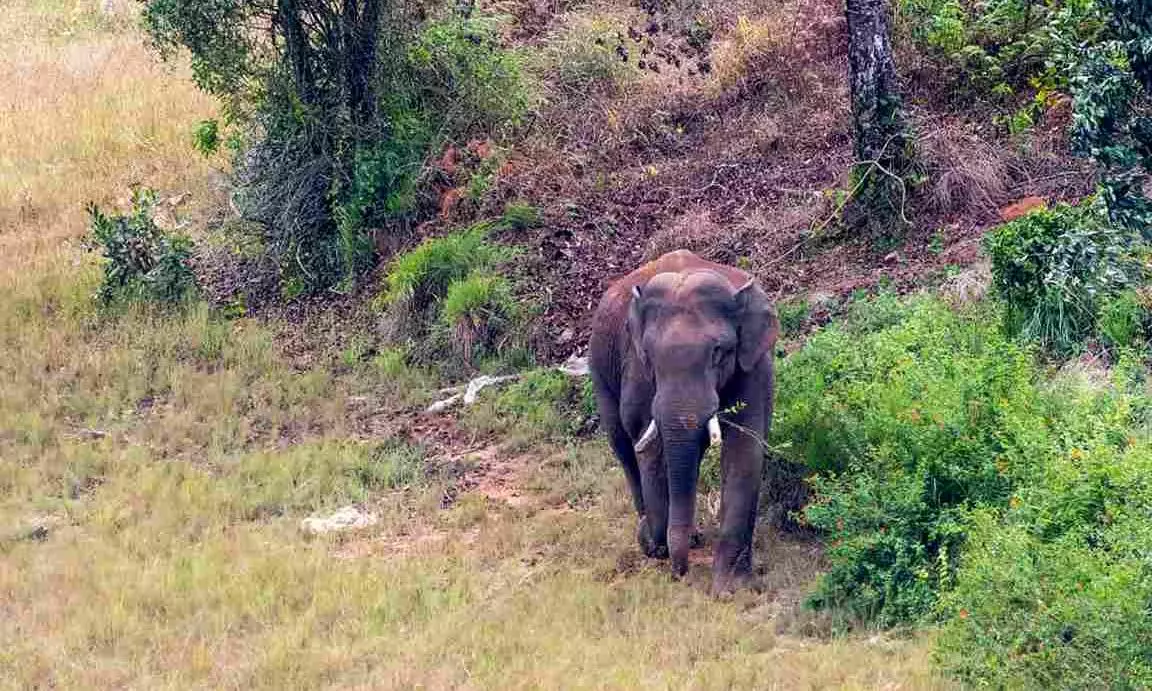
Radio-collaring tusker Chakkakomban only option; residents unhappy, says forest department
Senior officer says the department wants to give the Idukki elephant a chance to remain in its habitat, but says that translocation could be considered if the approach fails

Chakkakomban is back in the news, and the jackfruit-loving tusker of Chinnakanal in Kerala has split activists, public, residents and the forest department. We have heard from an expert panel. Now, the forest department tells us where it stands and what it plans to do.
Chakkakomban, known for raiding homes in the Idukki district in search of jackfruit, outsmarted a 140-member forest team on Wednesday (November 25). A tranquilliser dart failed to sedate him fully, while dense fog, rain and nightfall forced officials to call off the 12-hour capture operation. The mission is on Thursday (November 26) as well.
Also read | Arikomban gone, enter Chakkakomban: Why chasing elephants won’t end Kerala’s crisis
High Range Circle Chief Conservator of Forests (CCF) DK Vinod Kumar says the forest department’s priority is to radio-collar Chakkakomban and release the Idukki tusker back into the same habitat, rather than translocate him, despite many residents' demands to move him elsewhere.
Growing conflict, shrinking options
Speaking to The Federal, the officer said most human-elephant conflict in the Munnar region stems from accidents. Either people are unaware that an elephant is nearby and inadvertently get in its way, or they try to drive the animal away from their farmland without taking precautions or seeking help. “Most such incidents turn fatal,” he said, putting the death toll at more than 10, nearly 13, over the past 10 years.
The department maintains records of such incidents, with entries classified by range and division.
“Let me say that species conservation is more important than an individual animal,” he said. “We are giving him a chance.” If this approach fails, he said, the department might consider active wildlife management, including translocation.
''Such animals,'' he said, ''are often killed in acts of revenge.''
He acknowledged that most residents are unhappy with the plan.
“People are not happy with radio-collaring. They want translocation,” he said, adding that human-elephant conflict in Chinnakanal was intensifying and hostility towards animals was growing. Such situations could eventually slip out of the department’s control, he said, making it imperative to act now. “As I said, it is the only option,” he said.
On whether radio-collaring works, the officer cited instances from Odisha and Chhattisgarh. During his tenure at the Wildlife Institute, a scientist had collared six elephants in those states, and subsequent monitoring showed that the animals had become more docile and caused much less trouble.
“It was not perfect, but the temperament was reduced very much,” he said. An elephant’s collar weighs around 20 kg, and the animals can clearly feel its weight. The calming effect, he said, could be psychological.
Forest officials caught in crossfire
He cautioned, however, that translocation as a next step would be far from easy and it is a long journey.
The officer said forest officials were caught between two opposing sides. “When we go in, there is anger from the public. When we take steps, conservationists are angry. So we are in the line of fire always,” he said. “We want the animal to survive, and we don’t want people to suffer either.”