Kerala University's bid to ban campus politics sparks row over student autonomy
Draft code seeks to ban strikes, digital campaigns as Left gains ground on campuses, student politics gets deeply involved in govt-governor feud over running of varsities

The University of Kerala’s proposed Students’ Code of Conduct has opened a fresh front in the state’s long-running battle over campus politics, with its most contentious provision proposing a blanket ban on political activities on campus.
The draft Kerala University (Students’ Code of Conduct) Regulations, 2026, prepared by the university syndicate, is ostensibly aimed at maintaining discipline and ensuring that academic activities are not disrupted. But the breadth of its provisions has triggered criticism that the university is moving beyond regulating violence, vandalism and disruption to effectively prohibiting organised student politics.
What does draft code propose?
The proposed regulations apply to students of the university, its teaching and research departments, affiliated colleges and other institutions maintained or affiliated with it. The preamble itself says the regulations are intended to regulate political activities inside classrooms and campuses while ensuring a “congenial atmosphere” for academic and institutional activities.
The operative provisions, however, go considerably further.
Also read: Why student union elections remain suspended in several universities
Clause 3 says no student can involve themselves in political activity or encourage fellow students to participate in such activity inside the campus. Organising students or gatherings for political purposes would constitute “serious indiscipline and misconduct”. The draft defines political activity broadly. It includes promoting or supporting the ideology, policies or programmes of a political party, mobilising support or membership, soliciting funds, and organising meetings, demonstrations or campaigns in support of a political organisation.
No physical or online protests allowed
The restrictions are not confined to party meetings or election campaigning. Strikes based on political ideology or directions from political parties or their affiliates would be treated as “gross indiscipline”. Dharnas and gheraos are prohibited, as are political slogans inside classrooms, offices and other campus spaces.
Even political activity through digital platforms comes within its ambit. Students would not be permitted to use digital platforms to “incite, organise, or propagate political activities affecting University functioning”.
Also read: Kerala University Union election results spark clashes, 50 SFI workers booked
The draft also makes students individually liable for participation in political gatherings. Principals and heads of departments would have the power to initiate disciplinary action, while the Vice-Chancellor would exercise such powers on the university campus.
Political awareness vs mobilisation
There is a distinction in the draft between politics and academic discussion. Faculty-supervised academic discussions, research, debates and classroom activities would not be considered political activity if they are not connected to political mobilisation.
Also read: Kerala PhD scholar’s plight rekindles memories of Rohith Vemula
Critics question whether political awareness and political mobilisation can be neatly separated in a university environment where student organisations have traditionally been the vehicles through which young people debate public issues, organise campaigns and protest against decisions of university and government authorities.
Strict penalties for violation
The proposed code provides for strict disciplinary action, including fines and suspension of up to 30 days for prima facie violations. Penalties range from warnings and fines to transfer, temporary dismissal and permanent dismissal, with proceedings expected to be completed within 30 days. It also proposes financial penalties for damage to institutional property, including ₹5,000 for students and ₹10,000 for political parties for a first violation. Repeat offences could attract fines of up to ₹1 lakh on political organisations, with unpaid dues recoverable as land revenue.
Unconstitutional move: Pinarayi
It is this combination of a sweeping definition of political activity and the severity of the proposed punishment that has turned what could have been a conventional campus discipline code into a larger political controversy. The timing has added another layer to the controversy.
Leader of the opposition and CPI(M) leader Pinarayi Vijayan has strongly opposed the proposal, describing the move to ban student organisation activities as “highly condemnable”.
Also read: Keralam's Sanskrit varsity 'funeral' protest: Row over arrests, Governor's intervention
Vijayan argued that the attempt to drive politics and political awareness out of university campuses amounted to a fear of a generation that asks questions.
“The Constitution gives every citizen who turns 18 the right to vote and thereby participate in determining the governance of the country and electing governments. To argue that young people who are eligible to vote and help shape the country's future have no right to think, organise and respond politically within the institutions where they study is unconstitutional and reflects a complete rejection of politics,” said Pinarayi.
Pushback by employees’ union
“Colleges and student movements have played an unparalleled role in the country's social and political development, dating back to the freedom struggle. From the anti-British struggle to resistance against authoritarian moves in independent India, students have been at the forefront at every critical juncture. At several points, campuses have even acted as catalysts in shaping the country's political trajectory. A move to completely ban political activities from campuses with such a historic legacy cannot be accepted,” added the former chief minister.
Also read: Campus uprising: How August saw India's top institutions roiled by protests
The Kerala University Employees’ Union, too, has opposed the proposed regulations, describing the move as undemocratic and arguing that students should have the opportunity to develop political awareness and participate in organisational activities.
Backdrop of govt-governor clash
The proposed regulations come at a time when the atmosphere in Keralam’s universities is already politically charged, with the Governor, in his capacity as Chancellor of state universities, locked in continuing disputes with the state government over university administration and the appointment of Vice-Chancellors.Critics, particularly Left student organisations, have alleged that the Chancellor’s interventions have favoured or facilitated the appointment of Vice-Chancellors perceived to be sympathetic to the right wing. These allegations are politically contested and have been part of the wider state-government-Chancellor confrontation over university autonomy and appointments.
Also read: How Keralam varsities are now caught in govt vs governor political contest
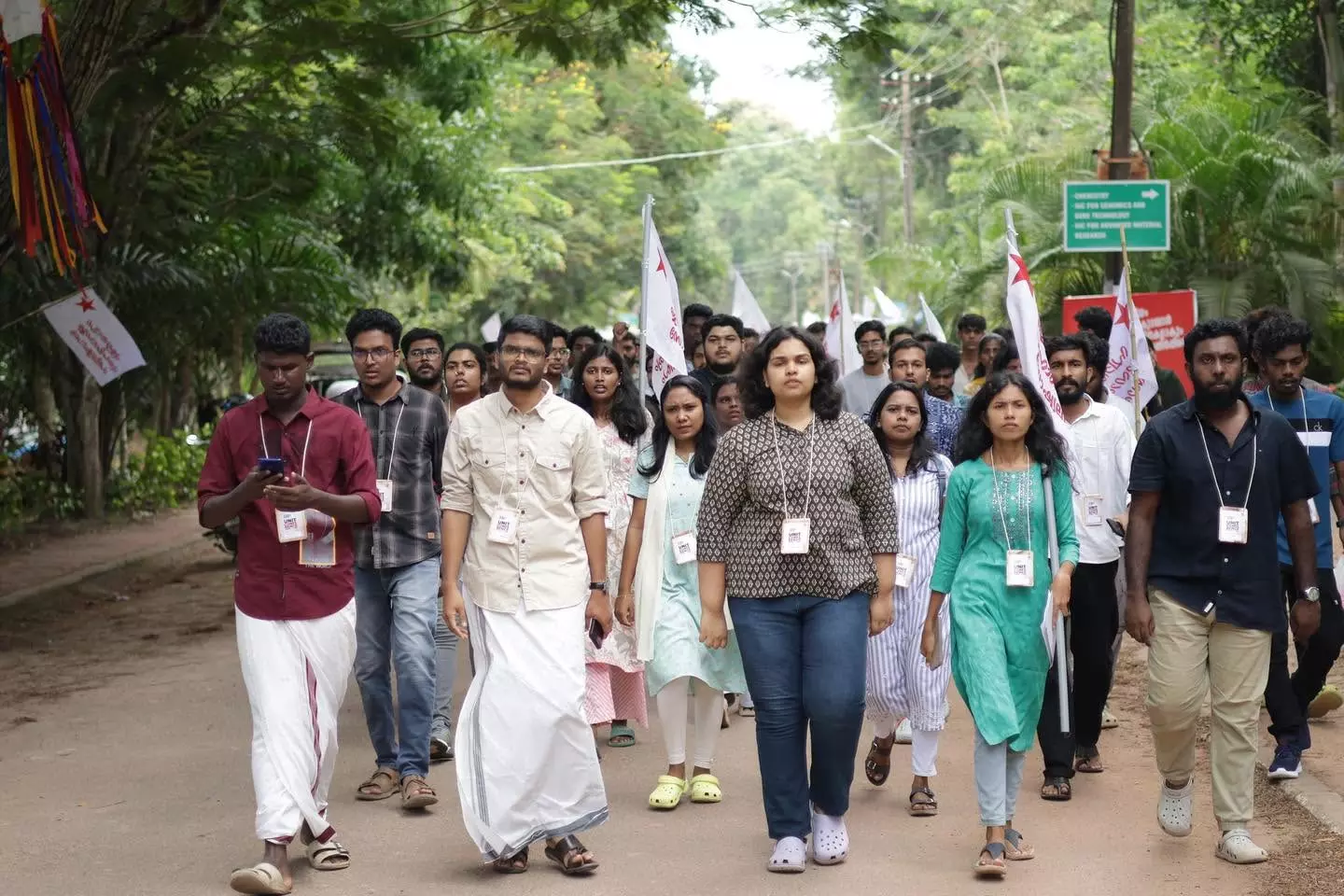
Student organisations, particularly the SFI, have been protesting against several university-level decisions. The proposed restrictions therefore arrive at a moment when organised student politics is already deeply involved in disputes over the functioning of universities.
Draft comes amid SFI’s stupendous win
There is also an immediate electoral backdrop. Recent student union elections in universities in Keralam have seen strong performances by the Students’ Federation of India (SFI), the CPI(M)’s students’ wing. In elections to colleges affiliated with Kerala and Kannur universities, the Kerala University figures have been reported separately, with SFI winning 62 of the 71 unions where elections were held.
The results have given student politics added significance at precisely the moment when the proposed regulations seek to restrict organised political activity on campuses.
However, the university administration has maintained that the proposals are aimed at ensuring discipline and preventing disruption, and that the document is still at the discussion stage rather than a final regulation.