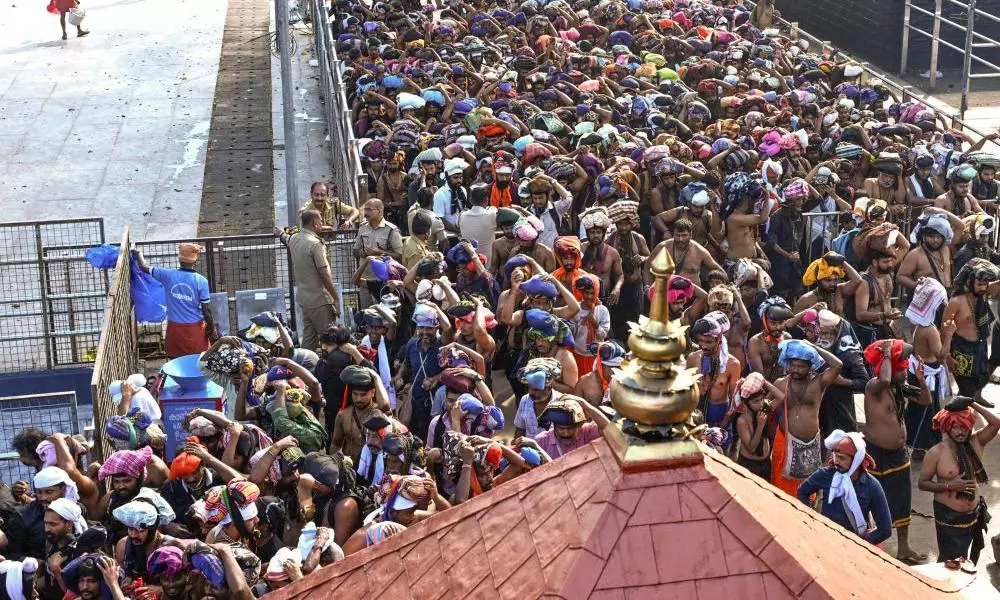
Women’s entry into Sabarimala moves to centre stage ahead of Kerala Assembly polls
What was once a legal question has steadily evolved into a defining political marker that continues to test ideological commitments and electoral calculations

With elections around the corner, the Sabarimala issue has once again moved to the centre of Kerala’s political discourse, as the Supreme Court prepares to hear review petitions on women’s entry into the Sabarimala temple.
On Monday (Febrary 16), the Supreme Court said a nine-judge bench will begin hearing the issues referred in the Sabarimala review on April 7. The composition of the bench will be notified separately by the Chief Justice of India (CJI) through an administrative order.
What was once a legal and constitutional question has steadily evolved into a defining political marker that continues to test ideological commitments, electoral calculations, and the delicate balance between faith and rights in the state.
Hearing of review
A bench led by CJI Surya Kant, along with Justices Joymalya Bagchi and Vipul Pancholi, is hearing the review petitions related to the Sabarimala women’s entry issue. Of the 67 petitions listed, around 60 concern Sabarimala, while others relate to matters such as female circumcision in the Dawoodi Bohra community, temple entry of Parsi women who married outside the faith, and mosque entry of Muslim women.
These petitions were earlier part of proceedings before a nine-judge bench of the Supreme Court, which began hearing arguments in February 2020 but could not complete the process.
Notably, one of the petitioners opposing women’s entry, Kandaru Rajeevaru, the chief priest of Sabarimala, is currently in jail after being accused of stealing gold from the temple.
Polarising public debates
In September 2018, the Supreme Court lifted the decades-old restriction on the entry of women of menstruating age into Sabarimala, ruling that exclusion violated constitutional guarantees of equality and dignity. The judgement was immediately hailed by rights groups and sections of progressive opinion as a landmark affirmation of gender justice.
But it also triggered an unprecedented social churn in Kerala. For a section of devotees, backed by the political right wing including the Bharatiya Janata Party and later by the Congress-led opposition, the verdict was seen as judicial overreach into matters of faith and tradition. The stage was set for one of the most polarising public debates in the state’s recent history.
Also Read: Ayyappa politics takes centre stage in Kerala ahead of elections
The backlash was swift and intense. Statewide protests erupted, led primarily by right-wing groups and the BJP and backed politically by the United Democratic Front. Demonstrations, hartals, and confrontations with the police marked the months that followed the verdict. “Devotee collectives” framed the issue as one of protecting religious autonomy, while political parties saw in it an opportunity to mobilise sentiment.
Tradition vs social reform
The ruling Left government, led by the Left Democratic Front and spearheaded by the Communist Party of India (Marxist), initially chose to implement the verdict. It positioned itself as a defender of constitutional morality, arguing that the state had a duty to uphold the court’s order regardless of political consequences.
When a few women eventually entered the temple under police protection, the reaction was explosive. Protests intensified, public anger escalated, and the issue became deeply intertwined with identity politics. The government’s enforcement of the verdict was portrayed by its critics as an assault on tradition, while supporters argued it was a necessary step toward social reform.
LDF faced backlash
The confrontation transformed the Sabarimala question into a full-blown political flashpoint. The narrative shifted from a court-mandated reform to a battle over belief, with political parties aligning themselves along sharply-defined lines.
The political costs soon became evident. In the subsequent electoral cycles, the Left faced a backlash in several constituencies where the Sabarimala issue dominated campaign narratives. The controversy dented its carefully-cultivated image as a government attuned to public sentiment.
Also Read: CPI(M) shifts stance on Sabarimala women's entry issue as Ayyappa Sangamam nears
Many observers described it as an electoral debacle rooted in misreading the emotional intensity of the issue. The opposition successfully framed the Left as insensitive to faith, and the temple debate began to overshadow governance achievements.
Left’s attempt to strike a balance
Over time, the Left recalibrated its approach. While it never formally abandoned the principle of gender equality, its tone became more cautious. The emphasis shifted from active facilitation of women’s entry to respecting “devotee sentiment” and allowing the judicial process to take its course.
This gradual softening was seen as an attempt to strike a balance between ideological consistency and political realism. The government began avoiding strong public positions on enforcement, instead focusing on administrative neutrality.
Also Read: Sabarimala Temple: How millions of women joined hands for gender equality
The shift found endorsement from influential social organisations such as the Nair Service Society and the Sree Narayana Dharma Paripalana Yogam. Their response signalled a tentative acceptance of the Left’s recalibrated position and suggested a broader attempt to defuse tensions around the temple issue.
Opposition accuses govt of ‘ambiguity’
Yet the opposition has continued to press the government for a clear articulation of its stand. Leader of Opposition VD Satheesan has repeatedly questioned what he describes as ambiguity in the government’s position.
“The government cannot keep shifting its stand depending on political convenience,” Satheesan said. “Our main question is whether the government stands by the affidavit (in favour of women’s entry) currently submitted in the Supreme Court or is willing to revise it. There should be no ambiguity on this issue, and if the government still supports women’s entry, it must say so openly.”
Social harmony
Within the Left, the debate is equally complex. Party leaders acknowledge the need to respect judicial authority while remaining sensitive to public sentiment. CPI(M) State secretary MV Govindan has emphasised that the party’s approach is rooted in balancing constitutional values and social harmony.
“Our position has always been consistent with the Constitution and social realities,” Govindan said. “We are not abandoning principles, but we also recognise the need to maintain peace and respect the beliefs of devotees. The matter is before the court, and we will act in accordance with the law.”
Also Read: Apex Court to hear plea seeking women's mosque entry in light of Sabarimala verdict
When asked whether the party would change its stance, the secretary remarked that nothing is permanent except change, calling it a matter of evolving political realities rather than a fixed position.
Legal issues
The current review hearing ensures that the Sabarimala debate will once again dominate headlines. The legal questions of equality, essential religious practices, and the limits of judicial intervention remain unresolved in public perception, even as they continue to be debated in courtrooms.
The set of key constitutional questions arising from the Sabarimala case include the interplay between the right to religious freedom under Articles 25 and 26 and the right to equality under Article 14, and the scope of terms such as “public order, morality, and health” in Article 25(1). The court is also examining how “morality” and “constitutional morality” should be interpreted, how far courts can assess whether a practice is an essential part of a religion or denomination, and whether such determinations should rest with religious authorities.
Also Read: Congress proposes law to bar entry of all women to Sabarimala shrine
Other issues relate to the meaning of “sections of Hindus” in Article 25(2)(b), whether essential religious practices are protected under Article 26, and the extent to which persons outside a faith can challenge its practices through public interest litigation. The applicability of the 1965 Kerala rules on entry to places of public worship to the Sabarimala temple may also come under consideration.
Tension between belief and equality
Each revival of the case has reignited the political contest around it. For parties across the spectrum, Sabarimala is no longer just about temple entry; it is about identity, governance, and the limits of reform in a society negotiating tradition and modernity.
The review petitions before the Supreme Court may address the legal dimensions, but the political and social questions will persist long after the hearings conclude.
For Kerala, Sabarimala remains more than a temple issue. It is a mirror reflecting the tensions between belief and equality, law and sentiment, ideology and pragmatism. And as elections approach, that mirror is once again at the centre of the state’s political stage.