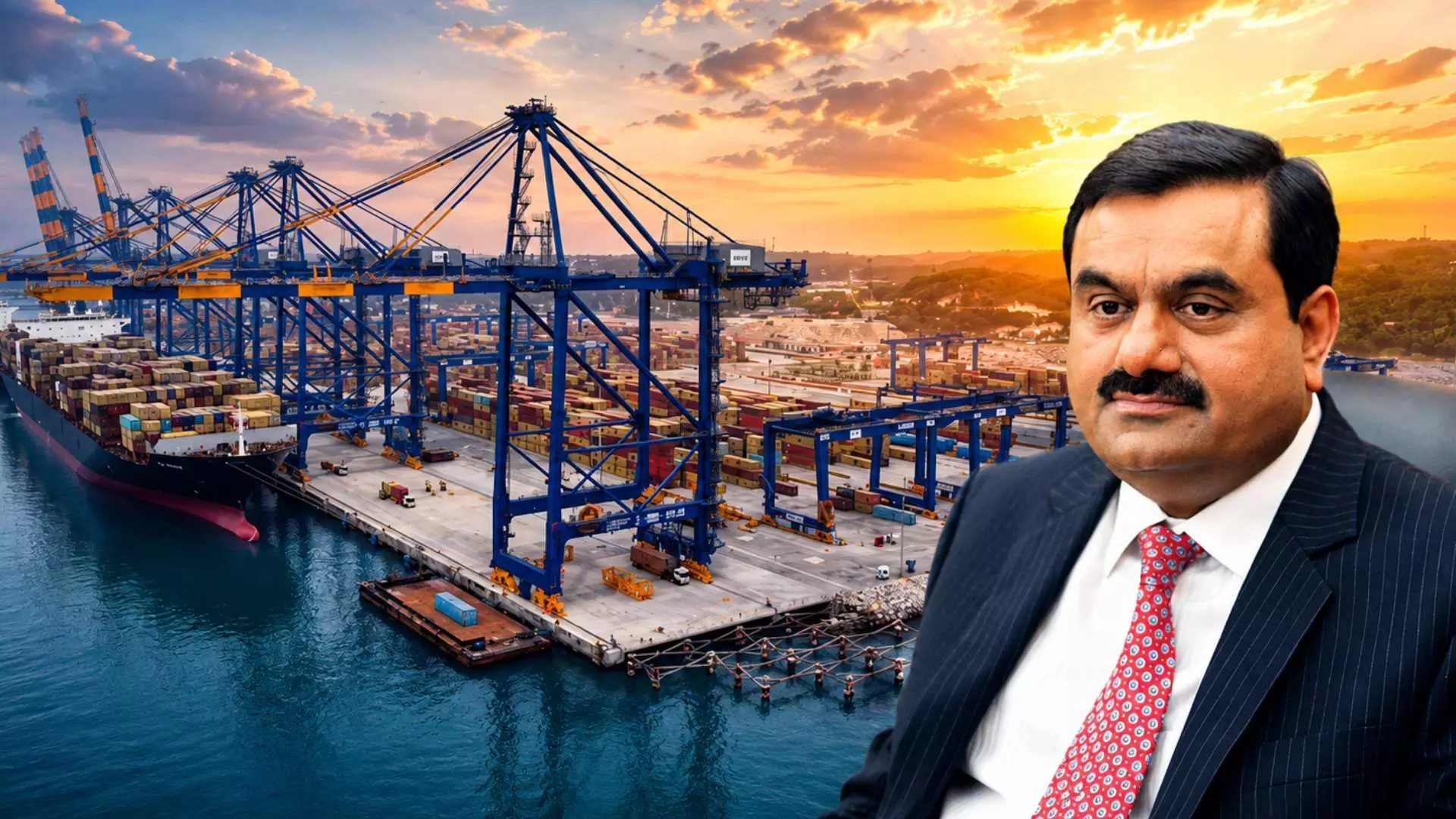
Vizhinjam Port: Will MSC gain control through Adani stake sale?
Adani's reported plan to sell a 49 per cent stake to Mediterranean Shipping Company has sparked a debate over control, competition, and Kerala's future role in India's strategic port

The proposed sale of a 49 per cent stake in the company operating Kerala's Vizhinjam International Seaport to Mediterranean Shipping Company (MSC) has triggered a major political and strategic debate. While the Adani Group is expected to retain majority ownership, questions are being raised over who could ultimately exercise operational influence over one of India's most strategically important ports.
The discussion has shifted far beyond the political debate over who deserves credit for bringing the Vizhinjam project to Kerala. It is now centred on ownership, governance, competition, national security, and the extent of the Kerala government's powers in approving any change in the port's shareholding structure.
The reported transaction has also reignited concerns about the balance between attracting global investment and safeguarding public interest in critical infrastructure.
The proposal
According to reports, the Adani Group is considering transferring a 49 per cent stake in its Vizhinjam port holding company to MSC, the world's largest container shipping company.
Although Adani Ports would continue to hold 51 per cent and remain the majority shareholder, the proposed transaction has raised a larger question: does majority ownership automatically translate into effective control?
Also Read: Kerala to scrutinise Adani-MSC Vizhinjam Port stake deal before giving approval: Satheesan
MSC is no ordinary investor. As the world's largest container shipping company, it operates one of the biggest global shipping networks. Its presence as a significant shareholder in India's largest transshipment port could potentially reshape commercial dynamics at Vizhinjam.
Kerala govt's stance
The issue has already reached the Kerala Legislative Assembly.
Chief Minister VD Satheesan stated that the Kerala government has not received any formal proposal from the Adani Group seeking approval for such a share transfer. He also said that any transfer would require the state's approval and, in certain situations, approval from the union government.
He assured the Assembly that any proposal would be examined by considering national security, public interest, competition, investment, and long-term development before any decision is taken.
Legal questions
The chief minister's statement has also prompted questions about how much authority the Kerala government actually possesses once a formal proposal reaches it.
Legal experts point out that while the concession agreement contains provisions governing share transfers, several approvals also fall within the jurisdiction of the union government and regulatory authorities.
If all statutory approvals are secured, an important legal question remains: can the state realistically block the transaction?
The debate, therefore, extends beyond whether permission is required. It also concerns whether Kerala, despite being the contracting authority and landowner, could eventually have only a limited role in determining the ownership structure of its flagship infrastructure project.
Opposition's concerns
The Opposition has voiced stronger concerns.
Former finance minister TM Thomas Isaac has argued that the reported transaction reinforces concerns previously expressed by the Left regarding the state's recently-announced Samudra Mission, which focuses on port-led development.
According to Isaac, discussions between Adani and MSC appear to have progressed without consulting the Kerala government, despite the state itself being a stakeholder in the project.
Also Read: Kerala’s Vizhinjam port makes history as it receives first mothership
He has also urged the government to clarify whether any informal discussions had already taken place with Adani regarding the proposed stake sale, arguing that it is difficult to believe such an important transaction could have advanced without the state's knowledge.
Leader of the Opposition Pinarayi Vijayan also warned in the Assembly that today's minority stake could eventually translate into operational control if future restructuring occurs or if commercial decisions increasingly favour MSC's shipping interests.
Question for regulators
Supporters of the proposal argue that MSC brings exactly what Vizhinjam requires the most — cargo.
A transshipment port depends heavily on attracting major shipping lines. Having the world's largest shipping company as an investor could guarantee higher cargo volumes, open new shipping routes, and accelerate Vizhinjam's emergence as an international maritime hub.
However, critics argue that there is another side to the debate.
If one shipping company gains excessive influence over port operations, competing shipping lines could perceive themselves to be at a disadvantage and choose rival ports instead. Competition regulators around the world closely examine such instances of vertical integration between shipping companies and ports.
MSC's history in Kerala
The proposal has also attracted attention because of MSC's recent history in Kerala.
In May last year, MSC's Elsa 3 sank off the Kerala coast while sailing from Vizhinjam towards Kochi.
Initially viewed as a marine accident, subsequent investigations reportedly pointed towards technical failures and safety lapses rather than adverse weather alone. Hazardous cargo and fuel entered the sea, leading to environmental concerns, legal proceedings, and compensation claims.
The incident remains fresh in public memory.
Also Read: As PM Modi inaugurates Vizhinjam port, a fierce 'credit' war rages in Kerala
For many in Kerala, MSC is therefore associated not only with global shipping leadership but also with one of the state's most significant recent maritime accidents.
Critics argue that while this should not automatically prevent future investment, it reinforces the need for careful scrutiny of any proposal involving a strategically-important public asset.
Vizhinjam's strategic importance
Vizhinjam occupies a unique strategic position.
Located close to one of the world's busiest international shipping lanes, the port is expected to become one of India's most important transshipment hubs over the coming decades.
Any significant change in ownership, governance, or operational influence is therefore likely to attract close attention from both the state and union governments.
The larger debate
As of now, no final approval has been granted.
The Kerala government says it has not received any formal proposal from Adani, although the company has indicated that informal discussions involving governments have been taking place. Before the transaction can proceed, approvals from both the state and union governments are expected.
Regardless of whether the deal ultimately goes through, it has already opened up a much larger debate. Is this simply another foreign investment that will help Vizhinjam grow faster?
Or could it mark the beginning of a gradual shift in influence from a port operator to the world's largest shipping company?
Also Read: Vizhinjam port will place India at top of maritime map: Union Minister Sonowal
The answer will depend not merely on the transfer of 49 per cent equity, but on shareholder agreements, governance rights, operational control, and the conditions eventually imposed by regulators.
Until those details become public, the debate surrounding Vizhinjam is likely to remain focused as much on transparency, competition, and public interest as it is on investment.
(The content above has been transcribed from video using a fine-tuned AI model. To ensure accuracy, quality, and editorial integrity, we employ a Human-In-The-Loop (HITL) process. While AI assists in creating the initial draft, our experienced editorial team carefully reviews, edits, and refines the content before publication. At The Federal, we combine the efficiency of AI with the expertise of human editors to deliver reliable and insightful journalism.)