



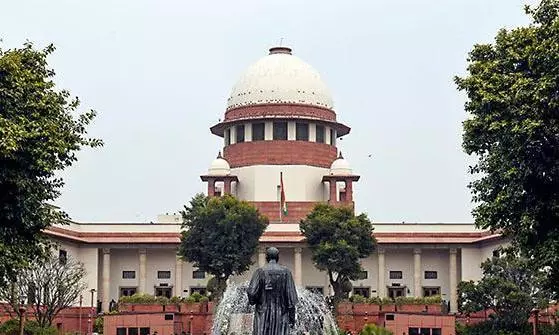
SC's nine-judge bench to hear Sabarimala review from April 7
The 2018 verdict on women’s entry into Sabarimala returns to spotlight as review petitions and wider questions of faith, gender, and tradition head to a nine-judge bench

The Supreme Court’s nine-judge bench will begin hearing the issues referred in the Sabarimala review on April 7, 2026. The composition of the bench will be notified separately by the Chief Justice of India through an administrative order.
A three-judge bench comprising CJI Surya Kant, Justice Joymalya Bagchi, and Justice Vipul M Pancholi passed the order today, directing that the reference be listed before the larger bench. The hearings are scheduled to conclude on April 22, 2026.
The matter arises from the Court’s landmark September 2018 judgment, which permitted women of menstruating age to enter the Lord Ayyappa temple at Sabarimala. Alongside these review petitions, the Court is also examining related issues such as the issues of Muslim women's entry in dargah/mosques, entry of Parsi women in fire temples if they have married a non-Parsi, validity of the practices of excommunication and female genital mutilation among the Dawoodi Bohra community.
Of the 67 petitions listed, around 60 concern Sabarimala.
Also read: Women’s entry into Sabarimala temple: SC to review petitions from today
Solicitor General of India Tushar Mehta told the bench that the Central Government was supporting the review of the judgment.
The background
In November 2018, the Supreme Court, by a 4:1 majority, ruled that women of all age groups could enter the Sabarimala temple, declaring that "devotion cannot be subjected to gender discrimination".
The majority opinion was delivered by then CJI Dipak Misra, along with Justices RF Nariman, AM Khanwilkar, and DY Chandrachud. The lone dissent came from Justice Indu Malhotra, the only woman judge on the bench.
The CJI's judgment held that Lord Ayyappa devotees will not constitute a separate religious denomination. Rule 3(b) of the Kerala Hindu Places of Public Worship (Authorization of Entry) Rules 1965, which prohibited entry of women in Sabarimala, was also struck down as unconstitutional.
Assailing this decision, a bunch of review petitions and writ petitions later came to be filed.
On November 14, 2019, a five-judge bench led by then CJI Ranjan Gogoi held, by a 3:2 majority, that several issues raised in the Sabarimala review were common to other pending matters.
These included questions relating to women’s entry into mosques, the validity of female genital mutilation among the Dawoodi Bohra community, and the right of Parsi women who marry outside the community to enter fire temples.
Political flashpoint in Kerala
With elections around the corner, the Sabarimala issue has once again moved to the centre of Kerala’s political discourse with this decision by the Supreme Court.
The Court decided to keep the review petitions in the Sabarimala matter pending until a larger bench could examine questions relating to essential religious practices. It observed that the broader issue, whether the judiciary can intervene in matters claimed to be essential to a religion—required authoritative determination by a larger bench.
After the CJI's judgement in 2018, rights groups and sections of progressive opinion in Kerala hailed it as a landmark affirmation of gender justice.
But it also triggered an unprecedented social churn in Kerala. For a section of devotees, backed by the political right wing including the Bharatiya Janata Party and later by the Congress-led opposition, the verdict was seen as judicial overreach into matters of faith and tradition.
Notably, one of the petitioners opposing women’s entry, Kandaru Rajeevaru, the chief priest of Sabarimala, is currently in jail after being accused of stealing gold from the temple.