Two seemingly unrelated incidents in Kerala have, within days, converged into a larger political signal.
The controversy over a bhajan troupe singing a Christian devotional near the Sri Mahavishnu Temple and the outrage surrounding a Vishu poster by Mehr Mandi & Grills, a restaurant in Alappuzha district, are now being read together as signs of the Sangh Parivar returning to a sharper Hindutva playbook after its Christian outreach reportedly fell flat in the recent election.
Bhajan row
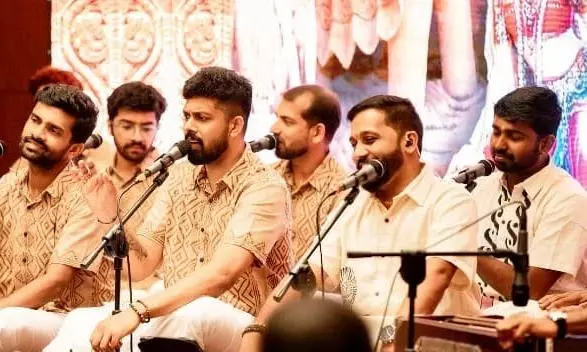
In Vembinkulangara, the issue began as a local cultural moment. A bhajan group, Nandagovindam Bhajans, performed a Christian hymn as a gesture of thanks to the local church community that had supported a temple-related event. The organisers and temple authorities maintained that the programme took place outside the temple premises and reflected a long-standing tradition of shared participation between communities.
Interestingly, Nandagovindam Bhajans is the same troupe that sections of the right wing had actively backed last year, especially in the wake of the rise of rapper Vedan, whose sharp anti-caste themes and high-energy performances had struck a chord with Kerala’s youth.
At the time, Nandagovindam was projected as a cultural counterpoint to Vedan. The troupe was framed as embodying a softer, value-driven and devotional discipline, in contrast to Vedan, who was dismissed in those narratives as abrasive and lacking refinement.
That earlier positioning makes the current backlash more striking. The recent reaction from sections aligned with the Sangh Parivar quickly reframed the act of them singing Christian devotional song as a violation of religious norms. The argument was clear that temples are not spaces for interfaith expression.
What might earlier have been seen as part of Kerala’s lived culture of coexistence was instead projected as a dilution of religious identity.
KP Sasikala of Hindu Aikya Vedi put it succinctly: “Chicken masala tastes good, but it should not be put in payasam (sweet pudding). Or, if you cut the branch you are sitting on, you will fall, no matter how strong it is.”
Disrupting Kerala's social fabric
Former finance minister T M Thomas Isaac describes this as part of a broader pattern.
“An organised attempt is underway to create communal divisions. Look at the Sangh Parivar leader who asks whether chicken masala can be mixed with payasam. Such statements are striking in the land of Sree Narayana Guru. There was a time when temple festivals hosted progressive programmes like KPAC plays and the storytelling of V Sambasivan was based on world classics. Today, even a revolutionary song can invite objections, even in courts. The response of the Vembinkulangara temple authorities shows that Kerala has not yielded to such divisive pressures,” said Dr Issac.
Congress leader K C Venugopal also has called this part of a wider attempt to disturb Kerala’s social fabric.
“The Sangh Parivar’s conspiracy to wound the heart of Kerala, a land rooted in communal harmony, is crossing all limits. The BJP-RSS attempt to spread religious hatred challenges Kerala’s unique culture, where temples and churches together celebrate Onam, Vishu, Easter and Perunnal. This land will resist such moves by all means.”
The BJP camp itself has not spoken in one voice. Former DGP turned BJP leader, T P Senkumar openly criticised the bhajan troupe, while some other leaders attempted to downplay the issue. At the same time, Sangh Parivar supporters from within the Christian community, who took a softer line faced backlash from hardliners on social media, pointing to differences over strategy.
Vishu-themed poster sparks anger
If the bhajan controversy foregrounded questions of religious space, the Mehr Mandi episode has been pushed along a different but related axis.
The backlash over a Vishu-themed poster featuring Lord Krishna alongside a non-vegetarian dish, has been amplified well beyond a debate on taste or sentiment. The restaurant owners despite their apology have been booked for creating communal division in the society.
Hindu organisations have alleged a concerted attempt to undermine their beliefs, claiming that multiple restaurants adopted similar advertisements during the Vishu season.
A BJP functionary from Thrissur, Praseed Das has filed a complaint with the National Investigation Agency seeking an inquiry into eight Arabian food outlets across the state run by Muslims, particularly those started after demonetisation. The move expands a cultural controversy into a matter of suspicion and security.
'Injecting poison'
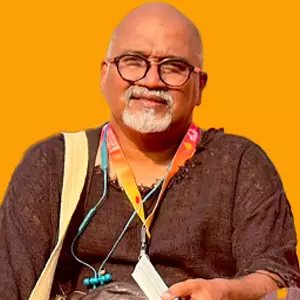
Talking on these recent controversies, senior journalist Sreejith Divakaran said, “There is a clear attempt to inject poison into cultural programmes at temples. But in Kerala, there exists an organic emotional resistance that helps society hold its ground. Temple committees, more often than not, push back and refuse to entertain such interventions. At the same time, as seen in parts of North India, efforts are being made to mix hatred even into food. In a state like Kerala, where food habits cut across linguistic and regional divides, the demand for a probe by the National Investigation Agency into certain eateries reflects a dangerous shift. It should be noted that, rising cooking gas prices, driven by policy decisions, have already pushed Kerala’s hotel industry into distress. These developments together point to a troubling direction."
Taken together, the two incidents point to a recalibration.
With minority outreach yielding limited traction, the emphasis appears to be shifting towards consolidation through sharper identity assertions. In Kerala, where every day social life has long operated through overlap rather than separation, the political attempt is to redraw those lines more clearly.
Whether that effort finds wider acceptance remains to be seen.