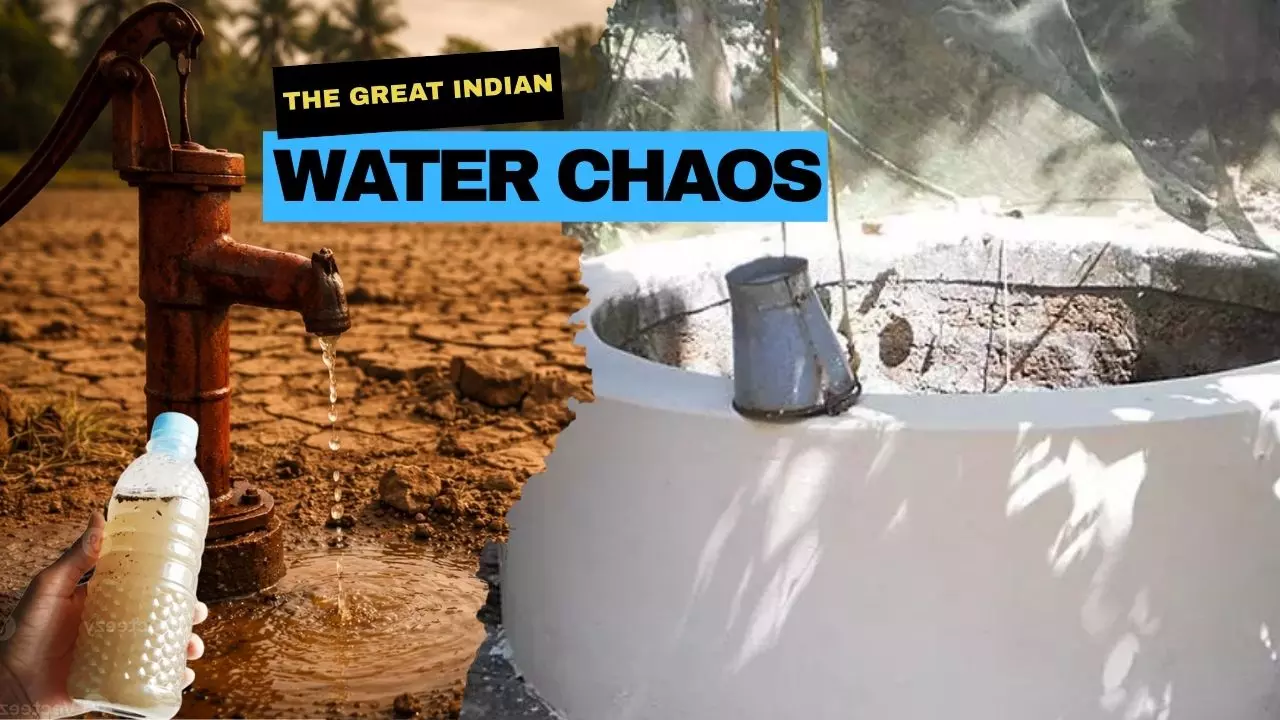
Kerala’s water woes: Worsening quality, lack of retention strategies
Studies, field reports, and long-standing groundwater concerns suggest that the state’s drinking water challenges are deep-rooted and structural

The recent deaths linked to drinking water contamination in Bhagirathpura, Indore, have once again brought India’s invisible water crisis into sharp public view. In a country where access to piped water is often mistaken for access to safe water, the episode has triggered concern far beyond Madhya Pradesh.
In Kerala, too, the Indore incident has raised a familiar but uncomfortable question: how safe is the water people consume every day?
Kerala has not witnessed contamination-related deaths on the scale reported from Indore. Yet, studies, field reports, and long-standing groundwater concerns suggest that the state’s drinking water challenges, though less dramatic in magnitude, are deep-rooted and structural.
Rural homes’ coverage doubles in 5 years
On paper, Kerala’s water story appears reassuring. Writing in Kerala Calling, the Public Relations Department’s publication, Water Resources Minister Roshy Augustine presents a sector undergoing what he calls a “remarkable transformation”.
Under the Jal Jeevan Mission, over 55 per cent of rural households now have functional drinking water connections.
Also Read: Sabarimala rush: Devotees complain of drinking water issue; TDB orders measures
According to data collated by the Kerala Water Resources Department, of the total 69.92 lakh rural households targeted for drinking water connections, 38.37 lakh had been covered by March 2025. This represents a substantial improvement from April 2020, when only 17.49 lakh rural homes had access to drinking water, with coverage more than doubling to around 38 lakh households by January 2025.
At present, 115 panchayats across the state have achieved 100 per cent drinking water coverage, along with nine assembly constituencies attaining complete access.
First state to have ‘water budget’
Urban infrastructure, too, has seen unprecedented investment. Projects under AMRUT 1.0 and 2.0, KIIFB-funded pipeline replacements, and expanded treatment capacity have together added over 228 million litres per day of treated water, benefitting more than 30 lakh people.
Also Read: Watch | TN-Kerala water feud to reach boiling point? Silandhi, Mullaperiyar issues
Kerala has also become the first Indian state to adopt a formal water budget, with over a thousand local bodies preparing water resource master plans.
Ernakulam study found bacterial contamination
But beneath these impressive numbers lies a more fragile reality.
A 2023 groundwater quality study conducted in selected villages of Ernakulam district by Feebarani John of Vimala College, Thrissur, had revealed a critical fault line in Kerala’s drinking water ecosystem. While most physicochemical parameters in well water remained within permissible limits, the study found widespread bacterial contamination, particularly during the pre-monsoon period.
Also Read: Chennai’s drinking water crisis mirrors deeper urban failures across India
The findings underscore a crucial distinction often overlooked in policy narratives, that access to water does not automatically translate into access to safe water.
The Ernakulam study stressed the need for continuous monitoring and region-specific interventions, noting that contamination patterns are spatially uneven. This is significant in a state where a large share of households still depends on open wells, borewells, and mixed sources even when piped supply exists.
Losing capacity to retain water
A broader structural warning emerges from a 2022 study by Dr Vinu Govind, based on research by the Centre of Excellence in Environmental Economics at Kerala Agricultural University. The study challenges the long-held assumption that Kerala’s high rainfall guarantees water security. Despite receiving an annual average rainfall of nearly 3,000 mm, Kerala is rapidly losing its capacity to retain water.
Undulating terrain, deforestation, aggressive sand mining, and large-scale wetland conversion have accelerated surface runoff, pushing rainwater quickly into the sea. Groundwater recharge has suffered as a result.
Water quality degradation
Water quality degradation compounds the scarcity problem. Unscientific waste disposal, inadequate sewage systems, and dense construction of household toilets without corresponding drainage planning have steadily polluted rivers, wells, and ponds.
The 2008 State Water Policy itself acknowledged Kerala’s failure to adopt adequate water retention and conservation strategies, despite repeated warnings.
Despite Kerala’s relatively strong development performance over the past two decades, the state is witnessing a troubling decline in water quality, a trend that runs counter to what is predicted by the Environmental Kuznets Curve (EKC).
Also Read: Indore water contamination: Death toll hits 10, over 1,400 fall ill
“Kerala has performed relatively better in the development sector during the past couple of decades, but the growing deterioration of water quality is contrary to that hypothesised through the Environmental Kuznets Curve (EKC). This indicates that water quality is a growing problem with development. It is a complex issue and warrants deeper investigation. A similar trend has been observed in the case of many developing countries in the world,” observes senior environmental scientist Dr Srikumar Chattopadhyay in his paper on Water Quality Degradation in Kerala.
Underlying risk factors
It is in this context that the Indore deaths serve as a cautionary marker rather than a distant anomaly.
Unlike Madhya Pradesh, Kerala has so far avoided large-scale fatalities linked directly to drinking water contamination. Stronger public health surveillance, decentralised local governance, and relatively higher awareness have played a role.
Also Read: Deve Gowda urges centre to address Bengaluru's drinking water shortage
Yet the underlying risk factors such as bacterial contamination, ageing pipelines, leaking sewage lines, and declining groundwater quality are unmistakably present.
Systemic stress
Even the government’s own figures hint at systemic stress.
Treating and supplying one kilolitre of water costs the state nearly Rs 25, while revenue recovery remains lower, leading to persistent deficits. High distribution losses, though now being addressed through pipeline replacement and meter reforms, have historically increased the risk of contamination through leakages and backflow, a factor implicated in several urban water crises across India.
Multi-layered response
Kerala’s response, as outlined by minister Augustine, is substantial and multi-layered: infrastructure expansion, irrigation revival, community-based micro-irrigation, financial restructuring, and institutional planning.
What remains less visible is a comparable emphasis on water quality governance including routine microbial testing, transparent public reporting, protection of recharge zones, and integration of sanitation planning with drinking water schemes.
Early warning recognition
The Indore tragedy underscores what happens when water systems fail silently until it is too late. Kerala’s advantage lies in recognising the warning early. The state’s drinking water problem may be less explosive than Indore’s, but it is no less real.
Also Read: 6 Indian cities could soon face water crisis including Mumbai and Delhi
The challenge now is to ensure that impressive coverage statistics are matched by equally-rigorous safeguards for water safety, before contamination turns from a warning into a crisis.
In water-rich Kerala, the struggle is not about finding water. It is about keeping it clean.