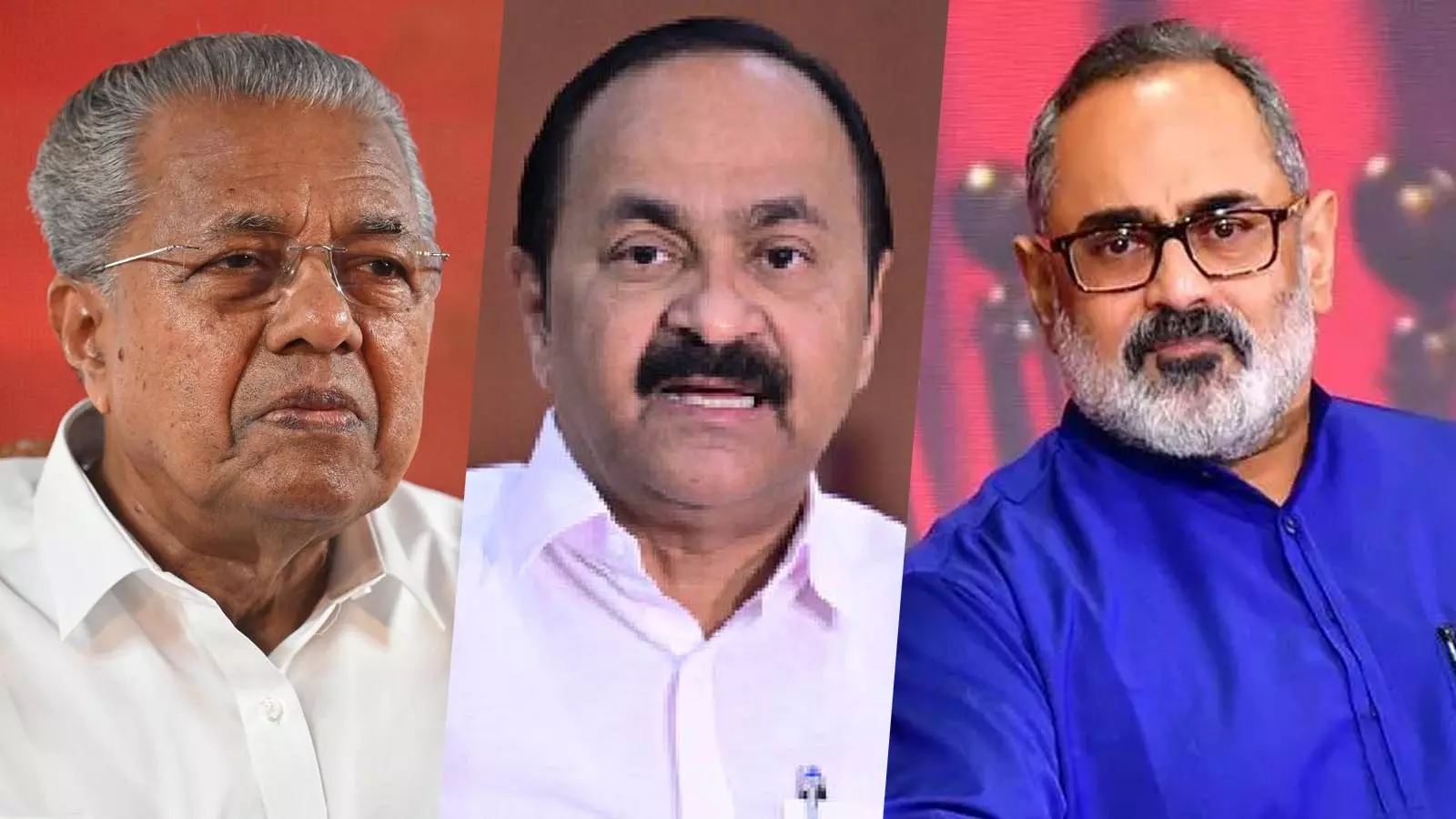
The Kerala Assembly elections 2026 could see the Congress facing a tricky challenge with the rise of the BJP-led NDA splitting the anti-Left votes.
Why anti-incumbency, favourable surveys fail to cheer Congress in Kerala
Opinion polls reveal over 53 pc of voters want LDF out, but fragmented opposition, organisational gaps fuel UDF anxiety over converting discontent into victory

In Kerala, the pre-election breeze is slowly gaining steam. Last weekend, a young man and woman visited this writer’s apartment complex and met the secretary of the residents’ association and interviewed voters who were available as part of a pre-poll survey.
The duo did not ask about the performance of the state’s Left Democratic Front (LDF) or who would win, but focused on who the interviewees preferred as the United Democratic Front (UDF) candidate to contest from Thrikkakara, one of Kerala’s most urban constituencies and currently represented by Congress’s Uma Thomas.
Also read: Rahul's Kochi event signals early UDF push for 2026 Kerala polls
The UDF candidate succeeded in 2022 her late husband, P T Thomas, a senior party leader who passed months after winning the seat in the last elections held in 2021.
Congress does soul-searching
What came out of a conversation with the two field workers is that the Congress was focusing more on its own winnability, choice of candidates and the organisational strength to convert urban dissatisfaction with the ruling Left Democratic Front (LDF) into votes.
More than targeting the Communist Party of India (Marxist)-led alliance, which is seeking its third consecutive term, over its policies or ideological differences, the Congress is more concerned with its own prospects.
Also read: What propelled MP Rahim to move the Right to Disconnect Bill
On the surface, the Grand Old Party appears buoyant, particularly after the local self-government (LSG) elections of December, which went in its favour, and the subsequent consolidation of Muslim votes since the 2024 Lok Sabha elections. Even pre-poll surveys unveiled over the past week have not spoken highly of the ruling LDF. Yet, the Congress is worried that the anti-incumbency might not automatically translate into votes to its advantage, thanks to a potential split in anti-Left votes.
Majority wants LDF out, yet...
Take this scenario, for example. A widely discussed Manorama News–CVoter survey found that 53.7 per cent of respondents want the current Pinarayi Vijayan government voted out, while 40.3 per cent said it should continue. For the Congress, these revelations are significant. It indicates that despite anti-incumbency, the LDF retains a committed base large enough to prevent a collapse. Besides, the dissatisfaction appears fragmented, with the third power, the Bharatiya Janata Party (BJP)-led National Democratic Alliance, positioned to benefit, alongside the UDF.
Also read: Why a high-speed rail network could lead to Kerala-Centre flashpoint
The same survey pointed to a mood of discontent without a decisive swing. Anti-incumbency does exist, but not as a wave strong enough to guarantee regime change. A three-cornered contest could split anti-incumbency between the UDF and the BJP-led NDA, preventing the Congress from capitalising fully.
Other pre-election assessments reinforce this paradox. Even where voters express fatigue with governance, support for several sitting LDF MLAs remains intact. It suggests a disconnect between statewide sentiment and local electoral behaviour. It also weakens the Congress’s strategy of relying on anti-incumbency to produce seat-level gains.
Congress's leaked assessment
The unease has deepened after details from a survey reportedly conducted by the Congress’s ace election strategist Sunil Kanugolu and his team were leaked within party circles and later to a section of the media. The internal assessment, based on the findings, flagged organisational weaknesses in at least four districts of Kerala and predicted neck-and-neck contests in several constituencies rather than decisive swings.
For a party that has historically relied on a state-wide mood to offset local deficits, this is not an encouraging sign. The Congress’s structural problems, including factionalism, weak booth-level machinery, and uneven district leadership, cannot be masked by generic anti-incumbency against the LDF.
In private conversations, Congress leaders admit the challenge is no longer just defeating the Left. It is also about preventing the BJP from becoming the default repository of protest votes, at least in some constituencies.
Surveys suggest dissatisfaction mainly over the policing, anti-minority air and issues such as the Sabarimala controversy are not entirely ideologically anchored. It is transactional. Voters are looking for alternatives, but the Congress is not necessarily the only beneficiary.
Congress's 'two-front' battle
“The situation is similar to 2010-11. We won the LSG elections then, even more decisively than this time, but failed to translate that momentum into Assembly results. You should remember TM Jacob’s 157-vote victory at Piravom and PA Madhavan’s win at Manalur. Those margins carried us over the line. Otherwise, we would have lost even then,” said a senior UDF leader from Malabar.
Also read: 2026 elections: Can Modi’s early Southern foray gain dividends in TN and Kerala?
“The CPI(M) also had internal issues at the time because of the Pinarayi–VS Achuthanandan factionalism. This time, the BJP factor is crucial, and we cannot firmly say they will not cut into our votes. We have minority support for now, but that alone may not be enough,” he added.
“The CPI(M) may be banking on central and southern Kerala. To be frank, it is tight. But we believe we still have the edge.”
This is precisely why the Thrikkakara-style internal surveys matter. They are less about measuring public opinion and more about diagnosing the party’s organisational health. Such exercises are happening in many constituencies where the Congress might go for a change in candidates, particularly where they lost the elections last time.
'Sandwiched' between Left, right
Questions about candidate preference indicate a recognition that leadership credibility and local networks could decide tight contests. Urban constituencies, once considered Congress strongholds, are now contested terrains, especially towards the south and in the capital. The BJP has expanded in middle-class pockets while the Left retains welfare-linked support among lower-income voters. The Congress finds itself squeezed between these two poles.
The Manorama–CVoter findings reinforce this dilemma. The 40 per cent, who still back the LDF, represent a resilient ideological and welfare-driven base. The rest are fluid, and that fluidity benefits a third player as much as the principal opposition.
Also read: With Twenty20 in its kitty, BJP eyes central Kerala breakthrough
Congress leaders also worry that anti-incumbency, without a clear narrative, can backfire. In Kerala’s political history, waves against incumbents have succeeded only when accompanied by a strong counter-vision. At present, the UDF campaign appears reactive rather than agenda-setting.
Left seeks to localise contests
Meanwhile, the LDF’s strategy has been to localise contests. Individual MLAs emphasise constituency delivery, welfare outreach, and crisis management.
Survey patterns showing continued backing for local representatives validate this approach and blunt statewide anti-incumbency.
“We faced back-to-back setbacks in the Lok Sabha and LSG elections, and the shift in minority votes was a major factor,” said a CPI(M) state committee member, adding, “but we still have a fighting chance and are relying on the strength of the government’s development and welfare initiatives. We have identified the areas where votes slipped to the BJP, and that is where we will concentrate our efforts. The latest developments in the Sabarimala gold theft case, where the needle of suspicion is also pointing towards sections of the Congress leadership, could further improve our position.”
Also read: Why Kerala gains on paper but loses fiscally under 16th Finance Commission
The BJP’s incremental vote share adds another layer of complexity. Even without winning a large number of seats, its ability to secure double-digit votes in select constituencies can alter outcomes dramatically.
Left heft
Congress strategists privately concede that triangular contests favour the Left’s disciplined vote base in some crucial constituencies.
Kanugolu’s leaked assessment reportedly warned about tight margins, organisational gaps, and the risk of losing close fights due to weak booth management.
Kerala’s political landscape is unusually fluid. The Left retains a committed core. The BJP is expanding at the margins. The Congress leads in perception but struggles in structure.