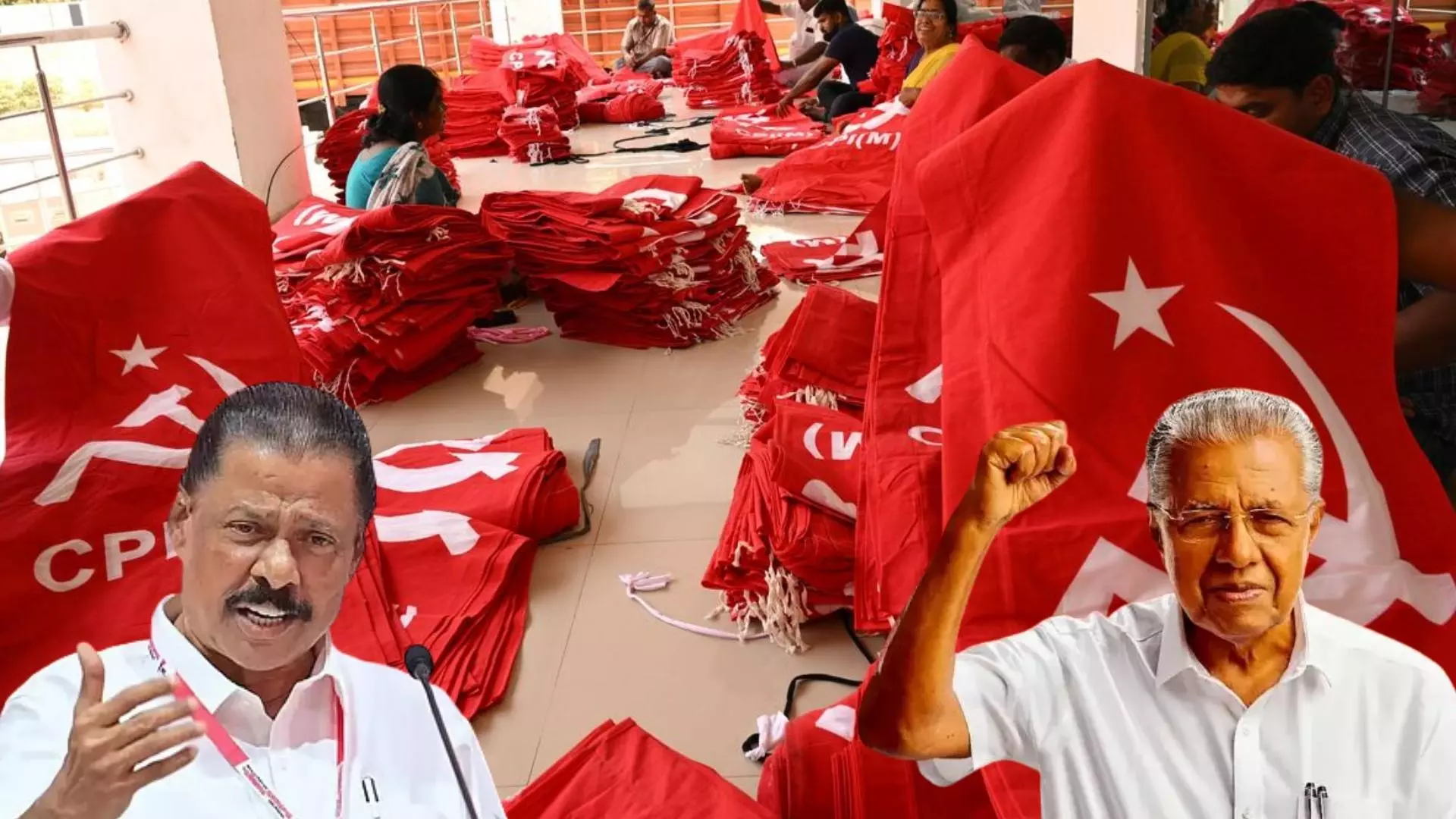
Why CPI(M)’s Kerala post-election review has reignited debate over party’s direction
The report flags minority concerns and labour discontent, but critics say it offers little clarity on accountability or the party’s future political course

The CPI(M)’s post-election review in Kerala, ratified after extensive internal deliberations, has triggered a debate about the party’s political direction and its ability to reconnect with key voter groups. While the report acknowledges several shortcomings, critics argue that it falls short of offering a clear roadmap for renewal.
The review concedes that the party paid a political price for not strongly opposing anti-Muslim remarks made by SNDP Yogam leader Vellappally Natesan. However, the report frames the issue largely as a “perception” problem, a characterisation that has drawn criticism from those who believe the controversy stemmed from a political choice rather than a communication failure. Silence during moments of communal provocation, they argue, was interpreted by voters as a tacit acceptance of such rhetoric.
Also read | Welfare state to market reforms? Kerala white paper signals economic shift
The report also reflects on the Global Ayyappa Sangamam, where a message from Uttar Pradesh Chief Minister Yogi Adityanath was read out. Describing the episode as “inappropriate,” the party appears to acknowledge concerns over the political signals sent by the event. Critics contend that such symbolic gestures blurred the CPI(M)’s traditional ideological opposition to Hindutva politics.
Eroding support base
Addressing the election setback, CPI(M) Kerala State Secretary MV Govindan said: “We have seen a decline in support across communities throughout the state. It would not be accurate to attribute this to any single group opposing us.”
The review also points to dissatisfaction among traditional labour constituencies, including coir workers, cashew labourers, construction workers and handloom artisans. These groups have historically formed a crucial part of the Left’s social base in Kerala.
However, while acknowledging the erosion of support among these sections, the report offers limited explanation for why the disconnect occurred or how the party intends to rebuild trust. Critics argue that this weakens the document’s value as a serious exercise in political introspection.
The party also admits that the Sabarimala gold theft controversy generated public backlash. While action was eventually taken against former Travancore Devaswom Board president and former MLA A Padmakumar, the review concedes that perceptions of a delayed response damaged the party’s image.
Accountability debate
Another major theme in the report is the allegation of a BJP-UDF nexus and vote transfers in several constituencies. While party leaders believe such factors influenced electoral outcomes, critics caution that relying too heavily on external explanations risks overshadowing deeper internal weaknesses.
The report also acknowledges errors in candidate selection in constituencies such as Payyannur and Taliparamba. Yet responsibility is largely assigned to district-level leadership, raising questions about accountability within the party structure.
Observers note that this creates a contradiction: while the CPI(M) often celebrates victories collectively, accountability for defeats appears more fragmented.
Strategic shift?
Beyond the review itself, there are indications that the CPI(M) is reassessing its political positioning. Recent criticism of Vellappally Natesan, renewed attacks on what the party describes as the UDF’s “soft Hindutva,” and efforts to highlight issues such as Vande Matram controversies, university senate nominations and the Governor’s role suggest a return to more familiar ideological terrain.
The central question, however, is whether this repositioning reflects a long-term strategic shift or a reaction to electoral setbacks.
Among party workers, disappointment over the review remains visible. Many had expected a more rigorous assessment that directly confronted political misjudgments rather than focusing on perceptions and communication gaps.
Also read | Kerala fiscal White Paper sparks showdown in assembly over Rs 5.07-lakh-crore debt
Former party leaders who later aligned with the UDF have already dismissed the report as inadequate, arguing that it avoids addressing deeper structural and ideological challenges.
Identity challenge
At its core, the debate surrounding the review goes beyond a single election defeat. It touches on the CPI(M)’s identity in Kerala and its ability to balance governance with ideology, pragmatism with principle.
The report suggests that this balance may have shifted in recent years. Whether the party can restore confidence among its traditional supporters will depend not only on internal discussions and feedback mechanisms, but also on its ability to provide political clarity and conviction.
As Kerala’s political landscape evolves, the CPI(M) faces a fundamental choice: whether to adapt to shifting voter sentiments or seek to shape them. The outcome of that decision could determine the party’s future trajectory in the state.
The content above has been transcribed from video using a fine-tuned AI model. To ensure accuracy, quality, and editorial integrity, we employ a Human-In-The-Loop (HITL) process. While AI assists in creating the initial draft, our experienced editorial team carefully reviews, edits, and refines the content before publication. At The Federal, we combine the efficiency of AI with the expertise of human editors to deliver reliable and insightful journalism.