Is Malnad protest against Kasturirangan report escalating into environment vs people battle?
While villagers, fearing loss of livelihood, want recommendations scrapped, environmentalists stress need for stringent curbs, and allege hands of mining, tourism lobbies behind protests

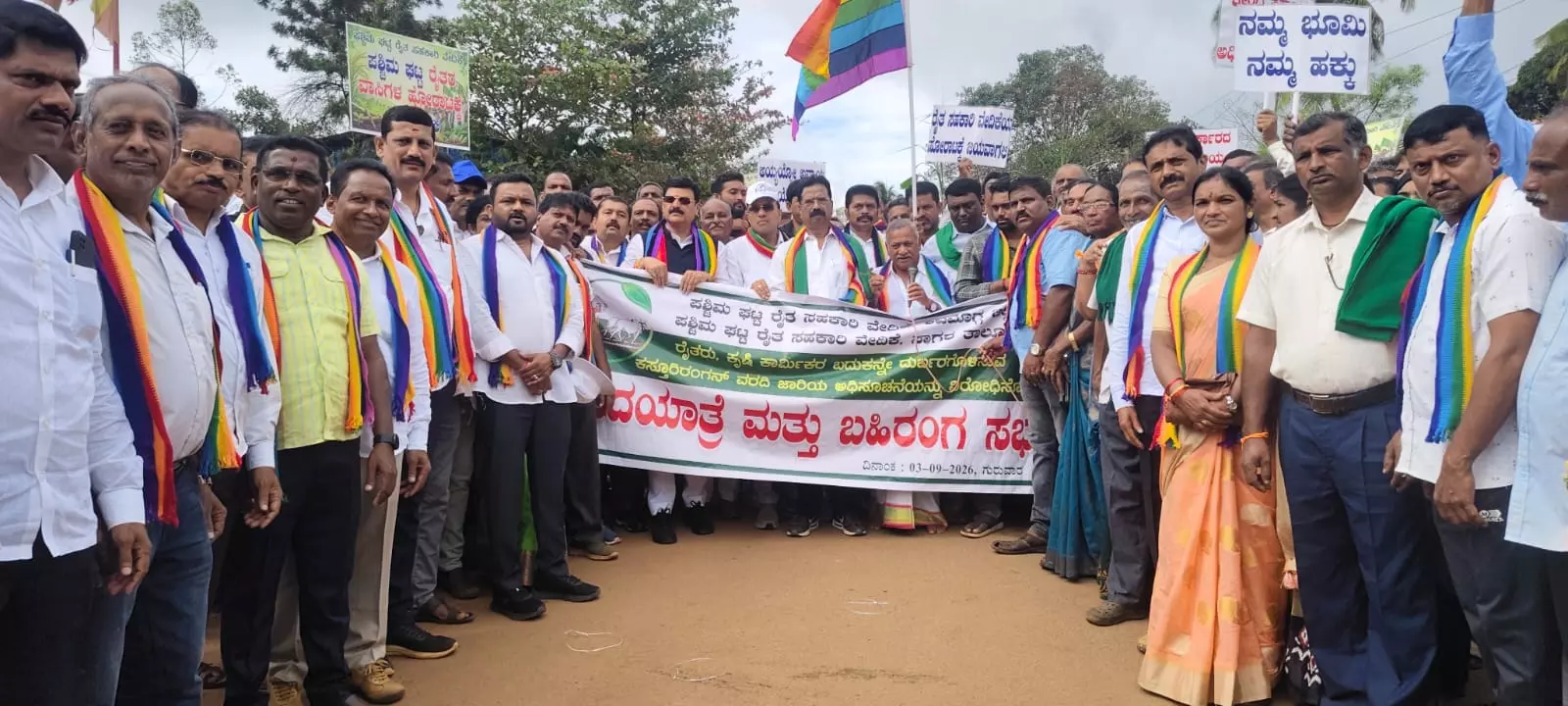
Opposition to the Kasturirangan Committee's recommendations on the Western Ghats is gaining momentum across Karnataka’s Malnad region, with protests continuing in places including Honnavar, Sringeri, Shivamogga and Karkala.
What began as a debate over environmental protection has now turned into a confrontation between residents and environmentalists, with political parties from both the Congress and BJP joining the protests.
Can Karnataka find a balance?
At the heart of the dispute is a difficult question: Can Karnataka protect the fragile Western Ghats without affecting the lives and livelihoods of people who have lived and farmed there for generations?
Farmers and villagers want the Kasturirangan panel's recommendations rejected, fearing restrictions on their land, agriculture, construction, and other local activities. Environmentalists, meanwhile, argue that the Western Ghats are under immense pressure from rampant deforestation, quarrying, mining, tourism and infrastructure projects, and a careful assessment is a must before any projects are allowed in its ambit. They also suspect the hands of mining, quarrying and commercial tourism lobbies behind the protest.
Also read: Kasturirangan report won’t be implemented at any cost: Karnataka minister Bangarappa
The Karnataka government is preparing to take a strong position against the recommendations and is expected to place its objections before the Centre. The special Assembly session, scheduled for September 21, 22 and 23, is expected to discuss the issue.
What the panel recommends
The Ministry of Environment and Forests (MoEF) in August 2012 formed a committee under the leadership of Dr K Kasturirangan to review the recommendations of its predecessor panel headed by Madhav Gadgil on the classification of Ecologically Sensitive Area (ESA) in the Western Ghats after they faced widespread opposition. The recommendations of the Kasturirangan Committee was published by the ministry in a draft notification in March 2014.
Also read: Kasturirangan obit: From curious stargazer to leading space visionary
The committee had recommended 37 per cent of the Western Ghats to be designated as ESA, covering around 60,000 sq km. It had also recommended a complete ban on mining, quarrying and operation of thermal power plants in the ESA.
With the committee using remote sensing data to survey and demarcate ESAs, farmers have alleged that many plantations and farming villages have been incorrectly mapped as natural forests and thus put under the ESA.
Farmers' fear for land, livelihood
For people in Malnad, the Kasturirangan report is not simply an environmental document. It is closely connected to their land and livelihoods.
Many families depend on agriculture, including areca nut, coffee, pepper and paddy cultivation. Residents fear that restrictions on land use could affect farming, construction of houses and roads, and the future value of their property.
Their argument is that people who have lived in the region for generations should not be made to pay the price for environmental damage caused by commercial activities.
Their demand is therefore clear: Reject the Kasturirangan recommendations in Karnataka.
The protests have received support from local groups and political leaders, making the issue increasingly difficult for the government to ignore.
Environmentalists warn of ecological damage
Environmentalists, however, say the debate should not be reduced to an environment versus people conflict.
Akhilesh Chipli, environmentalist and conservationist, strongly opposes major infrastructure projects, resort expansion and illegal forest encroachments in eco-sensitive areas.
The Kasturirangan report doesn’t put a blanket ban on infrastructure projects and only restricts townships and large construction projects exceeding 20,000 sq m while allowing eco-tourism and low-impact sustainable development in ESAs.
Environmentalists fear the area is still susceptible to being manipulated by businesses to set up infrastructure projects and allow scope for the formation of settlements using smaller plots.
Also read: Centre readies second draft notification on ESA in Western Ghats; 3 states in focus
“Development cannot mean cutting through wildlife corridors and disturbing fragile slopes. Even government-sanctioned power lines, road expansions and railway projects can fragment habitats,” Chipli argues.
He says such projects are contributing to soil erosion and landslides and are affecting natural streams in parts of Shivamogga and Chikkamagaluru.
“The drying up of natural streams and increasing ecological damage should be a warning. If we destroy the Western Ghats, the impact will ultimately be felt by the people living here,” he says.
Chipli's argument is not that all development should stop. Instead, he wants projects to be carefully assessed before being allowed in ecologically sensitive areas.
Wildlife corridors under pressure
Wildlife conservationist and United Conservation Movement trustee Joseph Hoover also raises concerns over the impact of development projects on forests and wildlife corridors.
“Forest and wildlife protection laws cannot be bypassed in the name of development. When thousands of trees are cleared for commercial and linear projects, wildlife corridors are affected and human-animal conflict can increase,” Hoover says.
He alleges that authorities have, in several instances, failed to adequately follow central forest-clearance requirements and protections related to ecologically important areas.
Hoover supports strict enforcement of the Kasturirangan and Madhav Gadgil recommendations.
“The Western Ghats need stronger protection. If we keep weakening environmental safeguards, we will lose the very ecosystems that support agriculture, water sources and wildlife,” he says.
However, claims regarding specific violations and the number of trees affected would need to be examined on a project-by-project basis.
Is mining lobby driving the opposition?
Environmentalists are also making a more serious allegation: that the campaign against the Kasturirangan recommendations is not being driven only by farmers and villagers.
They allege that mining, quarrying, commercial tourism and other business interests could benefit from weaker environmental restrictions.
Chipli and other activists argue that Karnataka should distinguish between genuine concerns of farmers and villagers and commercial interests seeking fewer restrictions.
“Farmers' concerns are genuine and they must be protected. But those concerns should not become a shield for mining, quarrying or activities that can permanently damage the Western Ghats,” environmental activists argue.
These are allegations and have not been independently established.
Activists question political role
Local activists are also focusing on ground realities and community rights.
Arvind Sigadal, a local activist, says people affected by major projects should have a greater say in decisions concerning their land and environment.
Also read: Interactive: Why the Western Ghats are crying for protection
For local communities, the issue is therefore not only about the Kasturirangan report. It is also about whether development decisions are being taken with adequate public consultation.
Rambhapuri seer adds religious dimension
The movement has received another boost with the intervention of Balehonnur's Rambhapuri Peetha seer, Sri Sri Sri Renuka Veerasomeshwara Bhagavatpada.
The seer has stressed that protecting the forests, sacred groves and natural rivers of Malnad is both a cultural responsibility and essential for the survival of local farming communities.
“Protecting the ecology of Malnad is our responsibility. Forests, rivers and sacred groves are not only natural resources but part of our heritage. We must not sacrifice them for short-term commercial gains,” the seer has said.
His intervention has given the protests an important religious and community dimension.
Political battle widens
The issue has now moved beyond environmental groups and village organisations.
Congress and BJP leaders and workers have participated in protests in different parts of the region. For political parties, opposition to the recommendations has become an important local issue because it directly affects farmers and landowners.
At the same time, the government faces pressure from environmentalists to protect the Western Ghats from unchecked development.
This leaves Karnataka with a difficult political balancing act.
Can Karnataka find a middle path?
The biggest question is whether the state should simply reject the Kasturirangan recommendations or propose a detailed alternative.
Environmentalists say Karnataka should conduct a scientific and ground-level assessment of the areas where restrictions have been recommended by the committee.
Areas with established villages and agricultural activity can be examined separately, while fragile forests, wildlife corridors and ecologically important zones can receive stronger protection.
Also read: How Madhav Gadgil put people at the heart of Western Ghats’ conservation
Such an approach could protect genuine community interests without opening the door to unrestricted mining, quarrying and destructive construction.
The special Assembly session could therefore become an important turning point.
The question is no longer simply whether Karnataka will reject the Kasturirangan report. The bigger question is whether the state can create a credible alternative that protects the Western Ghats while safeguarding the genuine rights and livelihoods of the people living there.
For now, the protests show that the debate is far from over. In Malnad, the battle between environmental protection, livelihood concerns and commercial interests is becoming sharper — and increasingly political.