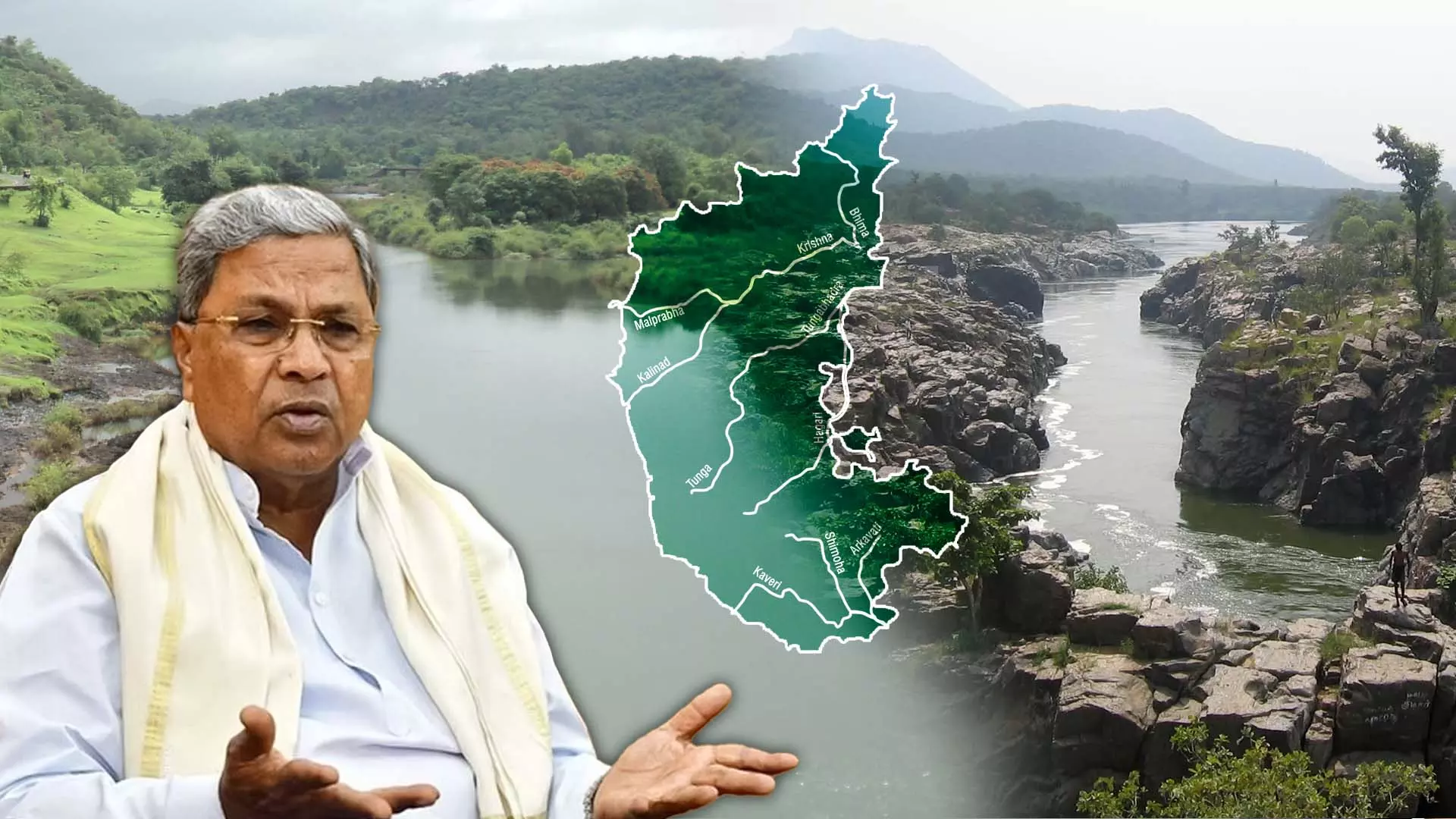
Karnataka’s water battles: State tussles with 17 inter-state river disputes before courts
From Mahadayi to Mekedatu, billions of rupees and Karnataka's water security hinge on prolonged legal battles. Can courtrooms alone decide the state's future?

River water sharing has remained one of Karnataka’s most sensitive and politically charged issues for decades.
The future of the state’s agriculture, drinking water supply, and major irrigation projects continues to be shaped inside courtrooms.
At present, Karnataka is involved in 25 inter-state river water dispute cases, of which 17 are still pending before the Supreme Court and various tribunals. These cases directly affect farmers, cities like Bengaluru, and development projects worth thousands of crores.
As legal proceedings drag on, irrigation works remain stalled, costs escalate sharply, and uncertainty over water security deepens across the state.
Why these cases matter
These disputes are not merely technical legal battles. They determine whether drought-prone districts receive irrigation, whether cities secure drinking water, and whether long-pending infrastructure projects can move forward.
Also read: Bengaluru’s water crisis deepens as cases of contaminated drinking water surge
Delays have a cascading effect. Projects awaiting clearance for years become exponentially more expensive, while farmers are forced to depend solely on erratic rainfall. The rural economy, in turn, bears the brunt of prolonged uncertainty.
The disputes have also strained relations between Karnataka and its neighbouring states, making resolution more complex and politically sensitive.
Mahadayi dispute
One of the most critical cases is the Kalasa-Banduri canal project linked to the Mahadayi river. The project is crucial for supplying drinking water to Belagavi, Dharwad, Gadag, and Bagalkote districts.
Although the Mahadayi Water Disputes Tribunal allocated 13.42 TMC of water to Karnataka, the project remains stalled. Goa and Maharashtra have challenged the implementation in the Supreme Court, citing environmental concerns.
Also read: Acting like Duryodhana: Ex-Goa minister on Karnataka building dams on Mahadayi river
Delays in issuing the final notification and granting environmental clearance by the Centre have emerged as major roadblocks, preventing work on the ground.
Upper Krishna delay
Another major project caught in legal limbo is the Upper Krishna Project Phase 3. Karnataka plans to raise the height of the Almatti dam to extend irrigation to nearly six lakh hectares of agricultural land in North Karnataka.
Also read: KCR slams Telangana govt over Krishna river projects, power supply to farmers
However, disputes between Andhra Pradesh and Telangana over water reallocation have stalled tribunal notifications. As a result, projects worth thousands of crores remain incomplete.
For farmers in North Karnataka, these delays have translated into recurring distress and missed agricultural seasons.
Other disputes
Karnataka’s legal challenges extend beyond Mahadayi and Krishna. The Polavaram project on the Godavari river has raised concerns over land submergence in parts of Karnataka, forcing the state into another round of litigation.
Also read: Chandrababu Naidu affirms completion of Polavaram projects by March 2027
In the Palar river dispute, Andhra Pradesh’s proposed dam has triggered objections from both Tamil Nadu and Karnataka. Once again, Karnataka has been compelled to approach the courts to safeguard its share of water.
These overlapping disputes underline how interconnected river systems have become flashpoints between states.
Cases and outcomes
In total, Karnataka is handling 25 inter-state river water dispute cases. Of these, eight cases have been resolved, while 17 remain pending before courts and tribunals.
The resolved matters include five cases related to the Cauvery river and one case linked to the North Pennar, involving disputes over check dams and reservoirs on the Markandeya tributary.
According to officials, these legal wins have strengthened irrigation and drinking water projects in several regions of the state.
Key legal wins
One of Karnataka’s most significant victories came in the Cauvery dispute, when the Supreme Court rejected Tamil Nadu’s challenge against preparing the detailed project report for the Mekedatu reservoir.
Also read: Mekedatu project: SC rejects Tamil Nadu’s plea against Karnataka
This ruling marked a crucial step toward securing Bengaluru’s future drinking water needs. The state has also successfully defended its position during distress-year water-sharing demands.
These outcomes have reinforced Karnataka’s legal standing, even as larger battles remain unresolved.
Cost of delays
Over the last two years alone, Karnataka has spent Rs 6.47 crore on legal fees, engaging senior advocates to protect its interests. While the amount may appear high, experts point out that the value of water secured runs into thousands of crores.
The greater cost lies in delay. A project estimated at Rs 1,000 crore a decade ago can now cost Rs.5,000 crore due to prolonged litigation and inflation.
Without assured irrigation, farmers face repeated crop failures, weakening the rural economy and increasing social distress.
Beyond courts
Experts argue that courtroom victories alone are not enough to resolve Karnataka’s water challenges. Alongside strong legal representation, the state needs sustained diplomatic engagement with neighbouring states.
Also read: Karnataka govt says team to be formed to prevent encroachment and pollution of Cauvery
Inter-state council discussions, political consensus, and pressure on the central government to issue pending gazette notifications are seen as equally critical.
Permanent teams of hydrology and water experts are also essential to strengthen Karnataka’s technical case in future disputes.
Karnataka’s river water disputes reflect a mix of hard-won legal successes and unresolved challenges. With 17 crucial cases still pending, the future of the state’s agriculture and drinking water security depends on swift legal action, political unity, and decisive intervention. Water, after all, is not just about politics — it is about survival.
The content above has been transcribed from video using a fine-tuned AI model. To ensure accuracy, quality, and editorial integrity, we employ a Human-In-The-Loop (HITL) process. While AI assists in creating the initial draft, our experienced editorial team carefully reviews, edits, and refines the content before publication. At The Federal, we combine the efficiency of AI with the expertise of human editors to deliver reliable and insightful journalism.