Is Congress losing its edge? Karnataka MLC results raise bigger question
The election’s biggest takeaway is the BJP-JD(S) alliance, which finally looked like a coordinated unit on the ground

The Karnataka Legislative Council election results have given the BJP-JD(S)-led NDA a major political boost and a big setback to the ruling Congress. The NDA won all four seats that went to the polls—the BJP won three and the JD(S) one.
For Congress, which is in power in Karnataka, losing all four seats is a serious political setback. The results do not mean that the Congress government is in danger or that its strength in the 75-member Legislative Council has changed dramatically. These elections were held in two Graduate and two Teachers’ constituencies, which have a limited and specialised electorate.
Setback for Congress amid alleged sting operation
However, the results have come at a politically sensitive time for Congress. The party is already facing internal differences, particularly between the camps of former Chief Minister Siddaramaiah and current Chief Minister DK Shivakumar. The controversy over the alleged sting operation involving Siddaramaiah has added to the party's political tension.
Also read: Bengaluru-Hosur Metro extension: What commuters, techies say
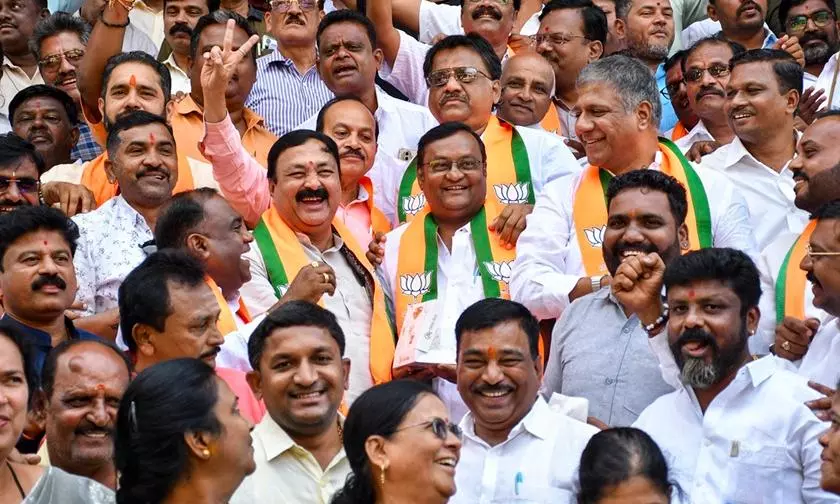
The biggest success of the election, however, is the BJP-JD(S) alliance. The two parties appeared to have worked together more effectively this time. Senior BJP and JD(S) leaders held joint meetings, shared responsibilities and campaigned together. The alliance also appears to have managed better coordination at the constituency level.
This matters because vote transfer between the BJP and JD(S) has often been a challenge in Karnataka. The results suggest that, at least in these four constituencies, the alliance was able to bring its supporters together against Congress.
How results panned out
The Bengaluru Teachers’ constituency is a good example. JD(S) candidate AP Ranganath defeated Congress candidate Puttanna by 908 votes. Ranganath secured 10,810 votes, while Puttanna got 9,902 votes. Puttanna was a strong candidate with a long political record in the constituency. He had won the seat five times. His defeat therefore sends an important message to the JD(S)-BJP alliance: their combined votes can defeat an established Congress candidate.
The BJP also won the other three seats with clear margins. In the West Graduates’ constituency, BJP candidate SV Sankanur defeated Congress candidate Mohan Limbikai by 9,323 votes. In the North-East Teachers’ constituency, Shashil G Namoshi won by 3,297 votes. In the South-East Graduates’ constituency, BJP candidate KM Suresh defeated Congress candidate Shashi Hulikunte Mutt by a huge margin of 23,098 votes.
Also read: Karnataka SIR: Chief Electoral Officer says ‘no bulk deletion’ of voters
The results raise another important question for Congress: Is the party losing some of its traditional support among sections of voters? This is especially important because of the AHINDA politics associated with Siddaramaiah. AHINDA brings together minorities, backward classes and Dalits. The MLC electorate is not the same as the wider Assembly electorate, so the results cannot be directly linked to a shift in the entire AHINDA vote.
The Siddaramaiah sting operation controversy may also have played a role in shaping the political mood. It is too early to say that the controversy directly caused the Congress defeat. But the issue has created another political challenge for the party at a time when there are already questions about internal unity.
NDA's strategy succeeds
Siddaramaiah’s role in the Congress defeat is another important question. Despite the party's political differences, he still has a strong personal support base, particularly among sections of AHINDA voters. The question is whether his active involvement in the campaign could have helped Congress perform better, or whether the controversy surrounding the alleged sting operation created confusion among his supporters and became an additional disadvantage for the party.
The results also put the focus on Shivakumar and the Congress organisation. While Shivakumar and other senior leaders did campaign, the party appeared less united compared to the BJP-JD(S) alliance, which presented a coordinated campaign.
There is also the question of the Siddaramaiah-Shivakumar relationship. If differences between the two camps affect the party organisation at the grassroots level, it could make it difficult for Congress to fight closely contested elections. In contrast, the BJP and JD(S) appeared more focused on defeating Congress. Their joint campaign gave the NDA a clear message of unity.
The NDA’s strategy and ground-level campaign were successful.
From the start, BJP and JD(S) leaders held joint meetings and sent a clear message of unity. Union Ministers HD Kumaraswamy, V Somanna and Shobha Karandlaje met with state BJP and JD(S) leaders. All the MLAs attended the meeting. After this, the leaders campaigned together. Senior leaders, including Pralhad Joshi and Kumaraswamy, participated in campaign meetings for the Legislative Council elections. Later, senior state BJP leaders also took part in the campaign. Responsibilities were assigned to leaders for each constituency. The BJP and JD(S) leaders ensured that there was no dissatisfaction or disagreement between the two parties anywhere. And it did not happen in Congress.
What results mean ahead of 2028 Assembly election
The controversy over the alleged conspiracy against Siddaramaiah within the Congress in connection with the sting operation issue is said to have benefited the NDA. It is said that this helped the NDA attract more votes from backwards-class voters.
The MLC results can't be treated as a prediction of the 2028 Assembly election. Graduate and Teachers’ constituencies have a much smaller and different electorate. But the results are still politically important. For the BJP and JD(S), the four-zero result is proof that their alliance can work on the ground. For Congress, it is a warning.
The bigger question for the ruling party is not simply why it lost four MLC seats. The question is whether the results mark the start of a shift in voter sentiment—particularly among voters who have traditionally been part of Congress's political and social support base. The MLC verdict may therefore be a limited election result, but it has given Karnataka politics a much bigger question to debate: Is Congress, which has a clear majority in the 2023 Assembly elections beginning to lose its political advantage, or was this simply a successful NDA strategy in a specialised election?