How Bengaluru to Hyderabad, Chennai bullet trains will help Karnataka
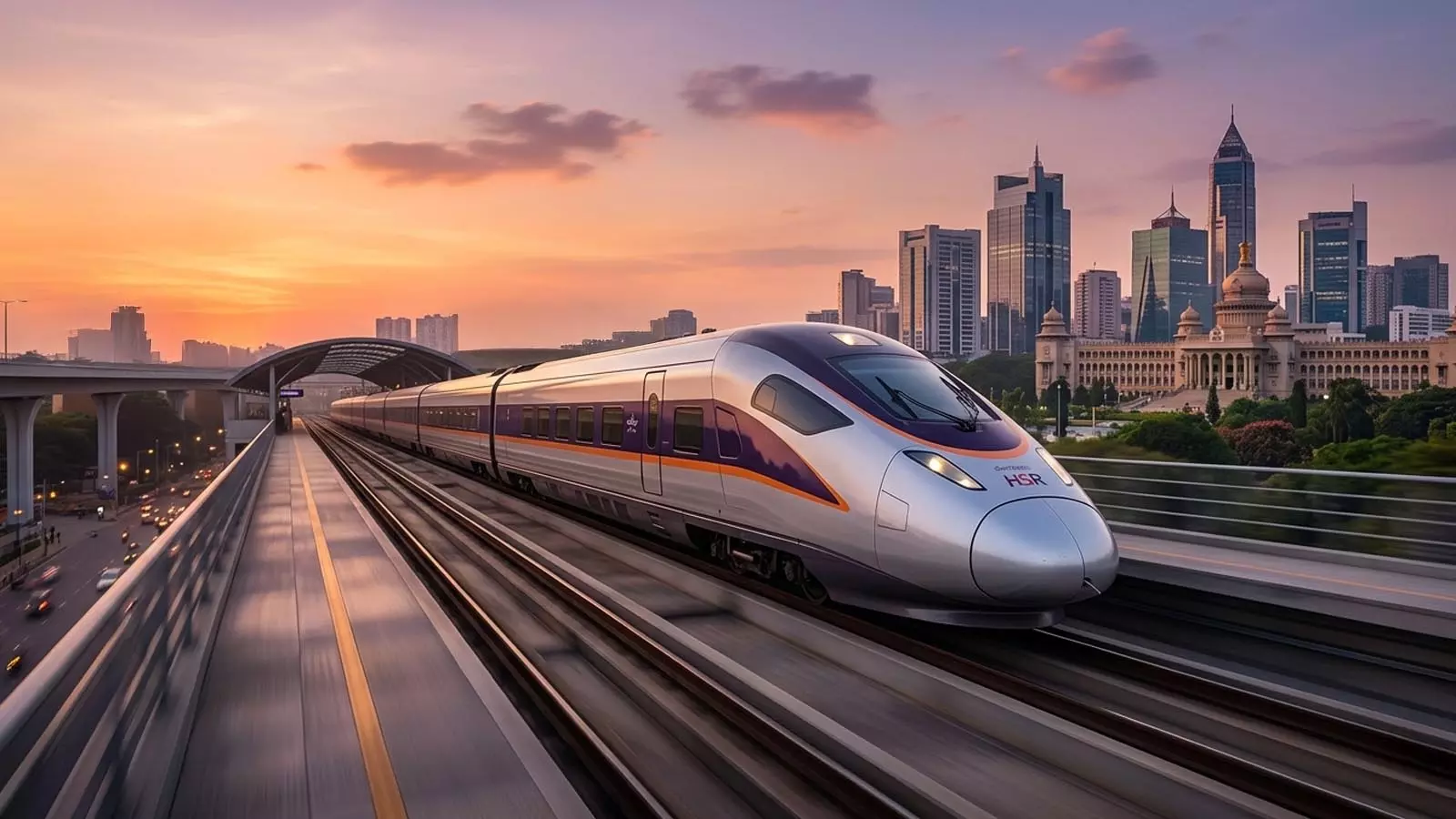
The Hyderabad-Bengaluru high-speed rail corridor will be elevated, with trains operating at speeds between 320 and 350 kmph

The Karnataka government has granted administrative approval to the Centre’s ambitious Bengaluru-Hyderabad and Bengaluru-Chennai high-speed rail corridor projects, raising expectations significantly. South India’s first high-speed rail network is set to come up in Bengaluru, and these trains, capable of running at 350 kmph, are expected to transform the pace of public transportation. The implementation of both corridors is also expected to accelerate the state’s overall development.
Here is a detailed look at the two projects.
Hyderabad-Bengaluru high-speed corridor
This corridor will connect Karnataka, Andhra Pradesh and Telangana. Of the total 607 km rail line, nearly 101 km will pass through Tumakuru, Chikkaballapur and Bengaluru Rural districts in Karnataka.
Also read: Bengaluru-Mysuru bullet train to cut travel time to 30 minutes
At present, express trains operating under the South Western Railway zone take between 8 and 12 hours to travel from Hyderabad to Bengaluru. With the high-speed rail service, the travel time is expected to come down to just 2 hours and 10 minutes.
Under the Hyderabad-Bengaluru high-speed rail corridor project, stations are proposed at Alipur in Chikkaballapur district, near the Devanahalli airport in Bengaluru Rural district, and at Kodihalli in Hoskote taluk. The entire corridor will be elevated, with trains operating at speeds between 320 and 350 kmph.
Bengaluru-Chennai-Mysuru high-speed corridor
This is a major project connecting Chennai and Mysuru via Bengaluru. The corridor, stretching between 435 and 463 km, will include a 306-km Chennai-Bengaluru section.
Also read: Bengaluru's AI City: Here is everything you need to know
Currently, travel between Bengaluru and Chennai takes 5 to 7 hours. The high-speed rail is expected to reduce this to just 1 hour and 15 minutes. Proposed stations along this corridor include KGF in Kolar district, Kodihalli in Hoskote, Whitefield and Baiyappanahalli in Bengaluru.
Kodihalli station in Hoskote is planned as the junction for both the Bengaluru-Hyderabad and Bengaluru-Chennai routes. A major depot and service station are also proposed there.
Nodal officer appointed for land acquisition
The state government has appointed a nodal officer to oversee land acquisition for both high-speed rail corridor projects. Around 1,757 hectares of land are proposed to be acquired in Karnataka for these projects.
The Baiyappanahalli station is planned to be integrated with the Metro and Suburban Rail networks, ensuring seamless connectivity for passengers.
Once completed, the high-speed rail project is expected to position Bengaluru as the hub of South India’s high-speed rail network.
How Hyderabad high-speed project will help
The Bengaluru-Hyderabad high-speed rail (Bullet Train) project is expected to significantly transform Tumakuru district. According to the current project report, there is a possibility of a station being set up in the Sira region of the district. This would provide direct high-speed rail connectivity to local residents.
Tumakuru is already part of the Chennai-Bengaluru Industrial Corridor. With the addition of high-speed rail connectivity, major companies from Hyderabad and Bengaluru are expected to show greater interest in investing in Tumakuru.
Land prices around the proposed stations are likely to rise sharply, giving a major boost to the real estate sector. Travel time from Tumakuru to Hyderabad could come down to between one-and-a-half and two hours, while Bengaluru could be reached in just 20 to 30 minutes. This would make daily commuting to Bengaluru or Hyderabad for work a practical option while continuing to live in Tumakuru.
The areas surrounding the stations are also expected to generate employment opportunities for locals in hotels, transport and other service sectors. Tumakuru, known as a major education hub, could attract students from Hyderabad and Andhra Pradesh more easily due to improved connectivity.
Residents of Tumakuru would also gain faster access to advanced healthcare facilities in Bengaluru and Hyderabad. Overall, the project is expected to help Tumakuru emerge as a major economic satellite city on the lines of Bengaluru.
Similarly, the Bengaluru-Hyderabad high-speed corridor passing through Chikkaballapur district is expected to improve connectivity there as well. From the proposed Alipur station, passengers could reach Devanahalli or Hoskote stations in Bengaluru within 15 to 20 minutes.
At present, travelling to Hyderabad by road takes around 8 to 10 hours. With the high-speed rail, the journey could be completed in about two hours.
This region is known for large-scale cultivation of fruits, vegetables and flowers. The high-speed rail service could help transport these products quickly to large markets such as Bengaluru and Hyderabad.
Bengaluru’s IT sector is also expected to expand along the corridor. New industries and tech parks are likely to come up in the Chikkaballapur and Gauribidanur regions.
The corridor’s direct connectivity to the Devanahalli airport is expected to make air travel easier for people from neighbouring districts as well.
Bengaluru Rural district is expected to emerge as the nerve centre of the high-speed rail project. Kodihalli in Hoskote, where both the Hyderabad and Chennai routes intersect and major stations are planned, is likely to witness large-scale development.
Major railway depots, training centres and maintenance units are proposed there, creating thousands of direct jobs.
Industrial zones in Hoskote, Devanahalli and Doddaballapur are expected to attract multinational companies looking to establish manufacturing units. Modern townships and smart cities are likely to develop around the high-speed rail stations, pushing up land prices significantly.
How Chennai-Bengaluru high-speed rail corridor will help
Currently, travelling from Bengaluru to Chennai takes around 5 to 6 hours by train and 6 to 7 hours by road. The high-speed rail is expected to cut this travel time to just 1 hour and 15 minutes, making it even faster than air travel.
As the distance between Bengaluru and Chennai effectively shrinks, the entire corridor is expected to evolve into a unified economic zone. People could live in Bengaluru and work in Chennai, or stay in Chennai while doing business in Bengaluru, with much greater ease.
Since the high-speed rail will pass through KGF (Kolar), Hoskote and Whitefield, industrial areas in these regions are expected to see a surge in demand. Technical collaboration between Bengaluru’s IT companies and Chennai’s automobile hubs is also likely to become easier.
Traffic congestion in Bengaluru city could reduce as more people choose to stay in outskirts such as Hoskote or Kolar and commute into the city using high-speed trains.
New townships and smart cities are expected to come up along the corridor. Railway depots, station maintenance facilities and commercial complexes around the stations are likely to create large-scale employment opportunities for local residents.
As the high-speed rail will run on electricity, carbon emissions are expected to be far lower compared to road transport.
The project is also expected to revive the KGF region, which has long carried the tag of being a backward area. Large logistics hubs are likely to be developed there.
(This article was originally published in The Federal Karnataka)