



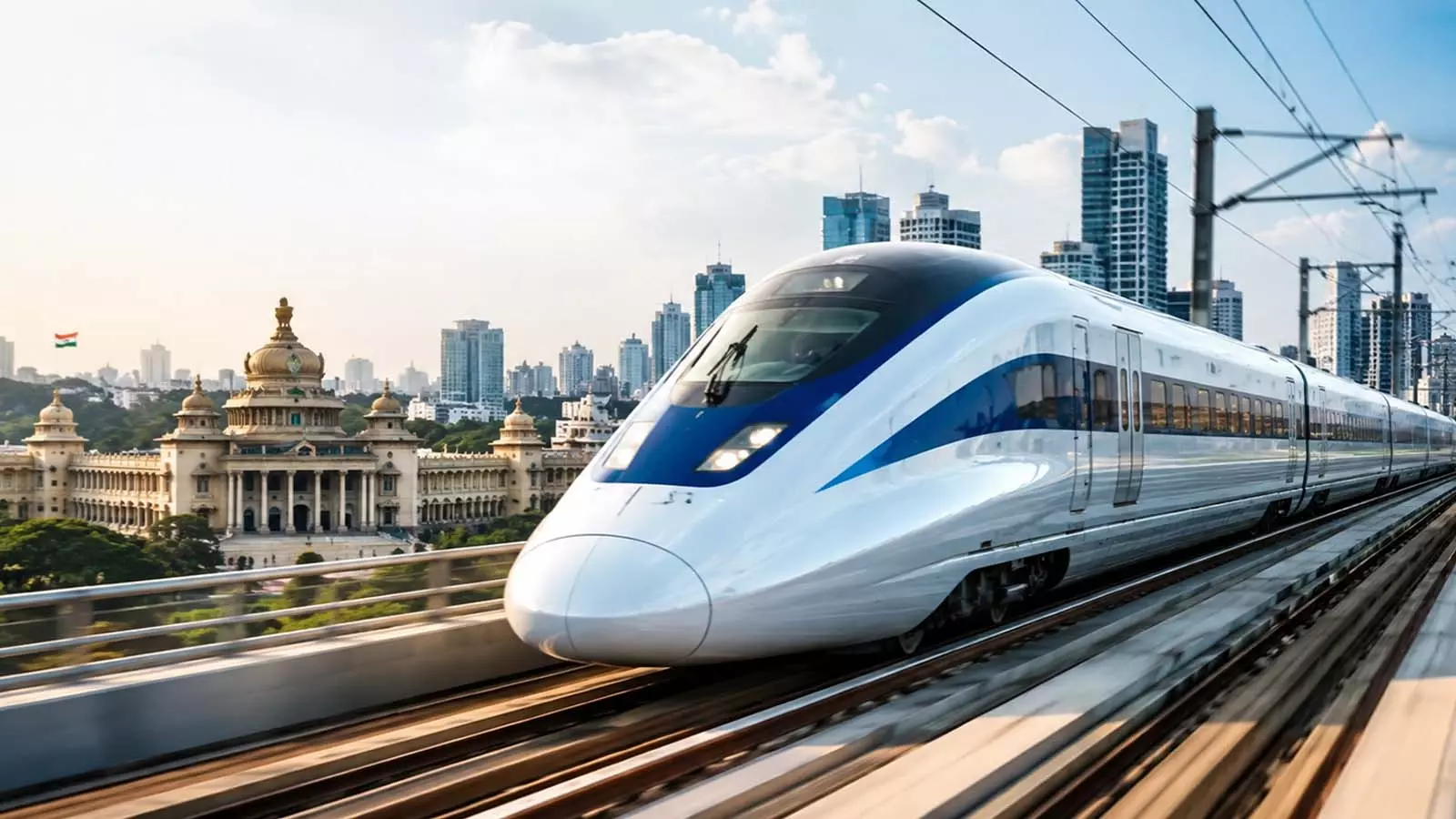
Bengaluru-Mysuru bullet train to cut travel time to 30 minutes
A total of five major stations have been identified along the proposed 157.34-km corridor. The bullet train originating from Mysuru will pass through Mandya, Ramanagara, Kengeri in Bengaluru, and Electronics City near Huskur

The highly ambitious ‘high-speed rail’ (bullet train) project, which could usher in a new era for south India’s transport and infrastructure sector, has now reached a decisive stage. Soon after the Union Budget 2026 announced bullet train projects connecting Bengaluru with Hyderabad and Chennai, the National High-Speed Rail Corporation Limited (NHSRCL) released the preliminary alignment maps for these corridors.
The most notable and heartening aspect for Karnataka is the clear indication that the project could also be extended to Mysuru, with a supporting route alignment already prepared.
Also read: High-speed trains: Bengaluru to Chennai in 73 minutes, Hyderabad in 120 mins
This massive network connecting Mysuru, Bengaluru, Chennai and Hyderabad could significantly strengthen south India’s economy.
Mysuru-Bengaluru extension
The initial announcement in the Union Budget had left out the Mysuru-Bengaluru stretch, naturally triggering disappointment among people and public representatives from the region. However, the newly released preliminary alignment clearly includes Mysuru in the high-speed rail network.
If implemented, it could completely transform travel between Bengaluru and Mysuru, with travel time between the two cities reduced to just 30 to 40 minutes.
Route and station details
A total of five major stations have been identified along the proposed 157.34-km corridor. The bullet train originating from Mysuru will pass through Mandya, Ramanagara, Kengeri in Bengaluru, and Electronics City near Huskur.
Also read: New sleeper Vande Bharat to connect Bengaluru, Mumbai in 16-18 hours via Kalaburagi
Notably, Ramanagara was absent in earlier proposals, but the new alignment includes a station there as well. The line will merge with the main Bengaluru-Chennai and Bengaluru-Hyderabad corridors at Kodihalli near Hoskote.
Strong reasons behind Mysuru’s inclusion
Mysuru-Kodagu MP Yaduveer Krishnadatta Chamaraja Wadiyar had consistently pressed the Union Railway Ministry to include this route. More importantly, a feasibility study conducted by a German expert committee reportedly concluded that the Mysuru-Bengaluru bullet train project would be economically viable and operationally successful.
Although the 10-lane expressway has already reduced travel time between the two cities, traffic congestion continues to rise steadily. At a time when the IT industry is increasingly looking towards Mysuru, a train service capable of transporting employees from Mysuru to Bengaluru or Electronics City in just 30-40 minutes could substantially ease pressure on Bengaluru.
It is also expected to provide a major boost to tourism and the real estate sectors in Mysuru, Mandya and Ramanagara.
Bengaluru-Chennai corridor: Just 1 hour 13 minutes
At present, travelling between Bengaluru and Chennai — India’s two major IT and industrial hubs — takes at least 5 to 6 hours by train and 6 to 7 hours by road. However, the proposed 306-km bullet train corridor could reduce this travel time to just 1 hour and 13 minutes.
Starting from Baiyappanahalli in Bengaluru, the route will pass through IT corridors such as Whitefield, Kodihalli near Hoskote — which could emerge as a junction where all three routes converge — and Kolar, located around 5 km from the city centre, before crossing Karnataka’s border.
Bengaluru-Hyderabad corridor: 607 km journey in 2 hours
The commercial and software connectivity between Bengaluru and Hyderabad is already globally recognised. Once the 607.03-km high-speed rail corridor connecting the two cities is completed, the journey could be finished in just two hours.
In fact, travelling by bullet train could become faster than the total time currently spent reaching airports, completing security checks, flying, and then travelling back into city centres.
(This article was originally published in The Federal Karnataka)