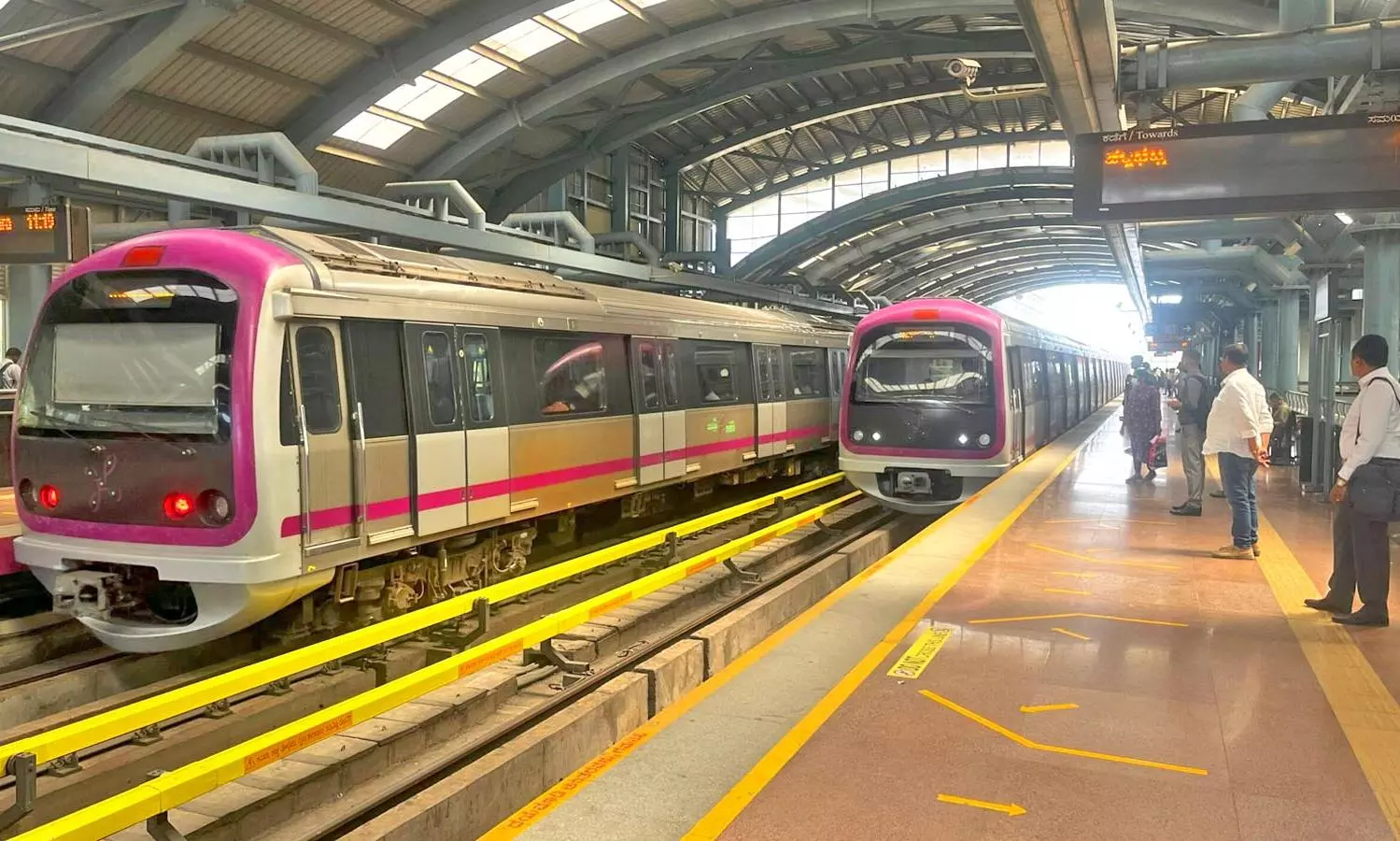
Another Metro fare hike move after last year’s steep rise upsets Bengaluru commuters
For Bengaluru, which is among the cities with the worst traffic congestion in the world, this fare hike is likely to aggravate the traffic problem further

Public anger has once again erupted in Bengaluru over the BMRCL’s move to hike Namma Metro fares.
Though the announced fare hike this time is not as steep as the 71 per cent hike announced in February last year, the 5 per cent that will come into effect from February 9 has also raised concerns that it will encourage middle-class commuters to turn to private vehicles again.
For Bengaluru, which is among the cities with the worst traffic congestion in the world, this fare hike is likely to aggravate the traffic problem further. The city, which features on private survey group TomTom’s list every year, has been ranked the second most congested city in the world this time too.
In 2023-24, Namma Metro’s operating income was Rs 129.3 crore, which increased to Rs 229 crore in 2024-25. But in 2025-26, it earned Rs 200 crore. BMRCL sources said the reason for the decline in income was that passengers, upset by the 71 per cent fare hike last year, withdrew from Metro.
Passing on the debt burden
While the fare revision has been decided on the pretext of reducing the debt burden, commuters will be the ultimate sufferers as Bengaluru Metro is already more expensive than other Metro services like Kolkata’s or Delhi’s. While the fare currently ranges from Rs 10 to Rs 90, the revision will take it to Rs 11 to Rs 95. There are fears that this hike will alienate the Metro from the common man.
Also read: Despite Union Budget omission, Sreedharan opens office to kickstart Kerala high-speed rail
Speaking to The Federal Karnataka, Bangalore Metro Passengers’ Association President Rajesh Bhatt said, “The state government has put passengers in a dilemma. They are either paying a high price to travel by Metro or getting stuck in traffic. Passengers are already reeling from the fare hike made a year ago. It is not right that they are now planning to increase the fare by 5 per cent again. BMRCL is cutting into people’s pockets to pay off its debt.”
Traffic or pocket?
The number of Metro passengers has been increasing day by day since the launch of the Yellow Line. Even though bus fares have been reduced, more people have been taking the Metro due to fear of traffic congestion. And that is what the government is trying to capitalize on.
Passengers travelling more than 25 km will have to pay the maximum fare of Rs 95, up from Rs 90. This distance could be covered for Rs 60 prior to last year’s hike. The renewed fare hike will put a heavy burden on those who travel daily for work and studies. There is a fear that middle-class communities in particular may eventually have to turn away from Metro travel.
“People should organize and fight against the government’s policies. Only then can the government be taught a lesson. The Metro commuters’ organization will prepare a plan for the fight,” said Rajesh Bhat.
What BMRCL says
Namma Metro increased fares in February 2025 only after a revision in June 2017. Between March 2017 and March 2024, BMRCL’s staff expenses increased by 42 per cent while maintenance and administrative expenses apparently became 366 per cent more expensive.
Also read: Bengaluru civic groups slam proposed Metro 5pc fare hike: 'Metro lifeline, not luxury'
BMRCL has to repay Rs 10,422 crore in loans between 2024-25 and 2029-30. So, a fare hike is inevitable to cover the loan repayments and maintenance costs. A BMRCL official told The Federal Karnataka that if the fares aren’t revised by 5 per cent this year, they will have to be increased by 10 per cent next year. “The hike is only 5 per cent because there may be a big resistance from the public otherwise,” the staffer added.
On February 9, 2025, BMRCL initially increased the Metro fare by 100 per cent in some sections. This led to intense protests by passengers, and the fare was reduced to 71 per cent from February 14.
Greenpeace India had also held a protest at a Metro station, holding placards. It had written to the state government demanding that affordable, gender-sensitive and disability-friendly public transport be prioritized instead of passing on the burden of its expenses to passengers.
Slow progress, bigger revenue
Compared to Metro projects in other cities, the progress of Namma Metro is slow. In Metro line has expanded by only 96 km, at an average of 6–7 km per year, since 2011. In comparison, Delhi Metro has expanded to 394 km since 2002. The route is being expanded at an average rate of 16–17 km per year.
Also read: Delhi Metro celebrates 23 years with special run of its first train
The maximum fare for Delhi Metro, which has a huge network, is Rs 64. On Sundays and holidays, it is Rs 43 for travel beyond 32 km. However, Bengaluru Metro already charges Rs 90 for travel beyond 25 km.
At the same time, Bengaluru Metro is a better revenue-generating organization than those in other cities. In 2023-24, Namma Metro’s operating income was Rs 129.3 crore, which increased to Rs 229 crore in 2024-25. But in 2025-26, it earned Rs 200 crore. BMRCL sources said the reason for the decline in income was that passengers, upset by the 71 per cent fare hike last year, withdrew from Metro.
Who revises the rates?
The central and state governments have formed a Fare Fixing Committee (FFC) to revise Metro fares. This committee is under the central government and is chaired by a retired judge of the Karnataka High Court.
Also read: Coimbatore, Madurai Metro rejection sparks political storm: DMK, allies plan protests
Last year, the committee had recommended a 45 per cent fare hike to the central government, which it had blocked. But after that, the BMRCL board, comprising representatives of the central and state governments, approved a 100 per cent fare hike, which, of course, it reduced after protests.
(This article was originally published in The Federal Karnataka.)