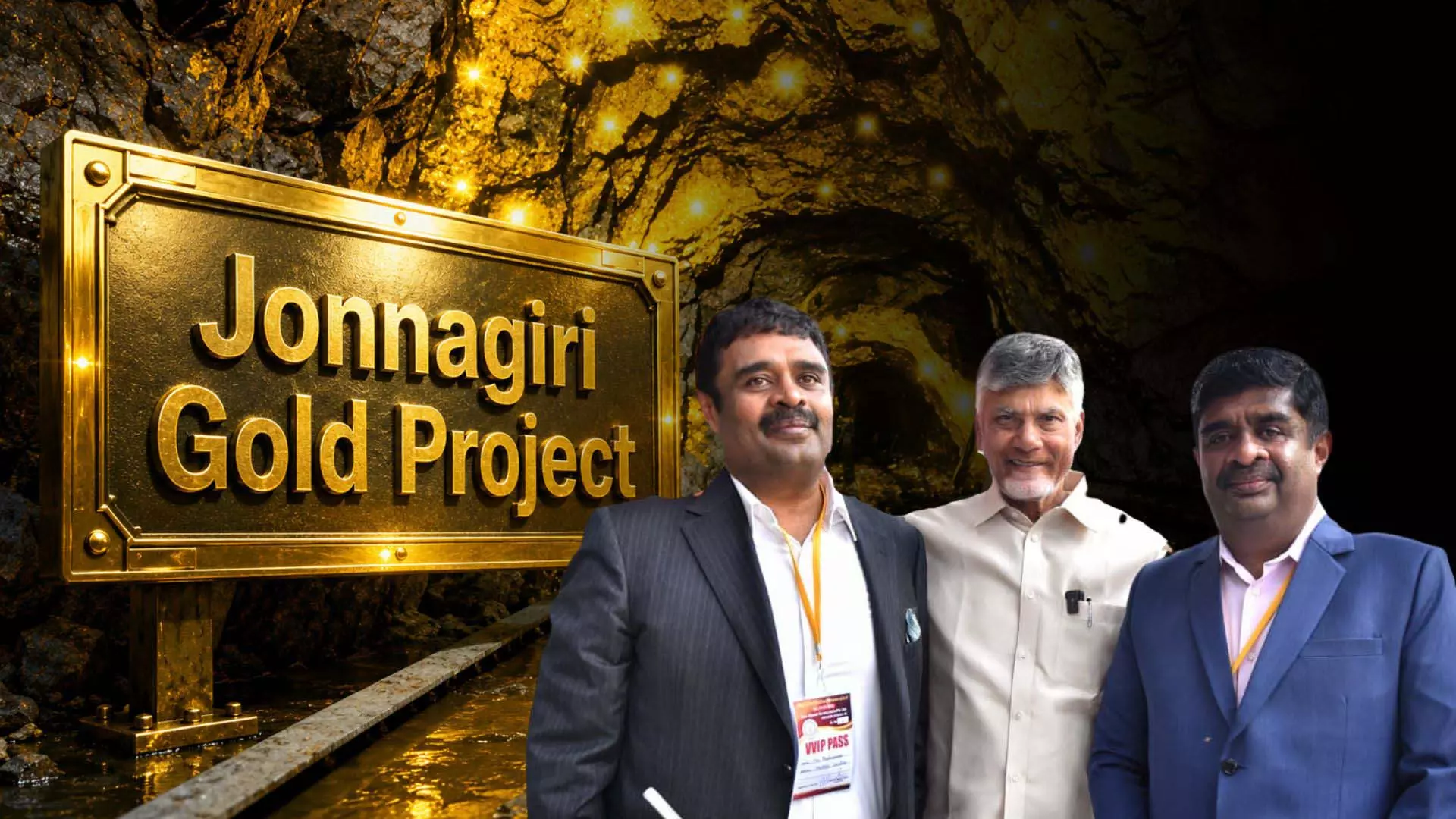
Why Jonnagiri launch, India’s first private gold project, is important
With domestic supply stagnant since the closure of KGF, the massive project marks a crucial step towards easing India's massive forex drain on precious metals.

India’s dependence on imported gold has long been a concern despite being one of the world’s largest consumers of the precious metal. That equation may be beginning to change with the launch of the Jonnagiri Gold Project in Andhra Pradesh, India’s first private gold mine since Independence. The project, inaugurated by Andhra Pradesh Chief Minister N Chandrababu Naidu on Wednesday (June 24), is being seen as a significant milestone for the country’s mining sector.
Located in Tugali Mandal of Kurnool district, the village of Jonnagiri was recently renamed Swarnagiri by the Andhra Pradesh Cabinet to reflect the importance of the gold mining project. During the inauguration, Naidu not only launched operations but also laid the foundation stone for a second expansion unit and flagged off heavy vehicles carrying gold-bearing ore for processing.
Also read: Is Tamil Nadu losing investments to Andhra? Here are facts behind project claims
In a symbolic gesture, the company behind the project presented the Chief Minister with a map of Andhra Pradesh crafted from gold produced at the mine.
Why it matters
The significance of the Jonnagiri project becomes clearer when viewed against India’s gold mining history.
After the closure of the Kolar Gold Fields (KGF) in Karnataka in 2001, India was left with only one operational gold mine — the state-run Hutti Gold Mine in Karnataka. Since then, the country has relied heavily on imports to meet its enormous demand for gold.
India remains among the world’s largest gold consumers, spending substantial amounts of foreign exchange on imports every year. At a time when global gold prices are at historic highs, the Jonagiri project is being positioned as a modest but important step towards boosting domestic production.
Also read: Vizag plant tragedy raises safety questions, triggers political row
While its output will not dramatically alter India’s gold import bill immediately, the project represents a rare expansion of domestic gold mining capacity.
Project details
The Jonnagiri Gold Project spans nearly 600 hectares across three villages in Kurnool district.
The total investment in the project stands at Rs 405 crore. Certified gold reserves at the site are estimated at 13.1 tonnes, while ongoing exploration suggests the broader mineral belt could contain as much as 42.5 tonnes of gold.
At full capacity, the mine is expected to produce approximately one tonne of refined gold annually for the next 15 years.
According to the management, all gold produced from the mine will be supplied directly to jewellers within Andhra Pradesh.
Tamil Nadu link
A less-discussed aspect of the project is the role played by Chennai-based Triveni Earthmovers and Infra Pvt Ltd.
The Tamil Nadu company is one of the key backers behind Geo Mysore Services India Pvt Ltd, the company that developed the Jonnagiri Gold Project.
Triveni is no newcomer to the mining sector. The company has decades of experience and operates more than 70 mining projects involving 12 commodities across five countries.
Mining footprint
Within India, Triveni operates coal mining projects in Jharkhand, including the NTPC-backed Pakri Barwadih coal block in Hazaribagh district.
The company is also involved in iron ore and manganese mining operations across Odisha and Keonjhar.
Its Brahmani River Pellets facility at Kalinganagar in Odisha, developed as a joint venture with JSW, operates a 230-kilometre slurry pipeline and serves major industrial clients including Tata Steel, POSCO, Mitsubishi and Glencore.
Beyond India, Triveni has coal mining operations in East Kalimantan and South Kalimantan in Indonesia and has also undertaken projects in the Democratic Republic of the Congo.
The company’s involvement in Jonnagiri reflects a strategic move into gold mining after building expertise across multiple mining sectors over several decades.
Investment push
For Naidu, the project also fits into a broader economic narrative centred on attracting investment into Andhra Pradesh.
During the inauguration, he described the launch as the beginning of a “golden chapter” in the state's history and projected Kurnool as an emerging industrial and mining hub.
The project has also created opportunities for local employment. Women and young people from nearby areas are being trained on simulator-based systems to operate heavy mining equipment at the site.
Cross-border business
The Jonagiri project also highlights an interesting reality of India’s investment landscape.
In recent years, Andhra Pradesh has often been projected as a state attracting investments that some observers believe could have gone to neighbouring Tamil Nadu.
Yet one of Andhra Pradesh’s most significant new industrial projects has been made possible with substantial backing from a Chennai-based company.
The development serves as a reminder that while states compete aggressively for investments, businesses and capital frequently move across state borders, creating partnerships that transcend political and regional rivalries.
(The content above has been transcribed from video using a fine-tuned AI model. To ensure accuracy, quality, and editorial integrity, we employ a Human-In-The-Loop (HITL) process. While AI assists in creating the initial draft, our experienced editorial team carefully reviews, edits, and refines the content before publication. At The Federal, we combine the efficiency of AI with the expertise of human editors to deliver reliable and insightful journalism.)