



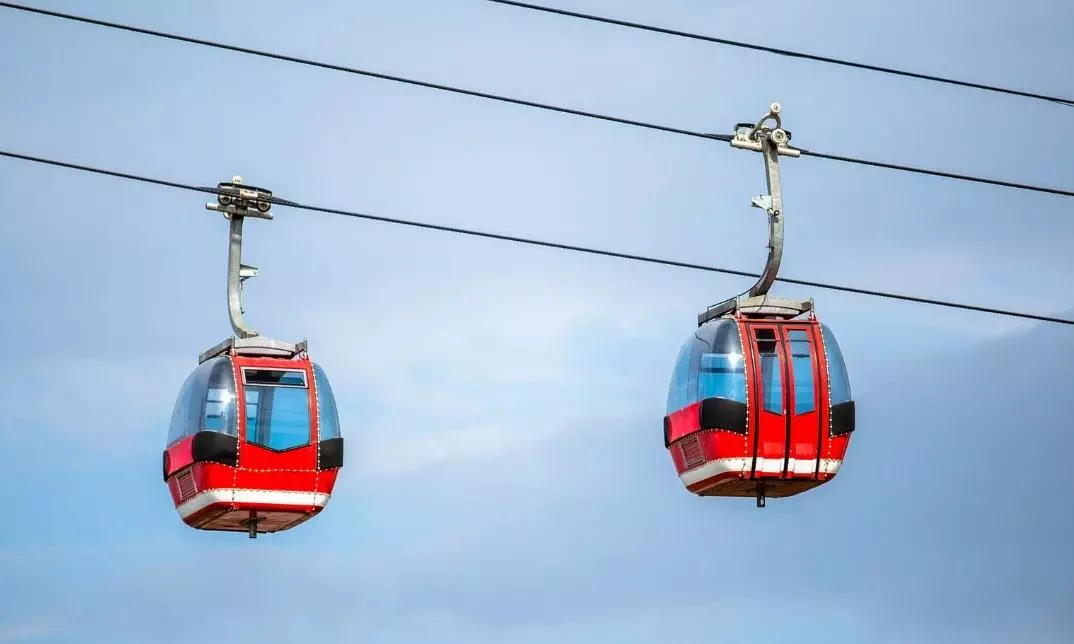
AP's Rs 750-crore ropeway plan faces scrutiny over cost, commuter value
Proposed 3.3-km, Rs 750-crore will create aerial corridor linking Vijayawada's rail and bus hubs with Kanaka Durga Temple, Punnami Ghat, Bhavani Island, Amaravati

The N Chandrababu Naidu-led Andhra Pradesh government has unveiled plans for a Rs 750-crore ropeway connecting Vijayawada Railway Station, Pandit Nehru Bus Station (PNBS), Indrakeeladri hill, home to the Kanaka Durga Temple, Punnami Ghat, Bhavani Island and the Sri Venkateswara Swamy Temple in Amaravati.
Billed as a project to improve connectivity, support pilgrims and boost tourism, it has also attracted criticism from urban planners and infrastructure experts, who argue that the investment may offer greater value as a tourist attraction than as a solution to the region's everyday transport needs.
The Amaravati Development and Infrastructure Corporation Limited (AGICL) invited Expressions of Interest (EOI) for the project in March under the Public-Private Partnership (PPP) model. The proposed ropeway, estimated to span about 3.3 km, is expected to integrate key transport hubs with major religious and tourism destinations along the Krishna riverfront.
Government's case
The government says the project is aimed at improving access to the Kanaka Durga Temple, particularly for elderly devotees, children and persons with disabilities, who currently rely on buses, autos, taxis or a steep climb to reach the shrine. During Navaratri and other major festivals, the temple precinct witnesses heavy footfall and traffic congestion, which officials believe the ropeway could help ease.
Also read | Amaravati then, tri-city model now: 12 years on, Andhra still unsure of capital plan
The project is also expected to create a tourism circuit linking the temple with Bhavani Island, offering aerial views of River Krishna, Prakasam Barrage and the Vijayawada skyline. At present, visitors largely depend on boats to reach the island. The Naidu government believes the ropeway will improve accessibility, increase tourist arrivals and complement plans to develop Bhavani Island as a major recreation and adventure tourism destination.
Officials also contend that shifting a section of pilgrim and tourist traffic to an aerial transport system could reduce congestion around Indrakeeladri and PNBS while lowering vehicular emissions. Being implemented under the PPP model, the project is also expected to attract private investment, generate employment during construction and operation, and create business opportunities for hotels, restaurants, transport operators and other local enterprises.
Critics question priorities
The proposal, however, has prompted questions over whether such a large investment should take precedence over strengthening conventional public transport in the state's developing capital region.
Urban planning experts argue that while the ropeway may improve the visitor experience for pilgrims and tourists, its utility for daily commuters is likely to be limited. The proposed alignment connects transport hubs with religious and leisure destinations rather than major residential and employment centres, leading some experts to view it primarily as a tourism project rather than an urban mobility solution.
Concerns have also been raised about the project's long-term financial and operational viability. Running and maintaining a high-capacity ropeway across the Krishna river basin could involve significant maintenance costs and operational challenges, particularly during adverse weather conditions.
Also read | Amaravati land allotment to spiritual bodies sparks debate over govt priorities
The PPP model has also come under scrutiny. While it reduces the government's upfront financial commitment, analysts say the project's success will depend heavily on sustained tourist and pilgrim footfall. If passenger numbers fail to meet projections, private investors could face challenges in recovering costs, potentially affecting the project's commercial viability.
Design challenges
Project planners will also have to factor in archaeological considerations and the presence of high-tension power lines while finalising the alignment and design.
The government has described the ropeway as more than a transport facility, envisioning it as an integrated pilgrimage, tourism and recreation corridor that could enhance the Vijayawada-Amaravati region's appeal.
Also read | Amaravati labour crisis slows Andhra capital works; World Bank discovers stark reality
Whether the project ultimately emerges as a transformative mobility solution or primarily a tourism attraction is likely to depend on its execution, passenger demand and its ability to address concerns over cost, commuter utility and long-term sustainability.
This article was originally published in The Federal Andhra Pradesh.