



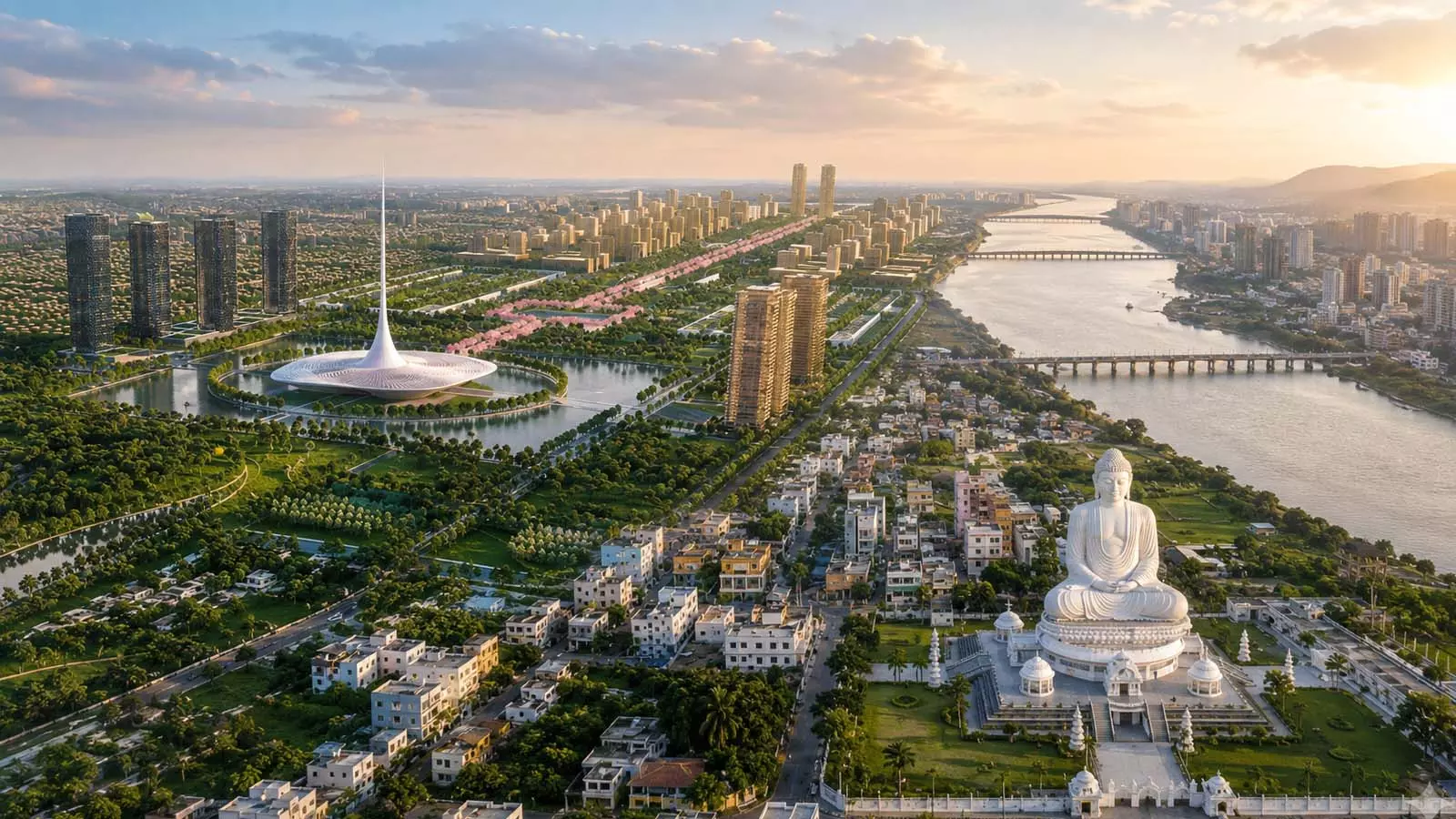
Amaravati then, tri-city model now: 12 years on, Andhra still unsure of capital plan
Critics say CM Naidu’s new tri-city capital plan an attempt to blunt appeal of Jagan's MAVIGUN model; but residents, farmers who gave up land for Amaravati bear the cost

The politics around Amaravati shifts by the day, leaving ordinary citizens and farmers who gave up their land for the capital in growing uncertainty.
More than 12 years have passed since it was declared the capital of Andhra Pradesh. Yet instead of moving forward, the ruling Telugu Desam Party (TDP) and the Opposition YSR Congress Party (YSRCP) continue to muddy the issue, so much so that it's hard to tell whether either side has settled on what "capital" even means for the state.
Integrated Capital Region vs MAVIGUN
One camp insists Amaravati alone should remain the capital; the other has long pushed a three-capital model. Now a new debate has entered the mix: MAVIGUN versus the Integrated Capital Region. So what is this curiously worded MAVIGUN?
Also read: Amaravati gets legal status as Andhra’s sole capital; Cong backs; YSRCP opposes
MAVIGUN is an 110-km urban corridor linking Machilipatnam, Vijayawada and Guntur, proposed by former chief minister Jagan Mohan Reddy as an alternative state capital. The Integrated Capital Region is the area surrounding the proposed capital of Amaravati.
Naidu’s new plan raises concerns
The latest flashpoint came when Chief Minister N Chandrababu Naidu, speaking at a review meeting with Amaravati contractors and officials, suggested the capital shouldn't be seen as confined to 29 villages at all, but reimagined as an Integrated Capital Region spanning Amaravati, Vijayawada, and Guntur.
Also read: Why Andhra’s govt job crisis is escalating despite CM Naidu's push
The remark landed awkwardly given recent history. When farmers earlier resisted the second phase of land acquisition, Naidu had warned that without additional land, Amaravati would remain "nothing more than a municipality".
Critics now ask why he has pivoted to folding in Vijayawada and Guntur, and suspect a broader political calculation behind the shift.
What's driving the change?
Analysts point to several possible motives behind the change of plan.
Financing pressure: Political analysts say presenting only the 29-village capital area may not be compelling enough to secure large loans from institutions like the World Bank and the Asian Development Bank. Showcasing the already-developed Vijayawada-Guntur urban belt could strengthen the state's case.
Reassuring contractors: With work underway on the ground, the coalition government may see value in projecting a bigger, more economically credible capital region.
Land values: Some allegations go further, claiming the move is designed to inflate land prices around Amaravati for the benefit of those close to the ruling party, under the cover of "capital development."
Also read: How Andhra is carving itself out as a major defence hub amid stiff southern competition
None of this, critics note, however, addresses the long-pending grievances of farmers who sacrificed their land for Amaravati in the first place — and the constant repositioning has only deepened public frustration.
MAVIGUN shadow
There's also a growing view that Naidu's new framing owes something to MAVIGUN (Machilipatnam-Vijayawada-Guntur), the industrial corridor concept floated by his predecessor Jagan. The latter had argued that MAVIGUN could become a low-cost growth corridor by building on cities that already have strong infrastructure — an idea that reportedly found real traction with the public.
He has said the YSRCP will campaign on the MAVIGUN agenda in 2029, framing it as a direct choice for voters, while continuing to allege irregularities in Amaravati's development. Critics argue that Naidu's tri-city framing looks like an attempt to blunt the growing appeal of Jagan's model by offering a rival version of the same basic idea.
Who pays the price?
In this contest for political advantage, it is Andhra Pradesh's roughly five crore residents — and above all the farmers who gave up everything for the capital — who bear the cost.
Also read: Does Andhra's ‘Satisfaction Levels’ model truly capture ground reality?
Under Jagan, critics say, time was lost to the three-capital debate. Under Naidu, a new set of experiments is now unfolding under the Integrated Capital Region banner. Jagan speaks of decentralised development; Naidu speaks of an integrated metropolitan region.
Either way, critics argue, the back-and-forth has left the capital's future no clearer than before — and left the people and farmers still waiting to find out when the political games will end and Andhra Pradesh will finally have a settled, definitive capital.
(The article was extracted from a video discussion on The Federal Andhra Pradesh)