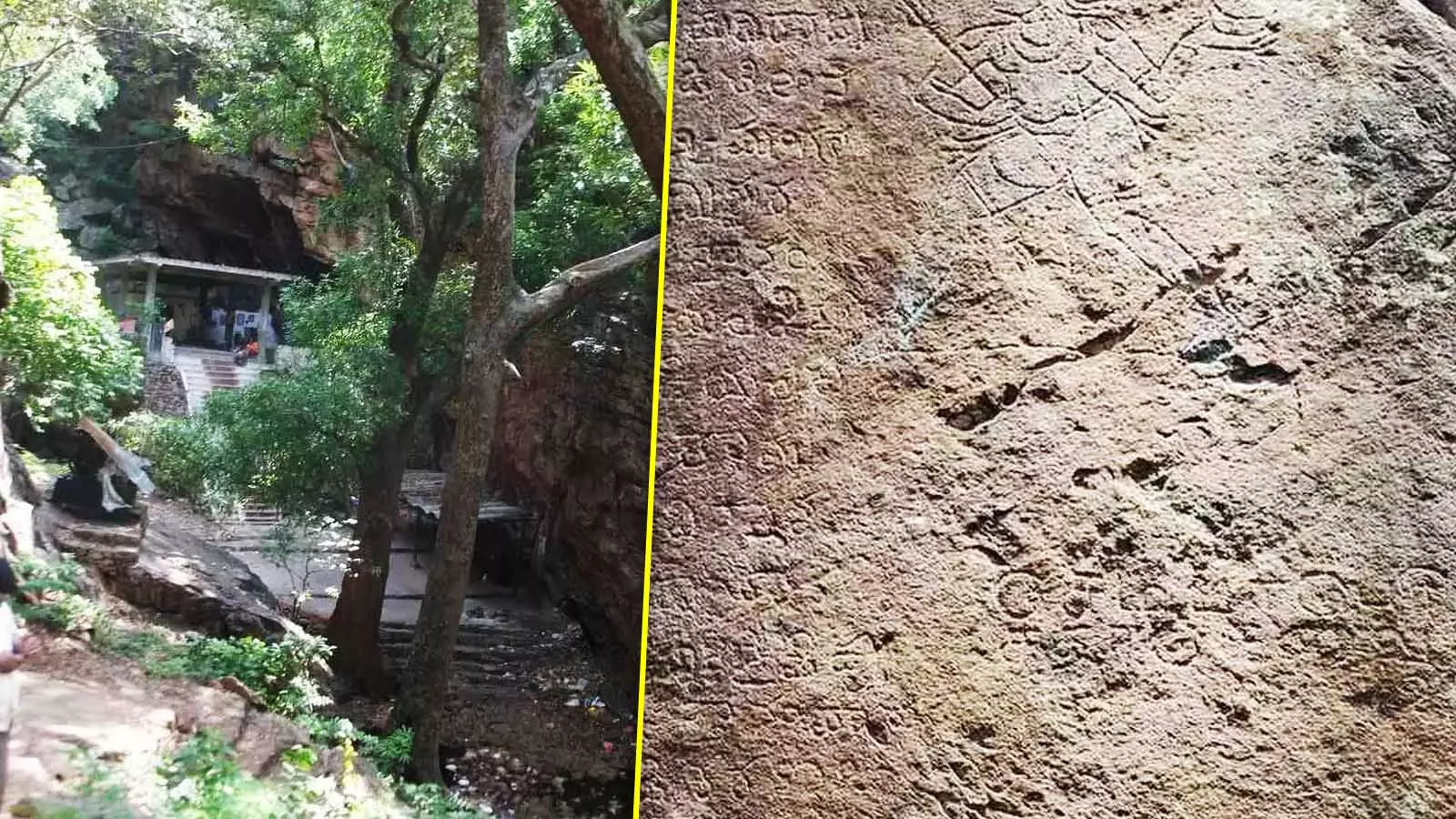
Valuable stone inscriptions are found tucked away in the forested region of Sadashiv Kona, near Tirupati. The area needs to be earmarked as a protected archaelogical site. Photos: Wiki Travels
Ancient stone inscriptions in Andhra's Sadasiva Kona face threat of silent decay
The 1,300-year-old inscriptions at forests near Tirupati reveal a rich Shaivite past but now face irreversible damage without urgent intervention

Sadasiva Kona, a forested region in Puttur close to Tirupati, is a rare confluence of history, spirituality and natural beauty.
As someone who treks through forests and experiences nature at close quarters, this place is not just a leisure destination for me. It is a living chronicle, silently carrying the weight of centuries. Sadasiva Kona is not only a sacred site for Shaivite devotees; it is also an invaluable treasure trove for archaeologists, geologists, sculptural experts and language researchers.
Silent decay
Stone inscriptions that should have endured for eternity are slowly perishing in the lap of the forest. Ancient inscriptions, sculptures and deity figures carved into the rock surfaces and tucked away within the Sadasiva Kona forest are being slowly erased by time, weathering and human neglect.
Climate exposure is causing the surfaces to fade. In several inscriptions, the script has already become illegible. Some sculptures have cracked and collapsed to the ground. Most distressingly, these invaluable relics have so far received no proper governmental or scientific protection.
A troubling question
While the world actively safeguards its history, why do we remain silent?
Also read: The Dig review: Why Keeladi findings matter to India’s present as much as its past
Countries with far shorter histories than even a single Indian state capital are showcasing their archaeological heritage through digital scanning, online archives and tourism promotion, while also generating revenue. Here, however, we are left merely watching inscriptions fade away, choosing silence over action.
Waterfall inscription
Near the waterfall to the left of the Ammavari temple, lies a striking ancient inscription carved on a massive rock by the water’s edge.
Researchers estimate that it may date back nearly 1,300 years. This inscription offers crucial insights into regional dynastic administration, the management of Shaivite temples, land grants, agrarian revenue systems and the evolution of South Indian languages.
Also read: Keeladi-Saraswati excavations lack scientific scrutiny: PA Krishnan
Today, however, the rock stone surface is peeling off in layers due to heat, rain, wind and algae growth. A lack of awareness among visitors has already led to the destruction of some portions of it. What remains is also at serious risk.
Urgent measures
Experts say that immediate conservation steps are essential, and the government, the Archaeology Department and research institutions must act without delay. The following measures should be taken:
a) High-resolution digital scanning of all inscriptions
b) Scientific chemical preservation
c) Installation of information boards at the site
d) Official declaration of Sadasiva Kona as a “protected archaeological site”
If these measures are not undertaken, centuries of cultural history face the danger of being lost forever.
Wider significance
What is to be noted is that Sadasiva Kona, Srikalahasti, Nagari, Nandalur and Puttur were major centres of the Pallava–Chola–Pandya Shaivite culture between the 7th and 10th centuries.
A Vattezhuthu inscription bearing a Nataraja figure near the Ammavarikona waterfall clearly indicates that this region once flourished as a hub of penance, rituals, education, medicine and culture.
This stone inscription is not merely a rock.
It is a living document that preserves our ancient past. Protecting it is the responsibility of the government, the duty of the Archaeology Department and the moral obligation of local citizens.
If we fail to safeguard it today, future generations will be deprived of reading a precious chapter of their own history.
(This article was originally published in The Federal Andhra Pradesh.)