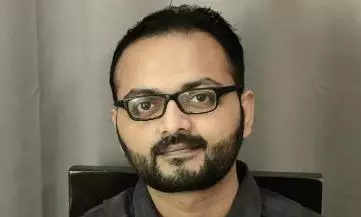
Sowmiya Ashok’s book, which explores the science, politics and sociology around Keeladi excavation in Tamil Nadu, explains why it has become a site of conflict over language, Hindutva and North India vs South India

Last year, the veteran Swedish archaeologist and writer Marie-Louise Winbladh published a book called Archaeology as a Weapon: Long-lasting Legacies of Colonialism and Nationalism in Israel, Palestine, Cyprus and Greece (Vernon Press). It’s an academic study across four chapters set in the four countries. Her central idea, as the book’s name suggests, is the weaponisation of archaeological excavations in order to “claim territories and to strengthen modern national identity”.
Winbladh critiques this co-option of academic work by powerful nationalist interests — by interfering with our study of the past, we are compromising the integrity of our collective future. It’s a powerful and troubling idea, one that was very much on my mind while reading the journalist Sowmiya Ashok’s excellent new book The Dig: Keeladi and the Politics of India’s Past (published by Hachette India).
The Dig explores the science, the politics and, dare I say, the sociology around the Keeladi excavation site in Tamil Nadu, easily India’s most high-profile archaeological event of the last decade. The artefacts and remains excavated from this village, estimated to be from between the 6th and the 3rd century BCE, marked the first time brick walls and ring wells had been discovered at a Tamil Nadu archaeological site.
Also read: Keeladi report: Politics, proof, and buried history | Explainer
Alongside the wide variety of other artefacts recovered, they suggest the existence of an ancient, sophisticated Tamil civilisation, the kind alluded to in Sangam poems. Keeladi and the archaeological findings therein have, however, become a kind of political battleground in recent years. Through extensive interviews as well as socio-political analysis (plus an array of secondary sources from literature and academia), Ashok explains why and also helps us navigate the haze of misinformation and half-truths surrounding Keeladi.
The flashpoints
As Ashok explains in the book, there are three primary sites of conflict around the Keeladi excavation — language, Hindutva and North India vs South India. The ruling BJP at the centre and its allies are desperate to link Keeladi to their conception of a glorious Hindutva-led past, steeped in Sanskrit and Vedic culture and connected to the Indus Valley Civilisation whose remnants can be found in the riverine plains of north India (at sites like the Haryana village Rakhigarhi, where K. Amarnath Ramakrishna, the archaeologist who led the Keeladi excavation until June 2025, completed his training).
However, no artefacts at Keeladi showed the slightest resonance with Sanskrit or with Vedic culture or any of the material found in north Indian plains. Instead, they showed remarkable similarities and overlaps with Harappan artefacts, suggesting that “the Harappans were proto-Dravidian speakers who had migrated south after the decline of the Indus Valley Civilisation, driven by reasons that ranged from invasion to climate change.”
Also read: Keeladi findings: Where's evidence for 600-year gap, asks ASI's Nandini Sahu
Moreover, there was another reason why the BJP and its allies saw potential political gains out of this situation. Between 2003 and 2005, the Archaeological Survey of India (ASI) fronted a divisive project called the Saraswati Heritage Project. Its unstated overarching aim was to push back the dates for Vedic culture and to bring the geographical boundaries of said culture within modern-day India (the excavation sites were/are primarily in Pakistan). Ashok explains the modus operandi succinctly in the book:
“Its aim was to debunk the Aryan migration theory, which suggested that the Indo-Aryan language speakers were part of a larger group of migrants who originally lived in the Central Asian Steppe and migrated into the Indian subcontinent around 1500 BCE. The project was also a way to push back the dates for the Vedic culture to an earlier period, while creating a new archaeo-ethnic category called the ‘Vedic Harappans’. This was a way to claim that the Aryans were an indigenously born group who composed the Vedas, built chariots, spoke Sanskrit, and spread their language and culture to faraway lands from India.”
Development vs cultural documentation
The Dig is especially strong when Ashok is exploring the ‘human interest’ angle, to borrow an old-fashioned journalistic term. Her profile of K. Amarnath Ramakrishna is excellent and really draws the reader into the world that the archaeologist is trying to unearth here. Amarnath, a Tamil-speaking person whose family originally hails from Saurashtra (Gujarat), is a fascinating interview subject, dropping scientific wisdom and Sangam poetry with equal aplomb. At one point, we are told that in communities of Saurashtrian Tamilians, people exchange migratory routes at weddings, and that the trajectory of Amarnath’s own family may well have mirrored the path taken by the Harappans themselves — an astounding detail that let me grinning and shaking my head in disbelief. One of the biggest achievements of The Dig is to incorporate narratives like this one within the overarching subject of the book, and to balance it all tonally.
Also read: Keeladi-Saraswati excavations lack scientific scrutiny: PA Krishnan
A scene that wasn’t directly connected to the rest of the book, but made a great impression on me nevertheless, was when Ashok delves deep into archival records to bring us a letter Prime Minister Jawaharlal Nehru wrote to Maulana Azad, the education minister, on the eve of the Nagarjuna Sagar dam’s foundation stone ceremony in 1955. The beginning of the construction would mean the submerging of priceless cultural artefacts, and Nehru is seen here struggling with the decision.
“This site of excavations is one of the most important and vital in India. The idea that this place, where so much of our ancient history and culture lie hidden under the earth, should be lost forever under the new lake has distressed me greatly. Yet the choice had to be made for the sake of the needs of today and tomorrow.”
Can you imagine a single political leader in today’s landscape who would have the conscience and the education to even cultivate such well-meaning doubts? That this subject was the topic of an emphatic yet respectful parliamentary debate makes one’s eyes tear up in this era of ‘lame-duck’ Parliament, where bills are passed with barely a question and sessions are suspended at the drop of a hat.
The Dig is a fascinating little slice of India’s past and present, with a few cautionary tales about the scary future thrown in for good measure. It’s highly recommended for anybody curious about how Indian politics and society have reached a ‘point of no return’ when it comes to polarisation.