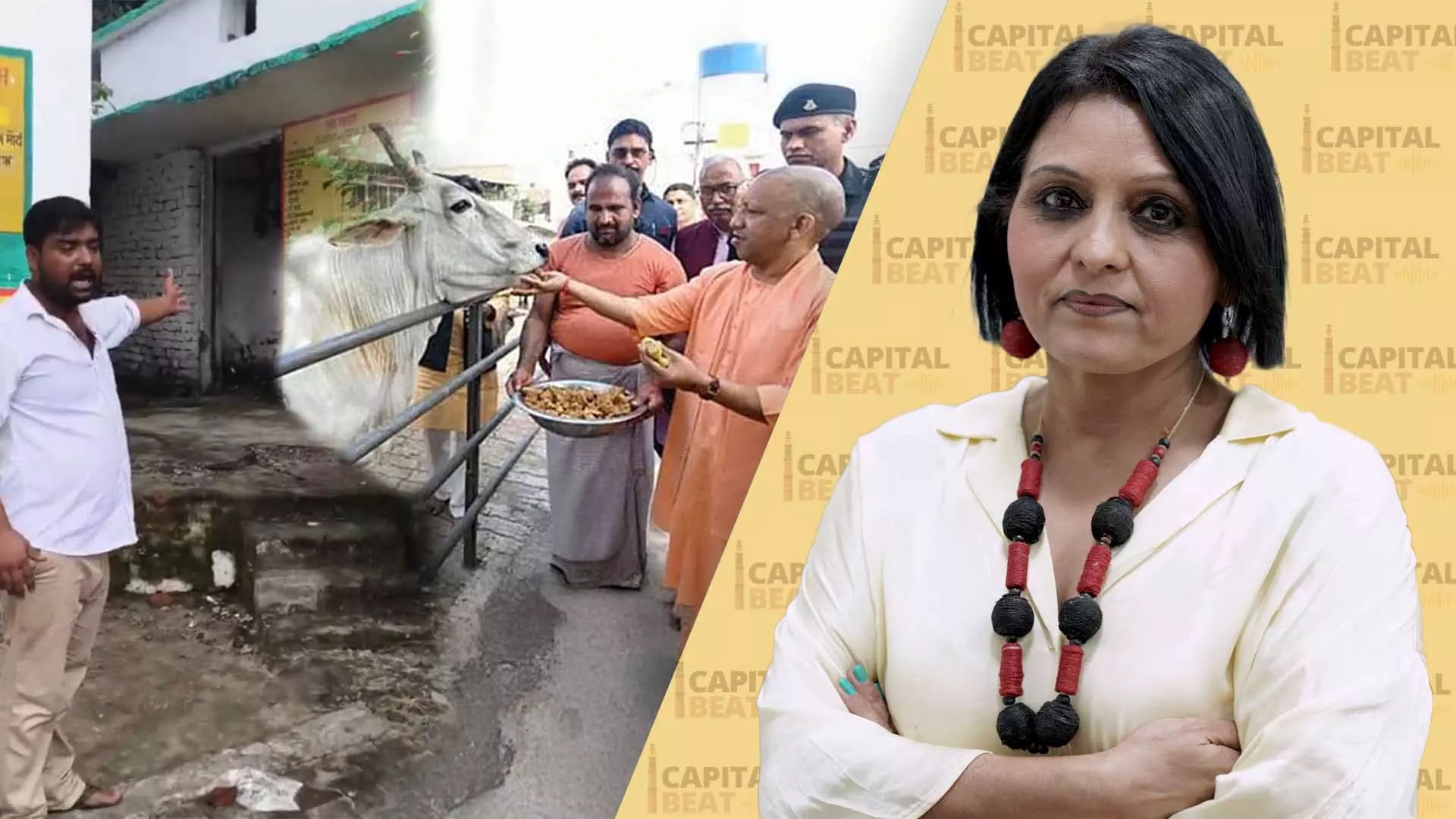
Will Yogi’s knee-jerk reaction to videos on govt schools have opposite effect?
Could the action against those filming alleged lapses in govt schools amplify the issue and give the Opposition a potent electoral plank ahead of Assembly polls?

Two arrests have been made and FIRs filed across multiple Uttar Pradesh districts over videos showing the allegedly poor condition of government schools.
Advocate Sannyam Panchal and his associate in Meerut were arrested after they allegedly entered a government school without authorisation and recorded its condition. The footage showed damaged infrastructure, poor drinking-water facilities, dirty classrooms, and other problems.
Is this a prudent way for the government to handle the situation? Could this issue turn into a larger political challenge for Chief Minister Yogi Adityanath ahead of the Assembly election?
'Citizens should be able to raise concerns'
Speaking to The Federal In its Capital Beat programme, Samajwadi Party national spokesperson and lawyer Sarvesh Tripathi said the government was afraid of its “real face” being revealed. He argued that citizens should be able to raise concerns about public institutions, particularly schools, and questioned why people documenting the condition of the schools should face arrest.
Also Read: How government school mergers have triggered varied fallout across states
He also linked this to the wider issue of government education. He alleged that more than 30,000 schools had been closed in Uttar Pradesh, and argued that the government was failing to provide basic amenities while taking action against those raising questions.
Legal questions about restricting entry
Tripathi questioned the legal basis for treating entry into government school premises as unauthorised in circumstances where the schools may not even have proper boundary walls.
He argued that the state government’s guidelines restricting entry by journalists or others could raise questions about basic legal principles on whether filming conditions inside a public institution could automatically constitute an offence merely because an administrative directive restricts entry.
The UP government has reportedly allocated Rs 604 crore for repairing, rebuilding, and upgrading 3,126 council-run primary and upper-primary schools. A first instalment of Rs 302 crore was sanctioned, but the question remains why poor conditions remain visible if funds have been sanctioned.
Tripathi said allocation and execution were different issues. He alleged that significant portions of budgets across government departments remained unused, and questioned where the money allocated for schools was ultimately being spent.
'Wider governance problem'
Author and political commentator Sharad Pradhan argued that construction and infrastructure spending had become a major priority in Uttar Pradesh while other public needs were allegedly neglected.
He claimed that a substantial portion of allocations for construction could be siphoned off at different levels. He described corruption as having crossed “all limits” and argued that the condition of schools was part of a wider governance problem.
Also Read: CJP launches ‘School Thik Karo’ campaign, demands private school fee cap
Pradhan also reflected on his own earlier assessment of Yogi Adityanath. He said he had written a book on the chief minister and had once described Uttar Pradesh as having an honest chief minister. He said he now regretted that assessment, arguing that he had been influenced by the image projected at the time.
He further alleged that Adityanath was intolerant of dissent and that this could explain what he described as “knee-jerk” actions against journalists and others who raise questions. Pradhan cited the earlier case involving journalist Pawan Jaiswal, who filmed children being served roti and salt as a midday meal in a Mirzapur government school. Jaiswal was booked at the time, but was later given a clean chit after investigation.
Question of media freedom
Pradhan argued that the controversy should also be viewed through the question of media freedom. He alleged that journalists face intimidation at the local level while financial influence operates at higher levels.
He cited journalist Abhishek Upadhyay and his reporting on alleged irregularities related to Ram Mandir donations as another example. Upadhyay, who runs the YouTube channel Top Secret, recently moved the Supreme Court challenging an FIR in Ghaziabad that he alleges was intended to harass him over his reporting.
Also Read: How India’s shrinking education, health budgets are betraying rural youth
Senior journalist Shahira Naimwas of the opinion that the political environment in Uttar Pradesh has changed. She said the government could not assume that arrests and pressure tactics would prevent videos from reaching the public, especially when citizens could independently inspect nearby government schools.
She pointed to a recent protest by girls at a residential school in Lucknow over the absence of teachers, and argued that such incidents showed that the education issue was becoming increasingly visible and could gain momentum as the election approaches.
Education could become major issue
Naim said the government could face a larger political challenge if the school-related campaign expands, and that people could visit neighbouring schools themselves and assess whether the conditions shown in videos are accurate.
Tripathi maintained that education should not be compared with other electoral subjects because it affects everyone, regardless of political affiliation. He said the Samajwadi Party had historically placed education among its key priorities.
Can Opposition maintain pressure?
The key question, however, was whether the Opposition could sustain the issue long enough for it to become electorally significant. Pradhan cautioned that merely raising the issue would not be enough. He said opposition parties would have to maintain pressure consistently because the ruling BJP could attempt to divert public attention to other issues as the election draws closer.
He said both the school-infrastructure issue and the Ram Mandir donation controversy could remain relevant if opposition parties continued to raise them. At the same time, he said the opposition’s past inconsistency could allow the government to move the political conversation elsewhere.
Naim said the arrests could have the opposite effect from what the government intends. Instead of stopping people from documenting school conditions, she said, the action could encourage more citizens and students to speak out.