



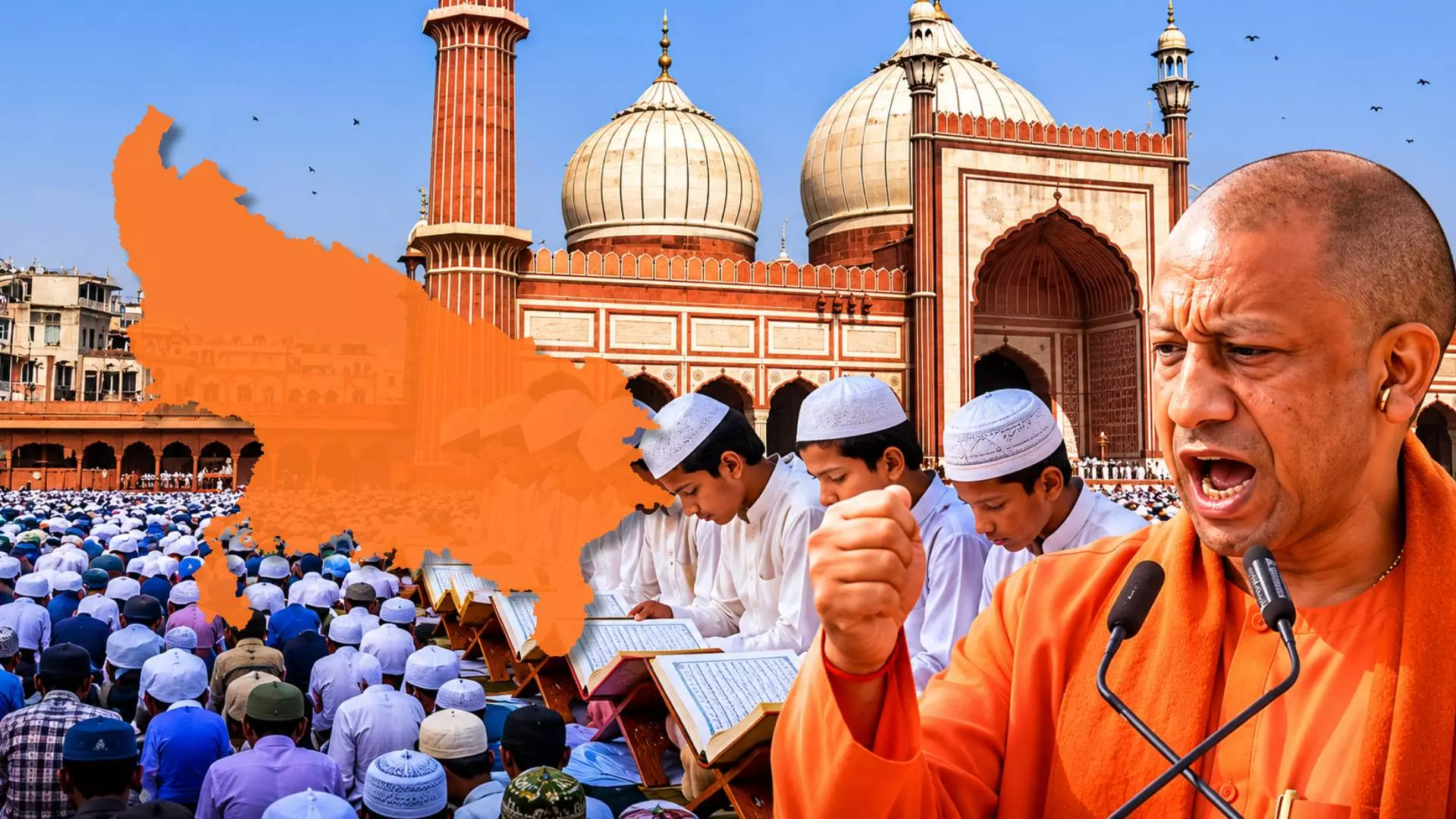
Are Anti-Muslim rhetoric and ‘bulldozer model’ BJP’s long-term poll strategies in UP?
As UP heads to the 2027 polls, debates over bulldozer politics, namaz crackdowns and Muslim representation are growing. Will polarisation again be BJP’s weapon?

With less than a year left before Uttar Pradesh goes to polls, the political battle in the state is increasingly revolving around religion and identity.
While the Opposition keeps accusing the Yogi Adityanath government of focusing on polarisation instead of addressing issues such as unemployment, inflation, slow development and corruption, the debate has particularly sharpened around what critics describe as the BJP’s “Bulldozer Model” — a political and administrative approach that has frequently targeted Muslims in the name of law and order.
Questions are now being raised over whether anti-Muslim rhetoric has become a recurring electoral strategy ahead of major elections in Uttar Pradesh. As slogans such as “80 versus 20”, restrictions linked to namaz, and speeches centred on nationalism and identity politics increasingly gain ground, political analysts believe these issues are likely to dominate the run-up to the 2027 Assembly polls.
Polarisation politics
During the 2022 Uttar Pradesh Assembly election campaign, Chief Minister Adityanath described the election as an “80 versus 20” contest, a remark widely interpreted as Hindu-Muslim polarisation.
He said, “80 per cent is those who are supporters of nationalism, good governance and development. Such people will vote for the BJP, and those who are against this and supporters of mafia and criminals, and anti-farmer, 15–20 such people will take a different path. So, in this 80–20 fight, it is the lotus that will show the way.”
The BJP’s campaign in western Uttar Pradesh also repeatedly linked issues such as migration, infiltration and law and order to the Muslim community. During the 2024 Lok Sabha elections, Prime Minister Narendra Modi accused the Congress of planning to redistribute wealth to “those with more children” and “illegal infiltrators”, remarks that triggered political controversy.
Muslim numbers
Muslims constitute nearly 20 per cent of Uttar Pradesh’s population, including around 3.85 crore voters. Out of the state’s 403 Assembly constituencies, 143 have a Muslim population exceeding 20 per cent.
Also read: CM Adityanath says namaz can't be offered on roads, suggests shift-based arrangement
Among these seats, 70 constituencies have a Muslim population between 20 and 30 per cent, 43 seats have between 30 and 40 per cent, while in 30 constituencies, Muslims account for over 40 per cent of the electorate.
In the Lok Sabha too, Muslims hold electoral significance. Of Uttar Pradesh’s 80 parliamentary constituencies, 36 have a Muslim voter share above 20 per cent.
Despite this demographic presence, Muslim political representation has sharply declined during BJP rule in the state.
Representation fall
Under Mayawati and the BSP government, 58 Muslim MLAs were elected to the Uttar Pradesh Assembly. During the tenure of Akhilesh Yadav and the Samajwadi Party government, the number rose to 68 Muslim MLAs.
However, after the BJP came to power under Yogi Adityanath, Muslim representation fell significantly. Only 24 Muslim MLAs were elected in 2017, while the number increased marginally to 34 in the 2022 Assembly elections.
The trend was also visible in the Lok Sabha elections. In 2014, not a single Muslim MP was elected from Uttar Pradesh’s 80 parliamentary seats.
Also read: Namaz-Hanuman Chalisa row intensifies at Lucknow University, 13 get notices
Political observers argue that Hindu consolidation through polarisation has repeatedly worked in favour of the BJP in Uttar Pradesh. They believe issues related to religion, mosques, madrasas, demographics and nationalism are likely to feature prominently again as election campaigning intensifies.
Opposition challenge
For the opposition parties, including the Samajwadi Party and the Congress, the challenge goes beyond merely countering the BJP’s rhetoric. Analysts argue that the Opposition must also present a concrete political and social agenda addressing the concerns of Muslims and other marginalised communities.
Critics say Muslim issues are often reduced to “vote-bank politics” during elections without meaningful policy engagement. The larger debate now centres on whether the political discourse in Uttar Pradesh is increasingly being shaped by fear and identity instead of governance and economic issues.
With social media amplifying speeches and videos centred on communal themes, concerns are growing that the 2027 Assembly elections could once again witness heightened Hindu-Muslim polarisation.
Also read: Religious prayers on private land not immune from regulation, says Allahabad HC
The political questions surrounding Uttar Pradesh are therefore becoming sharper: Is targeting Muslims now a central election strategy? Is the “Bulldozer Model” evolving into a long-term political formula? Or will voters eventually shift focus back to employment, inflation and development?
(The content above has been transcribed from video using a fine-tuned AI model. To ensure accuracy, quality, and editorial integrity, we employ a Human-In-The-Loop (HITL) process. While AI assists in creating the initial draft, our experienced editorial team carefully reviews, edits, and refines the content before publication. At The Federal, we combine the efficiency of AI with the expertise of human editors to deliver reliable and insightful journalism.)